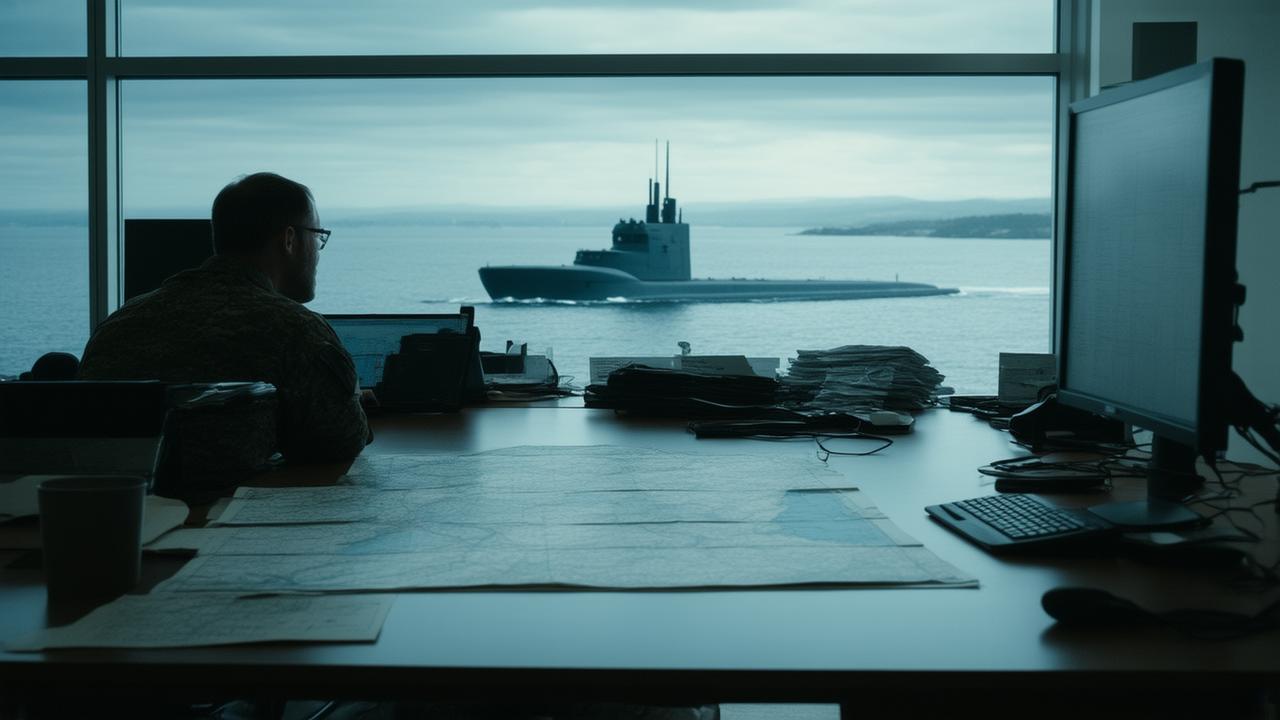
The sea off the Australian coast can look deceptively simple from the shore: a big blue horizon, a straight line where sky kisses water, waves rolling in with a patient, unhurried rhythm. But beneath that surface, in the ink-dark layers where sunlight fades and pressure climbs, a quiet revolution in strategy is taking shape. It hums not with engines yet, but with plans, contracts, simulations, and whispered calculations in Canberra, Washington and London. Australia’s renewed fascination with nuclear-powered submarines is not just a defence story. It is a story about how nations imagine the future, how they move on a chessboard that happens to be made of water, and how the Indo-Pacific—half map, half myth—is being quietly redrawn.
How a Quiet Ocean Became the Loudest Room in World Politics
To understand why Australia’s interest in nuclear submarines matters, you have to start with geography—messy, inconvenient, and inescapable. Trace your finger across a map from Western Australia to Hawaii, then down to New Zealand and west to India. The distances are huge, the ocean seemingly endless. Yet this vast blue canvas is threaded with some of the world’s busiest trade routes, critical energy flows, and military chokepoints.
For decades, Australia sat at the quieter edge of global strategy. Its security posture leaned heavily on alliances, especially with the United States, and on diesel-electric submarines designed mainly for surveillance and deterrence close to home. These vessels, like the Collins-class, operate with a kind of tactical modesty: they creep, listen, and signal that someone is watching the waterways that sweep past the continent.
Then the world’s tempo began to change. Naval patrols intensified in the South China Sea. Military budgets swelled across Asia. New technology—from hypersonic missiles to advanced undersea sensors—began to eat away at older assumptions about distance, time and warning. Australia, once comfortably behind the front row, realized it was drifting toward center stage.
In this new environment, the old tools suddenly looked too slow, too short-ranged, too easily outpaced. Nuclear-powered submarines—faster, stealthier, capable of staying submerged for months rather than days—offered not just more power, but a different way of thinking about strategy itself. They promised reach: the ability to move, unseen, across an entire ocean and still arrive with a full tank of options.
The AUKUS Ripple: A Pact That Echoes Underwater
When Australia announced in 2021 that it would pursue nuclear-powered submarines through the AUKUS partnership with the United States and the United Kingdom, the shockwaves ran far beyond the shipyards. This wasn’t just another defence procurement deal. It was a reshuffling of loyalties, industrial plans, and long-term security visions.
The choice to cancel a major conventional submarine contract with France and pivot toward nuclear technology was, in strategic terms, a loud declaration: Australia saw its future security environment as deeply tied to undersea dominance and long-range deterrence, not just coastal defence. The Indo-Pacific, already a region of wary glances and overlapping claims, felt the shift immediately.
In policy rooms from Tokyo to New Delhi, analysts began to redraw their mental maps. If Australia fields nuclear-powered submarines in the coming decades, they could patrol vast swathes of the Indian and Pacific Oceans, contribute to collective undersea surveillance networks, and complicate any potential adversary’s planning. They would be nodes in a wider lattice of allied forces, rather than solitary assets hugging their own coastline.
Critics saw danger in this. They warned of an arms race, of rising tensions, of blurred lines between nuclear-powered and nuclear-armed systems. Supporters saw something else: an attempt to stabilize a turbulent region by making sure that any risky move at sea would be met by a quiet, invisible, highly capable response from below the surface.
The Undersea Advantage: Why Nuclear Matters
Nuclear-powered submarines, unlike their diesel-electric cousins, don’t need to surface or snorkel frequently to recharge batteries. This single technological feature changes almost everything. Staying submerged for months means harder detection, longer missions, and a constant, ghost-like presence in distant waters. In strategic planning circles, that translates into ambiguity—of the carefully engineered kind.
No adversary can ever be fully sure where such boats are, what they’re watching, or which routes they might be shadowing. That uncertainty is the point. It forces any planner contemplating risky manoeuvres in the Indo-Pacific to factor in the possibility of an unseen audience, one that can both report and react.
But this undersea advantage is not just about hardware. It is about the networks, agreements, and interoperability that grow around it. Training crews, sharing sensitive propulsion technologies, integrating navigation and combat systems—these processes knit countries together in ways that are difficult to reverse and impossible to ignore.
New Currents in Indo-Pacific Strategy
As Australia leans into nuclear propulsion, the entire region is adjusting. Strategists now talk less about neat frontlines and more about “contested spaces”—stretches of ocean, sky, and seabed where surveillance, signalling, and presence matter as much as firepower.
The Indo-Pacific has always been an overlapping set of stories: the Indian Ocean’s trade routes, the crowded lanes of Southeast Asia, the island chains and deep trenches of the Pacific. Australia’s renewed submarine ambitions stitch these narratives together. Its potential undersea reach could connect, for example, Japanese intelligence in the north with Indian surveillance in the west and US assets scattered across the central Pacific.
As a result, joint exercises are becoming more complex. Scenario planning now assumes multi-domain coordination: satellites cueing submarines, patrol aircraft pinging data to naval task groups, cybersecurity units monitoring the digital backbone of the whole operation. The region is not simply arming; it is networking.
For middle powers like Indonesia, Vietnam, and South Korea, this shift is double-edged. On one side lies the promise of a more robust balance of power that might deter recklessness at sea. On the other, the risk that any local crisis spirals more quickly because there are now more capable actors invested, more alliances in play, more silent watchers below the waves.
Environmental and Ethical Shadows Beneath the Surface
Nature is a quiet but insistent character in this story. Nuclear-powered submarines mean nuclear reactors aboard vessels that may operate near fragile marine ecosystems, busy fisheries, and dense coastal populations. While the technology involved is designed to extremely high safety standards, the worst-case scenarios—accidents, radiation leaks, sunken hulls—haunt public debate.
Australia, long proud of its relatively strong environmental and non-proliferation credentials, now has to reassure not just its own citizens, but its neighbours. The questions are both technical and moral: How will spent fuel be managed? What happens if a submarine is lost in deep water? How will coastal communities be protected during construction, maintenance, and potential emergency responses?
These questions sit alongside older anxieties about militarization. Corals, whales, and migratory fish are oblivious to exclusive economic zones and alliance structures. They feel only the deep thud of naval sonar, the churn of propellers, the changing chemistry and noise of their world. The more strategic weight the Indo-Pacific carries, the louder that underwater world becomes.
Domestic Ripples: Jobs, Identity, and Long Timelines
Inside Australia, the nuclear submarine project is reshaping more than defence budgets. It is reconfiguring political debates, industrial priorities, and even national identity. Port cities along the southern coast imagine new shipyards, training facilities, and industrial precincts springing to life. Universities eye expanded engineering and nuclear science programs. Small firms wonder whether they will find a niche in the complex supply chains that feed into such enormous platforms.
There is excitement in these possibilities—and unease. Nuclear propulsion demands skills and regulatory frameworks that Australia has, until now, largely sidestepped by eschewing civilian nuclear power. Building a workforce capable of maintaining and operating such vessels will take decades, not years. In the meantime, the country must navigate the politics of cost overruns, delays, and shifting international conditions.
➡️ Why Australian psychologists are studying loneliness as a measurable public health risk
➡️ The surprising role of Australian wetlands in buffering floods and storing carbon
➡️ How Australia’s migration story is influencing modern identity and everyday language
➡️ What Australian historians now believe about the early contact period along the northern coast
➡️ How Australian supermarkets are quietly changing portion sizes without changing prices
➡️ Why Australian scientists are watching Antarctic ice shelves with growing urgency
➡️ Australia’s new appetite for native ingredients is transforming restaurant menus nationwide
There is also a subtler psychological shift. Australia has long balanced two stories about itself: the sunlit, easygoing, middle-power democracy; and the hard-nosed strategic outpost of Western alliances, perched on the edge of a restless region. Nuclear-powered submarines feed the second story. They signal an Australia that expects turbulence ahead and intends not just to weather it, but to glide silently through its darkest waters.
How Nuclear Submarines Reshape Regional Calculations
In the war rooms—real and metaphorical—of the Indo-Pacific, Australia’s nuclear ambitions are already being pencilled into the equations. Planners model how many submarines will be operational by certain dates, which bases they might deploy from, and how they could be integrated with allied assets. Even before the first boat slides into the water, its shadow appears on the strategic seabed.
Some neighbours quietly explore ways to deepen their own undersea capabilities, whether through more advanced conventional submarines, anti-submarine warfare aircraft, or seabed sensor networks. Others focus on diplomacy: new dialogues, crisis hotlines, and confidence-building measures aimed at keeping an increasingly crowded undersea domain from becoming a hair-trigger environment.
In many ways, the most profound change is psychological. The sense that the Indo-Pacific is a peripheral theatre has evaporated. Instead, it feels like the central nervous system of a wider global order, where supply chains, climate pressures, and security anxieties all intersect. Australia’s nuclear submarine project is both a response to that feeling and a force that amplifies it.
At the Edge of the Chart
Stand again on that Australian shoreline. The waves are still rolling in. Gulls still circle over fishing boats. Children still bury their feet in warm sand. The ocean has not changed its colour; the air is still salted and bright. Yet, just beyond the visible, the future is taking on a different shape.
Submarines are, by design, creatures of secrecy. But the choices that summon them into being are not. They radiate outward through parliaments, alliances, budgets, shipyards, training academies, and the quiet calculations of rival planners. Australia’s renewed interest in nuclear-powered submarines has become one of those choices—a hinge around which Indo-Pacific strategy is slowly, irresistibly turning.
Whether that turn leads to greater stability or greater risk will depend on what comes next: the diplomacy that wraps around the hardware, the environmental safeguards woven into every stage of planning, the honesty with which leaders speak to their citizens about cost, consequence and purpose. For now, the story is still being written, line by line, in the deep, unseen spaces under the Indo-Pacific’s broad and restless skin.
Key Factors in Australia’s Nuclear Submarine Turn
| Factor | Description | Indo-Pacific Impact |
|---|---|---|
| Extended Range & Endurance | Nuclear propulsion allows months-long submerged operations and vast patrol areas. | Enables persistent presence across both Indian and Pacific Oceans, complicating rival planning. |
| AUKUS Partnership | Technology-sharing pact with the US and UK focused on nuclear submarines and advanced capabilities. | Deepens alliance networks and reinforces a bloc-oriented security architecture. |
| Regional Deterrence | Invisible, survivable platforms increase the cost of coercion or conflict at sea. | May deter escalation, but also fuels concerns about an undersea arms race. |
| Industrial Transformation | Shipbuilding, nuclear regulation, and high-tech industries expand over decades. | Positions Australia as a long-term security and technology hub in the region. |
| Environmental & Ethical Concerns | Nuclear safety, waste management, and marine impacts raise public and regional questions. | Forces new diplomatic, regulatory, and scientific cooperation across the Indo-Pacific. |
Frequently Asked Questions
Are Australia’s planned submarines nuclear-armed?
No. The submarines Australia is pursuing under AUKUS are intended to be nuclear-powered, not nuclear-armed. The reactors provide propulsion and endurance, while the weapons on board are expected to remain conventional. Australia has reiterated its commitment to non-proliferation and has not signalled any intention to acquire nuclear weapons.
Why are nuclear-powered submarines seen as such a big upgrade?
Nuclear-powered submarines can operate underwater for far longer than diesel-electric vessels, travel faster, and cover greater distances without surfacing. This combination of endurance, speed, and stealth dramatically increases their strategic value, especially in a vast maritime region like the Indo-Pacific where distance and persistence matter.
Does this move increase the risk of an arms race in the Indo-Pacific?
It may. Supporters argue that more capable submarines strengthen deterrence and discourage aggression. Critics counter that they could spur others to expand or modernize their own fleets and anti-submarine capabilities. The net effect will depend on how regional powers balance military buildup with diplomacy, transparency, and crisis-management mechanisms.
How long will it take for Australia to field these nuclear submarines?
The timelines stretch over decades. Initial steps involve training, infrastructure development, and interim arrangements with allies. Full operational capability for an Australian-built nuclear-powered fleet is expected to emerge gradually, with key milestones likely in the 2030s and 2040s rather than in the immediate future.
What about the environmental risks of nuclear propulsion at sea?
Nuclear propulsion brings serious responsibilities. While modern naval reactors are designed with extensive safety measures, the risks of accidents, waste handling, and long-term environmental impact cannot be dismissed. Australia and its partners will need robust regulatory systems, emergency response plans, and ongoing engagement with coastal communities and regional neighbours to manage these concerns credibly.





