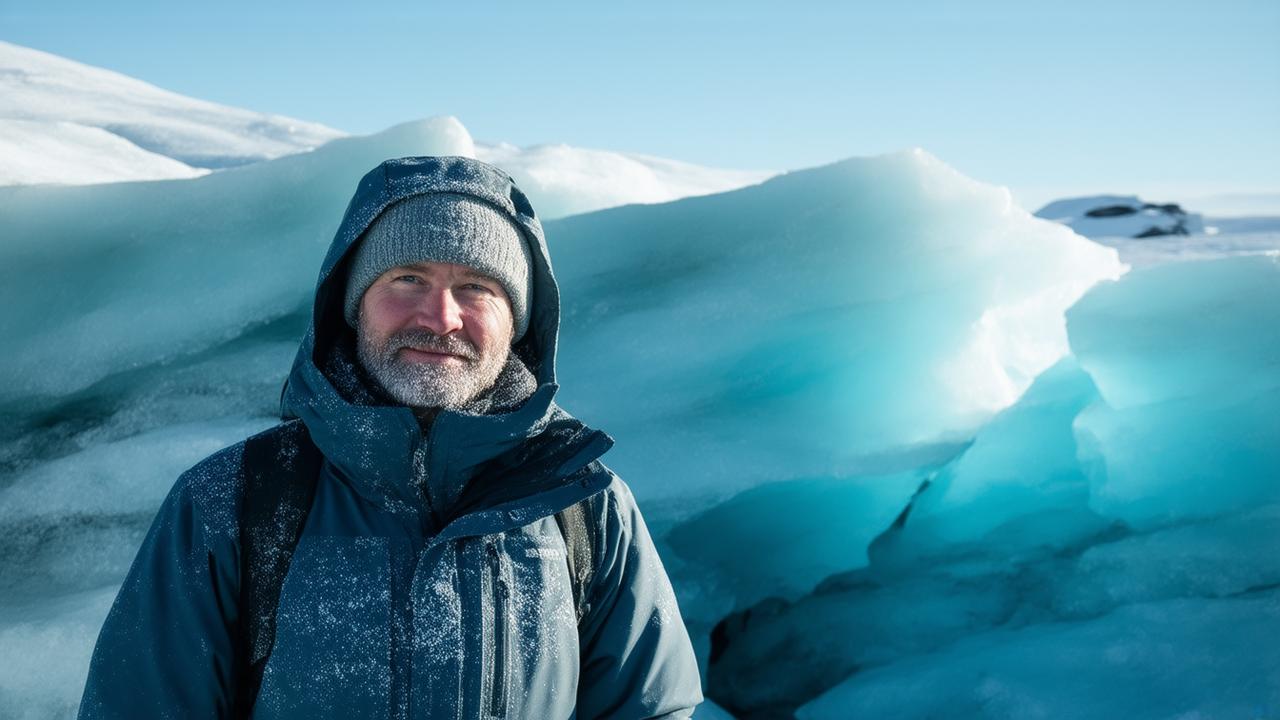
The helicopter’s rotors fade into the white distance, leaving behind a sudden, unnerving quiet. Out on the edge of the Antarctic continent, where the ice drops in a sheer, luminous wall into the Southern Ocean, a handful of Australian scientists stand listening. The ice itself is making noise—small, distant cracks like the snap of dry twigs, deep groans that seem to come from the bones of the Earth. They are here to listen, to measure, to understand. Because something in this frozen world is changing faster than anyone expected, and it’s changing in ways that will not stay in Antarctica.
Listening to a Giant That’s Starting to Stir
Imagine standing at the edge of a city made of ice—a city the size of a small country, floating, slowly drifting, and held in place by the cold grip of winter that never really ends. That’s what an Antarctic ice shelf is: a vast tongue of glacial ice that has flowed off the continent and spread out over the ocean, still attached at its landward edge, but flexing and floating on the sea.
For decades, these ice shelves have been the quiet guardians of the Antarctic interior. They act like buttresses, slowing the enormous rivers of land ice behind them. As long as they hold, the glaciers feeding them move more slowly, and the world’s sea levels rise at a more manageable pace. When they weaken or collapse, those inland glaciers can surge forward like traffic released from a jam.
Australian scientists know this story well, but over the last few years, they’ve seen it shift from theory to urgency. Satellite images, ship expeditions, seismic readings, and underwater robots are all sending the same message: the shelves are thinning, fracturing, and in some places, letting warm ocean water creep underneath in ways that are both subtle and profound. The giant is stirring—and they’re racing to understand how quickly it might wake.
The View from the Edge: Life at the Front Line of Ice
Down at Casey, Davis and Mawson stations—Australia’s outposts in East Antarctica—the work is a mix of monotony and adrenaline. One day might be dominated by the simple, grinding logistics of polar life: fuel runs, ice-core storage, repairing instruments battered by storms. Another day, a sudden calm in the wind means the helicopter can fly, and the team scrambles to load drilling gear, radar equipment, and survival packs.
From the air, the ice shelves look endless: a white, undulating plain, interrupted by crevasses like blue scars. Near the front, the smoothness breaks into chaos—jagged pressure ridges, growing cracks, and towering walls of ice where the shelf calves into icebergs. The pilots trace these features from above, while scientists stare at laptops, watching lines of data come alive in real time: ice thickness, surface elevation, internal layers of compacted snow built up over centuries.
The chill bites at any exposed skin when they land near the shelf edge. The snow squeaks under boots—a dry, crystalline sound unique to the deep cold. Drills whine into the surface, pulling up slender cylinders of ice that shimmer faintly blue in the pale light. Each core is like a time capsule, preserving years of snowfall, storms, and subtle temperature changes. Somewhere, back in Hobart, others will melt and analyze these samples, teasing out records of ancient air and ocean conditions to compare with what’s happening now.
Heat in a Frozen World: The Ocean’s Secret Pathways
The main culprit behind the sudden concern isn’t obvious from the surface. Up top, the ice looks as frozen and eternal as ever. But beneath the shelves, out of sight and difficult to reach, the ocean is warming. Not uniformly, not like a bathtub being heated, but in swirling, layered streams that snake along the sea floor and rise where the shape of the seabed forces them upward.
Australian oceanographers speak of “warm circumpolar deep water” with a mixture of fascination and dread. It’s only a few degrees above freezing, but to Antarctic ice, that slight warmth is enough to eat away at the base of the shelves over time. Using icebreakers, autonomous underwater vehicles, and tethered instruments lowered through drilled holes, they map where this water is slipping under the ice.
One of the most unsettling discoveries has been how quickly conditions can change. A subtle shift in winds over the Southern Ocean can redirect these warm layers, suddenly funneling heat toward an ice shelf that, until recently, was relatively stable. In East Antarctica—long considered the “sleeping giant” of the ice world—Australian teams are now recording thinning in shelves that were once assumed to be solid, steady anchors.
The stakes go far beyond local maps. When an ice shelf thins, it flexes more. Cracks lengthen. Surface meltwater can pour into those cracks, wedging them further open and hastening the break-up. And when the shelf finally fails, the grounded ice upstream—kilometers thick and resting on land—can speed up, pushing more ice into the ocean, converting it, in time, to higher seas.
Why This Matters at Your Front Door
Standing in a seaside suburb in Sydney or Fremantle, the connection to a remote white continent can feel tenuous at best. The waves may be a little higher on a stormy day, the tide lines creeping upward year by year, but the change is easy to overlook. The scientists monitoring Antarctic ice do not have that luxury.
Australia is a coastal nation in the truest sense—most of its people live near the ocean, and many of its cities hug low shorelines. The link between Antarctic ice shelves and those shorelines is now brutally direct: if the shelves weaken, glaciers flow faster; if glaciers flow faster, seas rise higher; if seas rise higher, the margin for error in coastal planning shrinks.
Australian research is feeding into models that try to answer the most anxious of questions: how much, how fast, and where? The numbers have a way of sounding abstract: centimeters by 2050, perhaps more by 2100, with extremes if runaway ice loss kicks in. But turned into storm surges over-topping sea walls, saltwater pushing into estuaries, and erosion gnawing at the edges of beloved beaches, the abstraction becomes frighteningly concrete.
Policy makers, city planners, and emergency services are beginning to lean heavily on the projections born of this Antarctic obsession. When they decide how high to build a new port, where to draw a line beyond which building is too risky, or how to design flood defenses meant to last decades, they are doing so with one wary eye on what the ice shelves are doing far to the south.
Watching from Space, Ice, and Ocean
The story of Australia’s watch on Antarctic ice shelves doesn’t unfold in just one place. It’s a patchwork of vantage points: satellites humming quietly in orbit, stations clinging to rocky outcrops, ships forcing paths through sea ice, and remote instruments blinking in the darkness of polar winter.
From space, satellites offer the big-picture view: the slow lowering of an ice shelf’s surface as it thins, the sudden calving of an iceberg the size of a city, the spiderweb of fractures extending inland. Radar instruments can see through darkness and cloud, tracking subtle movements, like the shelf’s edge creeping a few meters seaward each year—or hesitating and retreating.
On the ground, GPS stakes hammered into the ice record its motion millimeter by millimeter. Crevasse-mapping radars reveal hidden weaknesses, and small seismometers eavesdrop on the vibrations of cracking ice, much like a cardiogram listening for the stutter of a heart.
Meanwhile, out in the Southern Ocean, Australian research vessels patrol what can feel like the world’s most hostile laboratory. Crew and scientists battle long, heaving swells, katabatic winds, and drifting icebergs to reach the margins of the shelves. Here they release drifting floats, lower temperature and salinity probes, and sometimes, if conditions allow, send robotic submersibles on long, lonely journeys under the ice itself.
All of this generates an ocean of data: numbers, plots, images, time-series stretching for years. To bring this to life, consider a simplified snapshot of the kind of information that might guide a season’s anxiety:
| Ice Shelf Region | Average Thinning Rate (m/year) | Ocean Temperature Anomaly (°C) | Change in Glacier Flow Speed (%) |
|---|---|---|---|
| East Antarctic Shelf A | 0.4 | +0.5 | +8 |
| East Antarctic Shelf B | 0.2 | +0.3 | +3 |
| West Antarctic Shelf C | 1.1 | +0.8 | +20 |
Behind every line in that kind of table lies years of expedition planning, sleepless watches on stormy decks, computer models run again and again, and quiet, worried conversations about what happens if those numbers keep climbing.
Risk, Uncertainty, and the Race Against Time
One of the hardest parts of this work is learning to live with uncertainty. Scientists are trained to quantify doubt, to flag every assumption, to admit where their models might fail. But they are also increasingly aware that societies need decisions now, not in 20 years when the data set is perfect.
➡️ Why Australian psychologists are studying loneliness as a measurable public health risk
➡️ The surprising role of Australian wetlands in buffering floods and storing carbon
➡️ How Australia’s migration story is influencing modern identity and everyday language
➡️ Australia’s renewed interest in nuclear submarines is reshaping Indo Pacific strategic planning
➡️ What Australian historians now believe about the early contact period along the northern coast
➡️ How Australian supermarkets are quietly changing portion sizes without changing prices
➡️ Australia’s new appetite for native ingredients is transforming restaurant menus nationwide
In closed-door briefings and public reports, many Australian experts speak carefully. They know that predicting ice shelf collapse is not like forecasting tomorrow’s weather. Every shelf is different—shaped by the rock beneath, the winds above, the ocean currents below. Some may limp along, thinning slowly for centuries. Others may hold for years, then disintegrate in a single season when meltwater pools on their surface or a key fracture finally runs its course.
Still, there are patterns that are becoming hard to ignore. Wherever warm water reaches the grounding lines—the places where the ice lifts from rock and starts to float—loss seems to accelerate. Wherever shelves lose their grip on nearby islands or peninsulas, glaciers behind respond quickly, like a river freed from a dam.
The urgency you hear in Antarctic conversations now isn’t panic; it’s more like the strained edge in the voice of a doctor watching an illness progress faster than expected. There is still time to limit the damage, to stabilize parts of the system by curbing global greenhouse gas emissions, by planning wisely for coasts, and by investing in knowledge. But the window for avoiding the most dramatic scenarios is narrowing.
A Continent’s Whisper, A Country’s Future
On a still, clear day in Antarctica, the light is so sharp it almost hurts. The horizon blurs into sky, and the ice shelf seems to go on forever. Stepping back into a small, prefabricated hut at the edge of that vastness, an Australian glaciologist pulls off frost-encrusted goggles and sits down at a laptop. Outside, the largest frozen reservoir of fresh water on Earth stretches beyond sight. Inside, a streaming feed of numbers tells them, second by second, whether that frozen reservoir is holding its breath—or starting to exhale.
In the years ahead, Australians may hear more and more about grounding lines, calving fronts, and basal melt rates. These phrases may seem technical, abstract. But what’s really being described is the future shape of our coasts, the fate of low-lying suburbs and tidal wetlands, the safety of port infrastructure, and the character of the beaches where children learn to read the sea.
This is why Australian scientists keep watching, measuring, and returning again and again to a place that can feel hostile to human life. They are trying to listen closely enough, and early enough, to Antarctica’s changing heartbeat to give the rest of us fair warning. The shelves of ice that hold back the continent are no longer background scenery to the climate story; they are moving, cracking, and thinning characters at the center of it.
The urgency isn’t just about ice. It’s about time—time to understand, time to act, and time to decide what kind of coastline, and what kind of future, Australia and the rest of the world will choose to live with.
Frequently Asked Questions
Why are ice shelves so important for sea level?
Ice shelves themselves already float, so when they melt, they don’t directly raise sea level. Their importance lies in the way they act as buttresses, slowing the flow of the massive land-based glaciers behind them. When shelves weaken or collapse, those glaciers can accelerate, adding more ice to the ocean and driving sea-level rise.
Why are Australian scientists particularly involved in watching Antarctic ice?
Australia is geographically close to East Antarctica and has a long history of Antarctic exploration and research. The country operates several Antarctic stations and research vessels, giving its scientists unique access to key ice shelves. As a largely coastal nation, Australia is also especially vulnerable to sea-level rise, so understanding Antarctic changes is directly tied to its national interests.
Is all of Antarctica melting at the same rate?
No. Different regions respond differently to warming. Parts of West Antarctica have been thinning rapidly for years due to warm ocean water undercutting ice shelves. East Antarctica was once considered more stable, but new research, much of it involving Australian teams, has shown worrying signs of thinning and increased vulnerability in some of its shelves as well.
How do scientists actually measure changes in ice shelves?
They use a combination of methods: satellites to measure elevation and movement; radar and laser instruments from aircraft; GPS stations on the ice; drilling to obtain ice cores; ocean sensors under and in front of shelves; and computer models that integrate all these data to track and predict changes.
What can be done to slow or prevent ice shelf collapse?
There is no simple engineering fix at the scale of Antarctic ice shelves. The most powerful lever is reducing global greenhouse gas emissions to limit warming of both the atmosphere and oceans. Better coastal planning, early warning systems, and adaptation strategies can’t save the ice shelves themselves, but they can help societies cope with the sea-level changes that are already underway and those that future ice loss will bring.





