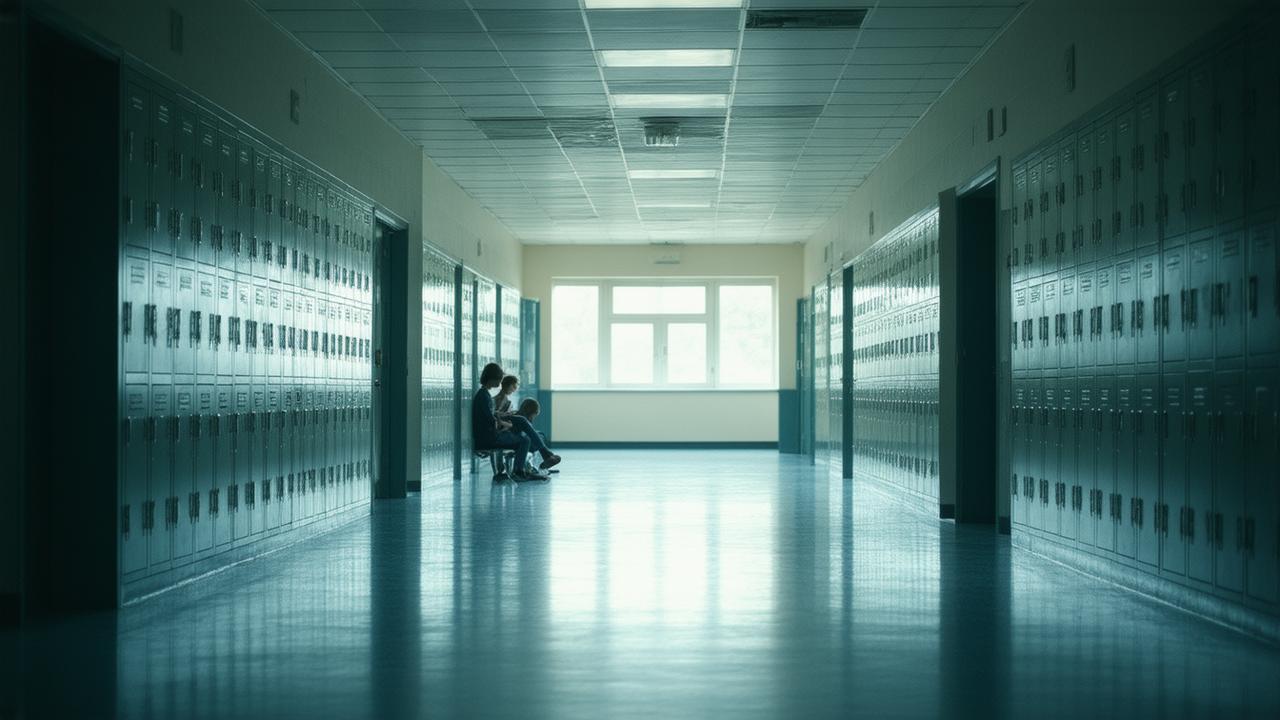
The bell rings across the asphalt and a flock of teenagers spills out onto the oval, the late‑afternoon light slanting gold through the eucalyptus trees at the edge of the school grounds. From a distance, it’s all easy laughter and swinging backpacks, the timeless choreography of adolescence. But step closer and you begin to notice the small tells that something has shifted: the girl who lingers on the bench, eyes fixed on her phone like it’s a lifeline; the boy pacing the fence line, chewing the inside of his cheek; the tight, quiet clusters of friends, voices low, the word “anxiety” no longer whispered, but spoken with the worn familiarity of weather.
The Quiet Wave Rising in the Classroom
Inside a sunlit classroom in suburban Brisbane, the walls are crowded with colourful posters: diagrams of ecosystems, a timeline of Australian history, a hand‑drawn rainbow of student goals. Yet the most important sign may be a small laminated card by the door: “Feeling overwhelmed? Take a Break Card and step out for five minutes.”
Ten years ago, a card like that would have been unthinkable in many Australian schools. Feelings, especially the difficult ones, were something to be pushed through, tidied away, or left for after school. But teachers started noticing it: the pale faces before exams, the shaky hands during presentations, the students who suddenly stopped turning in work and began sitting, hollow‑eyed, at the back of the room.
Conversations with school counsellors, GPs, and parents confirmed what research was already warning: adolescent anxiety was not just rising, it was reshaping the texture of the school day. Principals speak now of “the quiet wave” – not a dramatic crisis that erupts in a single moment, but a slow, insistent swell that touches every corner of the campus.
In response, schools from remote regional towns to inner‑city campuses have begun weaving mental health into the fabric of daily life. The shift is less about grand gestures and more about hundreds of small choices: how a teacher responds to a trembling voice during roll call, how the timetable flexes to allow for breathing room, how the school ground itself is designed to offer pockets of calm in a sea of noise.
From Detention to Discussion: Rethinking School Culture
If you peek into a staff room in a Melbourne secondary school these days, you’re as likely to hear conversations about emotional regulation as you are about assessment rubrics. Many schools are realising that anxiety is not a “problem student” issue but a cultural one. The question is no longer, “What’s wrong with this child?” but “What kind of environment are we creating for them?”
One English teacher in Sydney describes how her approach to late assignments has changed. Once, she handed out immediate detentions. Now, she starts with a quiet check‑in: “You’ve missed the last two tasks. Is something going on that I can help with?” Sometimes it’s simple disorganisation. More often, there’s a tangled knot of fear – of failing, of letting parents down, of not being good enough – that has grown so big the student can hardly look at it.
Schools across Australia are rewriting policies to reflect this softer, more curious stance. Behaviour management is being reframed as “wellbeing support.” Uniform breaches and missed homework are still addressed, but they are no longer the whole story. Instead, teachers are being trained to notice patterns: the student who suddenly starts arriving late, the one whose marks drop sharply in a single term, the constant stream of “I’m sick, can I go to sick bay?” visits that quietly mask panic.
Morning assemblies now sometimes begin with a minute of guided breathing. Peer support leaders talk openly about stress management during house meetings. Even the language has shifted: where once a student might be labelled “lazy” or “dramatic,” now you’ll hear, “I wonder if this is anxiety showing up.” That small reframe can open the door to conversation instead of conflict.
New Tools in Old Classrooms: Mindfulness, Check‑Ins, and Safe Spaces
Walk into a Year 8 science class in regional New South Wales, and you might catch a curious sight: a group of students sitting quietly for sixty seconds, eyes closed, hands resting loosely on their laps, as their teacher’s voice threads softly through the hum of the ceiling fans.
“Notice your feet on the floor,” she says. “Notice the weight of your body in the chair. You’re safe. You’re right here.”
This is mindfulness – once dismissed as a fringe idea, now increasingly common in Australian schools. Not every teenager loves it; some roll their eyes, others use the time to plan their weekend. But for a growing number, those small anchored pauses are lifelines in days that can feel relentlessly fast and loud.
Many schools are also experimenting with “emotional check‑ins” at the start of lessons. A simple mood scale on the board – 1 to 5, from calm to overwhelmed – gives students a language and a low‑pressure way to signal how they’re arriving in the room. A quick glance at the responses helps teachers decide whether this is the right moment for a high‑stakes oral presentation or if the class needs to ease in more gently.
Safe spaces are appearing across campuses: a quiet corner in the library with low lighting and soft chairs; a tiny “reset room” near the office equipped with beanbags, fidget tools, and a sand timer; a shaded bench under a jacaranda tree where staff know to check in if a student retreats there often. These are not escapes from learning so much as brief harbours – places to let the heart rate slow enough that learning becomes possible again.
Working Together: Teachers, Counsellors, and Parents
No school can carry this on its own. A deputy principal in Perth puts it bluntly: “If we try to be everything for every student, we burn out. If we work with families and health professionals, we build a net that can actually hold them.”
More schools are employing or partnering with psychologists, social workers, and counsellors who visit campus weekly. These specialists don’t just see students one‑on‑one; they also run workshops on anxiety, train staff in recognising early warning signs, and help shape whole‑school strategies.
Parents, too, are increasingly being invited into the conversation. Evening information sessions now go beyond NAPLAN and subject selections to include topics like “Understanding Teen Anxiety” or “Supporting Your Child Through Exam Stress.” In a hall that smells faintly of dust and instant coffee, you’ll hear parents sharing stories that echo one another: The daughter who can’t sleep on Sunday nights. The son who vomits before every test. The child who insists they’re “fine” while their grades quietly crumble.
A simple, mobile‑friendly snapshot of what many schools are putting in place looks something like this:
| School Initiative | What It Looks Like | How It Helps Students |
|---|---|---|
| Wellbeing Check‑Ins | Quick mood scales or questions at the start of class. | Normalises talking about feelings and flags early distress. |
| Mindfulness & Breathing | Short guided pauses during the day. | Builds simple tools to calm the nervous system. |
| Calm Spaces on Campus | Designated rooms or quiet corners to reset. | Offers safe retreat without leaving school. |
| Staff Training | Professional learning on anxiety and trauma‑informed practice. | Gives teachers confidence to respond with empathy. |
| Parent Workshops | Evening sessions and resources sent home. | Aligns home and school support for anxious teens. |
The power of this network lies less in any single strategy and more in the sense that a student doesn’t have to carry their fear alone. A teacher notices something, a counsellor follows up, a parent is looped in, a GP or psychologist adds another layer of support. Anxiety may still be present, but it is now held in many hands.
Rethinking Success: Less Pressure, More Presence
Beneath all these practical responses lies a quieter, more radical question: What do we really want school to be for young people?
For years, the answer seemed obvious: grades, scores, pathways to university or work. But as anxiety rates climb, more educators are speaking of a “slow revolution” in how success is defined. In a high school near Hobart, the principal describes it this way: “If a student gets a top ATAR but is too anxious to attend their own graduation, can we honestly call that a success story?”
Some schools are adjusting assessment schedules to avoid weeks overloaded with major tasks. Others are giving students more choice in how they demonstrate learning – a recorded presentation instead of a live speech, a project portfolio instead of a single high‑pressure exam. Timetables are being redesigned to include regular wellbeing lessons alongside maths and English, sending a clear message that emotional literacy is not a soft extra but a core skill.
On a breezy Wednesday in an Adelaide secondary college, a Year 9 class sits under a sprawling gum tree, notebooks open, as their teacher talks them through stress as a bodily experience: racing heart, shallow breathing, sweaty palms. They learn why the brain sometimes misfires and sounds the danger alarm when no real threat is present. They practise naming emotions – not just “stressed,” but “overloaded,” “worried,” “embarrassed,” “stretched thin.” This is science, psychology, and lived experience braided together in a way that quietly equips them for the turbulence of their teenage years and beyond.
➡️ Why Australian psychologists are studying loneliness as a measurable public health risk
➡️ The surprising role of Australian wetlands in buffering floods and storing carbon
➡️ How Australia’s migration story is influencing modern identity and everyday language
➡️ Australia’s renewed interest in nuclear submarines is reshaping Indo Pacific strategic planning
➡️ What Australian historians now believe about the early contact period along the northern coast
➡️ How Australian supermarkets are quietly changing portion sizes without changing prices
➡️ Why Australian scientists are watching Antarctic ice shelves with growing urgency
Listening to the Students Themselves
Perhaps the most significant shift underway in Australian schools is not in policies or programs but in posture: adults are starting to listen more closely to young people’s own stories of anxiety.
In a student‑led forum at a Canberra college, Year 11 and 12 students gather in a circle, the air thick with that nervous energy that comes when teenagers speak in front of their peers about something real. One student talks about the pressure of curated lives on social media, how every assignment mark feels like something that might be exposed online. Another describes trying to study in a crowded share‑house, the constant thrum of family stress throbbing in the background of every homework session.
Schools are inviting this kind of honesty into surveys and student leadership meetings. They’re asking: What makes your anxiety worse here? What helps? The answers are often simple and practical: clearer communication about deadlines, more flexible seating, teachers who check in quietly rather than calling students out in front of a class.
In one coastal school, a group of students successfully lobbied for a “low‑stimulus zone” during lunchtime – a small room with soft lighting and no loud conversations allowed. Another group helped redesign the school diary to include pages on coping strategies and helplines instead of just timetables and uniform rules. When students see their ideas shaping the environment, they feel not just heard but empowered, and that in itself can soften the edges of anxiety.
Walking the Long Road Together
As the sun slips behind the school buildings and the last of the students drift through the gates, the grounds grow quiet. But the questions linger in the air: Did we notice the ones who were struggling today? Did we give them enough tools, enough kindness, enough room to breathe?
Anxiety, after all, is not something that can be banished with a single program or poster campaign. It is woven into the wider pressures teenagers face – climate fears, economic uncertainty, the constant thrum of notifications in their pockets. Australian schools cannot erase all of that. What they can do is become places where those pressures are acknowledged rather than ignored, where young people learn that feeling anxious does not mean they are broken, only human.
In the end, the most powerful response might be the simplest: adults who walk alongside adolescents with steady, patient presence. A teacher who quietly says, “You can step outside for a minute if your heart is racing.” A counsellor who assures a student, “You’re not the only one who feels this way.” A principal who reminds the whole school, “Your worth is bigger than any exam.”
The journey Australian schools are on is far from finished. It is messy, imperfect, and constantly evolving. But as more campuses swap silence for conversation and punishment for understanding, a new story is beginning to take shape – one where academic learning and emotional wellbeing are not rivals, but companions on the same long, winding path from childhood to adulthood.
Frequently Asked Questions
Are all Australian schools addressing adolescent anxiety in the same way?
No. Approaches vary widely depending on size, location, resources, and leadership priorities. Some schools have extensive wellbeing teams and programs, while others are just beginning with simple check‑ins and staff training. But across the country, there is a growing recognition that anxiety needs a planned, whole‑school response.
What practical signs show a school is taking student anxiety seriously?
Look for visible wellbeing initiatives: calm spaces on campus, explicit lessons on mental health, staff who use supportive language, and flexible approaches to assessment where appropriate. Regular communication with families about mental health and clear referral pathways to counsellors or external services are also strong signs.
How can parents support what schools are doing about anxiety?
Parents can stay in close, non‑judgmental contact with both their child and the school. Sharing relevant information with teachers or counsellors, attending information sessions, and reinforcing coping strategies at home all help. Most importantly, parents can send a consistent message that wellbeing matters more than perfect performance.
Do mindfulness and breathing exercises really help anxious teenagers?
They are not a cure‑all, but for many students they offer simple, portable tools to stabilise breathing and calm the nervous system in stressful moments. Some teenagers won’t connect with these practices, and that’s okay; schools are learning to offer a range of strategies so each young person can find what works best for them.
What should a student do if their school doesn’t seem to understand their anxiety?
It can help to start by talking to a trusted adult at school – a favourite teacher, year coordinator, or counsellor if one is available – and describe how anxiety is affecting daily life. Bringing a parent or carer into the conversation often adds weight and support. If school responses still feel inadequate, consulting a GP or psychologist outside school can provide extra advocacy and guidance on next steps.





