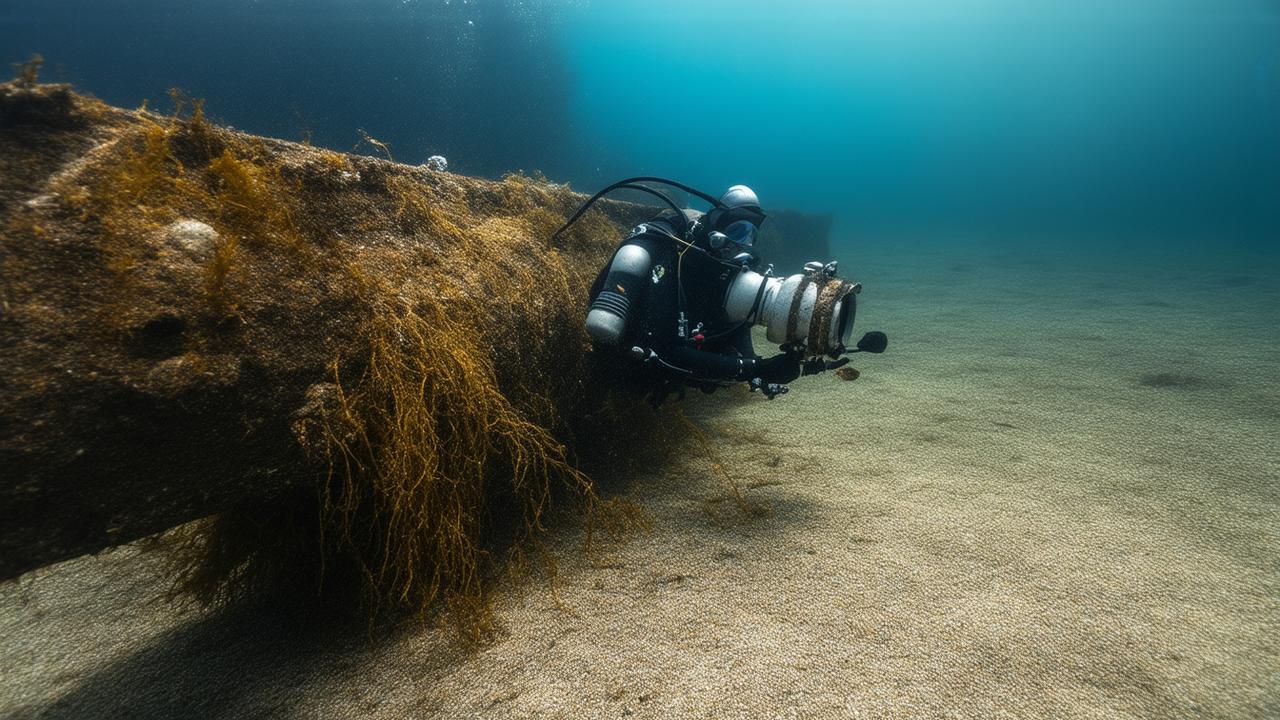
The first thing you notice is the silence. Forty meters below the choppy surface off the Australian coast, the world is muted to the hiss of your own breath and the slow thump of your heartbeat in your ears. The water is the color of over-steeped green tea, hazy with drifting particles. And then, out of the gloom, it appears—an outline becoming form, like a memory growing sharper. A rusted anchor, half-swallowed by sand. A tangle of stanchions. The ribs of an old ship, its timbers black and furred with marine life. This is a wreck Australian archaeologists know well—or thought they did. They mapped it years ago. They cataloged every plank. And yet, here they are again, descending through the quiet water, chasing questions that didn’t even exist when the wreck was first found.
The Myth of “Fully Explored” Wrecks
For decades, maritime archaeology carried a quiet assumption: once a wreck had been documented, measured, and photographed, it was more or less “done.” The story had been told. Commit the coordinates to an archive, write the reports, move on to the next discovery. But the sea is not a museum and shipwrecks are not static exhibits. They are living systems, changing year by year, grain by grain of sand, barnacle by barnacle.
Australian archaeologists are now admitting what the ocean has been insisting all along—there is no such thing as a fully explored shipwreck. The same iron hull that lay silent and unremarkable in the 1980s can, in 2026, be a radically different object. Sections collapse, sandbars shift, invasive species arrive, currents carve away silt and expose long-buried cargo. A storm can re-sculpt an entire site overnight.
Once upon a time, archaeologists swam through these sites with notebooks in watertight bags and tape measures looped around their wrists. They sketched in the dim underwater light, trying to capture the shape of a hull in wobbly pencil lines. They took a few rolls of film, knowing that each frame was precious. Today, those pencil sketches look almost quaint next to the laser-precise 3D models emerging from the same wrecks.
The myth of the “finished” wreck is collapsing under the weight of new tools, new questions, and a new understanding that history isn’t just what happened once—it’s also everything that’s happened since.
The Pull of Rust and Timber: Why Return Now?
On a gray dawn in Western Australia, a dive team leans over the side of a research vessel, threading cables and cameras like a nest of metal serpents. This is not just nostalgia dragging people back to old sites. There are clear, urgent reasons for the return.
New Technology, New Eyes
If the first surveys of these shipwrecks were like feeling around a dark room with your hands, today’s technology is the equivalent of switching on the lights. High-resolution multibeam sonar, underwater photogrammetry, drones, and autonomous underwater vehicles (AUVs) allow archaeologists to see these wrecks in almost absurd detail.
They can create digital twins of an entire site—hull, cargo, surrounding seafloor—with millimeter-scale accuracy. Return a year later, scan again, and layer the models on top of each other. Subtle shifts jump out: a collapsed deck beam here, a newly exposed crate there. It’s not just a snapshot anymore; it’s time-lapse history.
Things that earlier divers simply couldn’t see—hidden cavities, delicate inscriptions, unusually corroded patches of metal—now become data. That bronze nail someone swam past thirty years ago may suddenly reveal patterns about shipbuilding that rewrite a chapter of maritime history.
Questions Nobody Thought to Ask
When many of these wrecks were first studied, the focus was often straightforward: what ship was this, when did it sink, who was aboard? Identity and tragedy. These stories mattered, but they were only part of the picture. Today, archaeologists return armed with questions shaped by climate science, Indigenous knowledge, ecology, and social history.
What does the distribution of ballast rocks tell us about trade routes and resource extraction? How have coral and sponge communities colonized the wreck over decades, and what does that say about local ecosystems? Are there traces of everyday life—buttons, tools, seeds, ceramics—that previous teams dismissed as unremarkable, but now hint at migration, diet, and cultural exchange?
New questions crack open old sites. A misplaced nail pattern might indicate a ship was repaired in a different colony than it was built, quietly mapping the invisible movement of shipwrights, techniques, and timber across Australia’s coasts and river ports.
Shipwrecks as Time Capsules—and Test Sites
On the seabed south of Tasmania, a wooden vessel lies on its side, the hull cradling sand like cupped hands. Seaweed waves in and out of gaps between the planks. Somewhere in the darkness of the hold are cargo fragments that have spent more time underwater than any living person has spent breathing air.
Climate Clues in Corroded Steel
Australia’s shipwrecks are increasingly seen not just as historical sites, but as laboratories for change. Saltwater creeps into every pore of metal and wood, and the way materials break down in changing conditions tells a story of our warming seas.
By re-surveying wrecks documented decades ago, archaeologists can actually measure how corrosion has accelerated. Is iron rotting faster as waters warm and acidify? Are biofouling organisms—those crusts and fuzzes of marine life—spreading in new patterns? These changes are data points, part of a much larger picture that marine scientists are building of ocean health.
In some places, archaeologists have discovered invasive species hitching a ride on these old hulls, turning wrecks into stepping stones for marine organisms on the move. The sites, once valued only for their human stories, now double as barometers of environmental shift.
Shipwrecks as Artificial Reefs
Swim across the length of an iron steamer off Queensland and you might forget, for a moment, that you’re exploring a disaster. Fish flit between ribs. Soft corals bloom from rusted bollards. Turtles rest in the shadow of broken masts. For marine life, this is not a grave; it is shelter.
Over time, Australian archaeologists have watched wrecks transform from sharp, new scars on the seafloor into thriving artificial reefs. Returning to older sites allows them to study reef succession—the way life colonizes, competes, and stabilizes on a human-made structure. How long does it take for a barren hull to become part of the seascape? Which species arrive first, and who outlasts them?
This ecological layering doesn’t erase the human history, but it complicates it. Each wreck is now a conversation between past and present: the intentions of shipbuilders, the terror of a sinking, the quiet persistence of coral polyps and algae reclaiming human debris for their own purposes.
Rewriting Stories We Thought We Knew
In a quiet archive room in Canberra, there are boxes of old dive logs, rolled site plans, and dog-eared photographs—records from the first wave of shipwreck exploration in Australian waters. They feel definitive when you hold them, as if someone, somewhere, had finished the story. But every time archaeologists go back underwater, details unravel those early conclusions.
From “Shipwreck” to “Seascape”
One of the biggest shifts has been conceptual. The wreck itself used to be the star: a single object of timber or steel, isolated against the sea. Now, archaeologists increasingly talk about “seascapes”—the relationships between a wreck, the currents that flow past it, the animals that inhabit it, the people who fish above it, and the shorelines it sits near.
Returning to older wrecks with this broader lens exposes overlooked stories. A cargo of cheap ceramics, once dismissed as historically minor, may indicate supply networks to remote coastal camps. An anchor found far from the main wreck might suggest desperate measures during a storm, or an earlier failed attempt to avoid disaster.
And then there are the human stories that earlier researchers didn’t listen for. Australian archaeologists are now more intentionally seeking out Indigenous perspectives on waters and coasts where these ships went down. Some wrecks intersect with long-standing Aboriginal and Torres Strait Islander sea country, layered over deep-time relationships with those shores and sea lanes. Returning to the wrecks means reconsidering them not just as endpoints of colonial voyages, but as brief, violent moments in much longer coastal histories.
New Finds on Old Sites
Sometimes, revisiting a site is less about theory and more about something wonderfully simple: the fact that the ocean moved a bit of sand. A single storm can reveal parts of a wreck no one has ever seen. A steamer once surveyed as “broken in two” might turn out to be mostly intact, only deeply buried.
➡️ Why Australian psychologists are studying loneliness as a measurable public health risk
➡️ The surprising role of Australian wetlands in buffering floods and storing carbon
➡️ How Australia’s migration story is influencing modern identity and everyday language
➡️ Australia’s renewed interest in nuclear submarines is reshaping Indo Pacific strategic planning
➡️ What Australian historians now believe about the early contact period along the northern coast
➡️ How Australian supermarkets are quietly changing portion sizes without changing prices
➡️ Why Australian scientists are watching Antarctic ice shelves with growing urgency
It’s not unusual for divers to return to “known” wrecks and suddenly find new features: a sternpost here, a row of long-hidden copper sheathing there, the imprint of a missing mast in the seabed. Each new detail knocks loose assumptions and, occasionally, ship identities. A vessel cataloged confidently as one ship decades ago might, under renewed scrutiny, prove to be another entirely.
Balancing Curiosity and Conservation
Back on deck, after the dive, the archaeologists peel off hoods and masks, their hair kinked with salt, eyes bright with the intensity of the underwater world they’ve just left. On laptops balanced against rolling swells, new images flicker into view: rust, coral, shadow, wood. It’s tempting to think, “Let’s go back every year, forever.” But each return has a cost.
Protecting What Curiosity Reveals
Many of Australia’s wrecks are war graves or sites of immense personal tragedy. Divers move carefully, not just for safety, but for respect. The more compelling and vivid the digital reconstructions become, the more popular these wrecks can grow with recreational divers—and not all visitors are gentle. Anchors can crush fragile timbers. Careless fins can send centuries-old artifacts spinning into the murk.
Australian archaeologists are now in the delicate business of choosing when not to return. Sometimes, the best decision is to let a wreck rest, armed only with remote-sensing tools that don’t disturb the site. In other cases, protective measures—no-anchor zones, dive briefings, or even restricted access—are put in place around especially vulnerable or sacred locations.
There is a tension at the heart of the work: the drive to know more, weighed against the responsibility to do no further harm. Every revisit must justify itself, not as an adventure, but as an act of careful stewardship.
A Future Written in Saltwater
As the afternoon light flares gold on the swells, the research vessel turns for shore. On board, drives full of new data hum quietly, the digital ghosts of hulls and holds traveling over the waves. Back on land, those shipwrecks will be rebuilt on screens in glowing, rotatable models—time-lapse sculptures of decay and discovery.
This is why Australian archaeologists are returning to shipwrecks once thought fully explored: because the sea won’t leave them alone. Wrecks shift, crumble, reveal. Technology advances. Questions deepen. Climate changes. Communities ask different things of the past. Each return is less like flipping back to a finished chapter and more like discovering there was never a final page to begin with.
Somewhere off the coast tonight, a storm will cross shallow banks, pushing water hard across an old hull. Sand will scour away from timbers that haven’t seen light in a century. A crate might finally break open. A brass fitting may glint briefly in filtered sun. Months or years from now, divers will descend again into the green quiet, lights sweeping, hearts beating fast at the sight of something that has been there all along, waiting for the right question, in the right moment, to make it visible.
Key Reasons Archaeologists Are Revisiting Old Wrecks
| Reason | What’s Different Now |
|---|---|
| Advanced Technology | High-resolution sonar, 3D photogrammetry, and AUVs reveal details invisible in earlier surveys. |
| New Research Questions | Focus has expanded from identity and date of sinking to trade, daily life, and cultural exchange. |
| Climate and Environmental Data | Wrecks act as long-term indicators of corrosion, species movement, and reef development. |
| Changing Seafloor Conditions | Storms and currents uncover previously buried sections and artifacts. |
| Evolving Ethical Perspectives | Greater recognition of war graves, Indigenous sea country, and the need for careful stewardship. |
Frequently Asked Questions
Are these shipwrecks protected under Australian law?
Yes. Many shipwrecks in Australian waters are protected by heritage legislation once they reach a certain age or are formally declared as protected sites. This can restrict activities like artifact removal, anchoring, or commercial exploitation. Archaeological work generally requires permits and is governed by strict ethical and conservation standards.
Why not just focus on undiscovered wrecks instead of revisiting old ones?
New wrecks are still being found, but previously recorded sites are incredibly valuable because they offer time-depth. By comparing what archaeologists saw decades ago with what they see now, they can track changes in the wreck, the seafloor, and local ecosystems. Old wrecks become long-running experiments in decay, colonization, and environmental change—something a newly discovered site simply can’t provide yet.
Do archaeologists remove artifacts when they return to these wrecks?
Often, they don’t. Modern maritime archaeology favors in situ preservation—leaving artifacts where they are unless there is a strong reason to recover them, such as imminent deterioration or a major research question that can’t be answered otherwise. Most revisits focus on documentation, digital recording, and non-invasive study rather than salvage.
Can recreational divers visit these wrecks too?
Some sites are accessible to recreational divers, while others are restricted due to depth, safety, cultural sensitivity, or legal protection. Where visits are allowed, divers are expected to follow responsible diving practices: no touching, no taking, careful buoyancy control, and respect for any guidelines set by local authorities or heritage agencies.
How are Indigenous perspectives included in shipwreck research?
There is growing recognition that many wreck sites lie within or near Indigenous sea country. Archaeologists increasingly collaborate with Aboriginal and Torres Strait Islander communities, consulting about cultural values, place-based knowledge, and appropriate ways of working on and interpreting these sites. This can influence everything from research questions to how findings are shared with the public.
Will technology eventually make physical dives unnecessary?
Remote sensing and robotics are becoming more powerful, and in some cases they can reduce the need for divers, especially in dangerous or very deep environments. However, human observation underwater still provides nuance and flexibility that machines can’t always match. For now, the future of maritime archaeology in Australia looks like a partnership—human curiosity coupled with increasingly sophisticated digital tools, returning again and again to the same silent, shifting stories on the seafloor.





