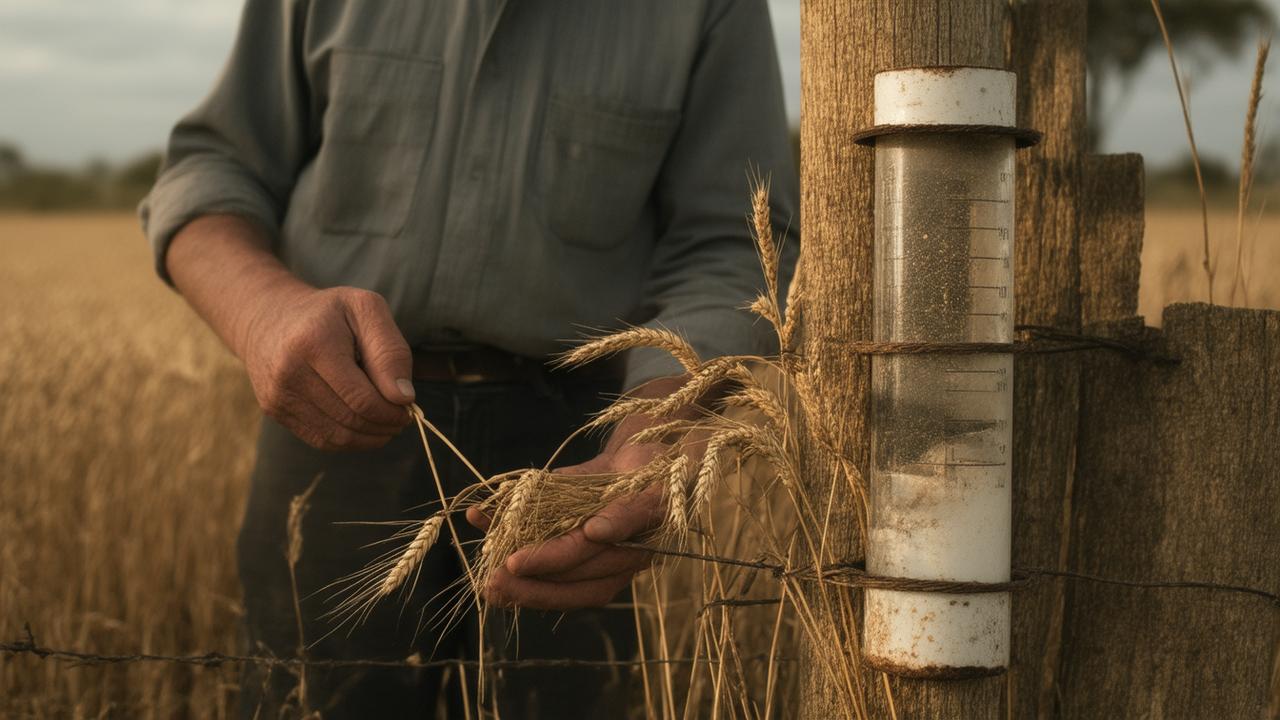
The first thing you notice is the silence. Not the gentle hush of a resting landscape, but a taut, waiting quiet that stretches over the paddocks like a sheet of glass. In the wheat belt of Western Australia, under a sky the colour of bleached tin, farmer Josh Miller kicks at a clod of powder-dry soil and watches it crumble into dust. This time of year, there should be a faint green sheen across his fields, tiny wheat shoots catching the early light. Instead, there are only the ghost lines of last year’s stubble and the memory of rain that didn’t come.
The old rhythm of rain is breaking
For generations, Australia’s wheat belt has moved to a kind of slow, dependable music: autumn breaks, winter rains, spring ripening, summer harvest. Farmers planned their lives according to patterns they could almost feel in their bones. But over the past few decades, the tempo has shifted. The beats are out of place. Some years, the first soaking autumn rain doesn’t arrive until winter is already peering over the horizon. Other years, it comes in violent, sudden downpours that race off the paddocks before the soil can drink them in.
In kitchen-table conversations from Geraldton to Wagga Wagga, the same story keeps coming up: the rain is different now. It’s not only about how much falls, but when, and how. Scientists looking at Australia’s climate records see the same patterns in harder numbers. The country’s southwest—home to a huge slice of the wheat belt—has seen a long-term decline in cool-season rainfall since the 1970s. At the same time, heavy rainfall events are becoming more intense in many regions, squeezing more water into fewer, more extreme days.
For farmers, this isn’t an abstract graph on a screen. It’s the painful gamble of when to plant, how much fertiliser to risk, whether to buy more seed or scale back. The old rule-of-thumb calendars pinned to farmhouse walls, once reliable guides, are starting to feel like relics from another climate.
Listening to the land when the forecast keeps changing
Walk through a wheat paddock after a good autumn break and the air smells faintly alive—damp earth, green growth, a thin sort of optimism. That smell has always signalled the start of a critical sequence. Wheat needs a certain pattern of moisture: enough rain early to get roots established, steady falls through winter to build biomass, then drier, cooler weather to finish the crop without a burst of disease.
Now, that sequence is increasingly scrambled. Autumn is often warmer and drier; winter rains are patchier; spring can be brutally hot. Farmers are being pushed into a kind of permanent improvisation, a conversation with the land where the questions keep changing. Do they chase early sowing on scant soil moisture, hoping the rain will follow? Or wait and risk missing the best planting window entirely?
In some districts, the “autumn break” has become less a dependable threshold and more a myth you might get lucky enough to catch. Instead of a few generous, soaking fronts, rain might arrive as scattered storms that dump a month’s worth of water in one night—and then leave three weeks of dry wind behind. There’s more erosion from bare paddocks, more runoff, more lost topsoil. The water comes, but it doesn’t always stay.
How climate is quietly redrawing the wheat belt
On the maps that politicians like to hold up at press conferences, the wheat belt is a clean, easy sweep across the southern interior—New South Wales, Victoria, South Australia, Western Australia, parts of Queensland. But from the ground, that sweep is starting to fray at the edges. Climate models and on-farm experience are converging on the same uneasily shared conclusion: Australia’s wheat belt is shifting.
In the west, the northern and eastern fringes of what used to be reliable cropping country are becoming more marginal as cool-season rainfall declines. In the east, some wetter or higher-altitude areas that were once seen as too risky or cool for wheat are suddenly more attractive as the climate warms and patterns tilt. It’s not that wheat will vanish from its historic heartlands tomorrow, but that the envelope of what’s viable is moving—subtly in some places, dramatically in others.
The effect is like someone quietly erasing old pencil lines on a map and sketching new ones. Consultants advising growers now talk about “climate analogues”: what your district might feel like, in rainfall and temperature, 20 or 30 years from now. A farmer outside Dubbo might be told: your future climate could look more like somewhere hundreds of kilometres further north does today. That means rethinking not just what you plant, but how you manage everything from soil to machinery.
Rain in numbers: a small table, a big story
Behind the lived experience of shifting seasons sit the numbers that explain why predictions are changing. While exact figures differ by region and source, the broad pattern is clear: cooler-season rainfall is trending down in key areas, and variability is trending up.
| Region | Key Rainfall Shift (Recent Decades) | Likely Impact on Wheat |
|---|---|---|
| Southwest WA | Marked decline in cool-season rainfall, later breaks | Higher yield risk, more reliance on stored soil moisture |
| Southern NSW & VIC | More variable winter–spring rain, hotter springs | Heat stress during grain fill, tighter sowing windows |
| SA’s Mallee & Eyre regions | Gradual drying trend, more frequent dry years | More frequent low-yield seasons, pressure to diversify |
| Parts of QLD interior | Erratic summer and shoulder-season rainfall | Increased reliance on opportunistic planting |
Each of those shifts ripples outward into decisions about land values, infrastructure, regional jobs, and export predictions. The wheat belt is not just a zone of paddocks; it is also silos, rail lines, ports, and towns whose main street café survives or closes based on whether trucks are loaded or idle.
Farmers are rewriting the playbook in real time
Drive through the wheat country now and the signs of adaptation are everywhere, if you know how to look. Direct-drill seeders leave fine, narrow scars through standing stubble—a way of planting without disturbing precious soil moisture. Wide, low-slung booms roll across paddocks before dawn, applying herbicides and fertilisers with a precision that would have seemed science-fiction in the 1980s. Weather stations sprout from fencelines like strange metallic trees, feeding data into phone apps that farmers check between fixing pumps and chasing sheep.
Australia’s growers have become, by necessity, some of the most climate-savvy business operators in the country. They are adopting earlier-maturing wheat varieties, experimenting with blends that can handle either a dry or a wet finish, and trialling crops like canola, lupins, or pulses to spread their risk. Some are adjusting sowing dates to chase cooler grain-filling periods, nudging their whole calendar a few weeks forward or back to dance around the hot spells.
Others are hedging their bets with mixed enterprises: cropping plus sheep, or cropping plus off-farm income, a portfolio of livelihoods instead of a single roll of the dice on rainfall. Agronomists talk about “farming the forecast” now, using seasonal outlooks for El Niño or La Niña years, not as prophecy but as one more tool in a kit that still includes watching the horizon and feeling the weight of the air.
The science and the stories converging
Inside research stations and university labs, teams are parsing terabytes of climate data, feeding models that try to peer decades ahead. The language is technical: circulation patterns, ocean–atmosphere coupling, deciles, projections. Yet the outcome is deeply personal for everyone whose life is written in seasons. Longer dry spells between rainfall events. A greater share of annual rainfall delivered in intense bursts. Warmer nights. Hotter, earlier springs.
What makes Australia’s changing rainfall patterns particularly disruptive is not just the shift in averages, but the rise in uncertainty. Predictions of national wheat production used to lean more comfortably on historical yields. Now, the spread of possible outcomes in any given year is widening. A “reasonable” season might deliver a bumper crop one year and a modest one the next, on apparently similar rainfall totals, simply because of when the rain fell, how hot it was, and how long the dry spells between fronts lasted.
In this sense, the models and the stories are telling the same tale. The numbers say: more variability. The farmers say: it’s getting harder to trust the patterns we grew up with. Both are right. And both are forcing the entire wheat supply chain—from seed breeders to export planners—to accept that yesterday’s map of the wheat belt is no longer a guarantee of tomorrow’s harvest.
What a new wheat belt future might feel like
Imagine standing on a rise outside a small wheat town ten or twenty years from now. The landscape will not suddenly look alien. Wheat will still sway in the wind; headers will still crawl methodically across the horizon in summer. But if you pay attention, you might notice more patchwork in the paddocks—different crop types stitched together, longer strips of native vegetation left for shade and shelter, perhaps more ground cover even in drier months.
➡️ Why Australian psychologists are studying loneliness as a measurable public health risk
➡️ The surprising role of Australian wetlands in buffering floods and storing carbon
➡️ How Australia’s migration story is influencing modern identity and everyday language
➡️ Australia’s renewed interest in nuclear submarines is reshaping Indo Pacific strategic planning
➡️ What Australian historians now believe about the early contact period along the northern coast
➡️ How Australian supermarkets are quietly changing portion sizes without changing prices
➡️ Why Australian scientists are watching Antarctic ice shelves with growing urgency
Farmers might talk more about soil carbon than rainfall totals, because a healthy, sponge-like soil buys them precious days when the rain fails. They might be planting varieties bred specifically for hotter, shorter seasons, or managing their crops with real-time satellite imagery that flags stress before human eyes can see it. In some districts, wheat might no longer be the king it once was, with more canola, chickpeas, or even novel crops in the rotation. In others, wheat may push into areas that used to be marginally too cool or too wet, as the climate envelope shifts.
There will also be hard choices. Some farms on the driest fringes may gradually exit cropping altogether, pivoting back to grazing or other land uses. Towns whose economies depend on big, predictable harvests might feel the strain of more frequent poor years, unless they manage to diversify. The national conversation about food security, exports, and regional resilience will have to reckon with the fact that climate change is not a distant threat to “somewhere else”—it is already remixing the rainfall that underpins one of Australia’s most important industries.
Holding on to hope in a tightening climate
Back on Josh Miller’s farm, late light turns the dust in the air to a kind of muted gold. He unlocks the shed where a row of carefully maintained machinery waits in the half-dark—a multi-million-dollar vote of confidence that the land will keep giving if he can stay one step ahead of the weather. On a bench near the doorway, a dog-eared notebook sits beside a smartphone displaying the latest seasonal outlook. In the margins of those two tools—the instincts passed down through his family, and the data pouring in from satellites and supercomputers—Josh is trying to sketch his own version of the future.
Hope out here is not a soft, wishful thing. It is stubborn, practical, often exhausted. It sounds like a drill seeder starting up on a morning when the sky is still empty but the forecast hints at a change. It feels like hands in the soil, checking for moisture; eyes on the radar; a quiet, ongoing decision to plant anyway. As Australia’s rainfall patterns keep shifting, hope is also about insisting that predictions can adapt as fast as the climate—so that the invisible lines of the wheat belt on our national maps do not become stories of regions we failed to help in time.
The rain, when it does come, smells the same as it always has: metallic, earthy, electric with relief. The difference now is what that smell means. It is no longer just a signal of another season beginning, but a reminder of how fragile the old rhythms have become—and how urgently we are being asked to write new ones.
Frequently Asked Questions
Why are Australia’s rainfall patterns changing?
Australia’s rainfall is being influenced by a warming climate interacting with natural drivers like El Niño, La Niña, and the Indian Ocean patterns. Warmer oceans and atmosphere change how moisture moves, leading to declines in cool-season rainfall in some regions and more intense downpours in others.
How does this specifically affect the wheat belt?
The wheat belt depends on reliable autumn and winter rainfall. When those rains arrive later, in smaller totals, or in short, intense bursts, it disrupts sowing times, crop growth, and grain filling. That raises yield risk and makes predictions from year to year more uncertain.
Is the wheat belt moving or shrinking?
In some areas, particularly in the southwest and drier margins, conditions are becoming less suitable for reliable wheat production. At the same time, some cooler or wetter regions may become more viable. It is less a simple “shrinking” and more a shifting of the zone where wheat can be grown profitably.
What are farmers doing to adapt?
Farmers are changing sowing dates, using earlier-maturing varieties, adopting conservation farming techniques, improving soil health, diversifying crops and income sources, and relying more heavily on seasonal forecasts and on-farm data to guide decisions.
Will Australia still be a major wheat exporter in the future?
Australia is likely to remain a significant wheat exporter, but with greater year-to-year variability in production. The scale and stability of exports will depend on how effectively farmers, researchers, and policymakers adapt to changing rainfall patterns and support more resilient farming systems.





