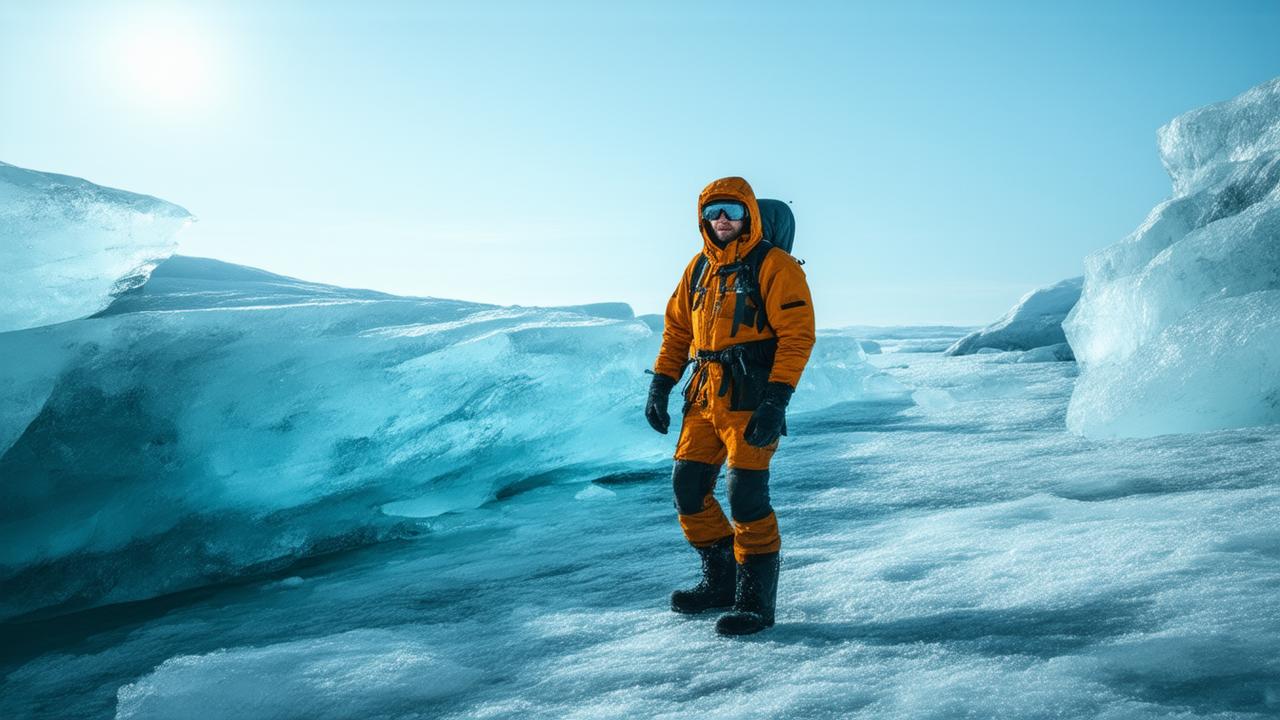
The sky over the Weddell Sea is the soft blue of old glass when the first crack sounds—a dull, bone-deep thud that ripples through the ice like a distant drum. A team of scientists, bundled to the eyes in wind-burned jackets, look up from their instruments, their breath turning instantly to glittering frost. Somewhere out across the flat, blinding plain of the ice shelf, a fracture has moved, widened, or woken up. They can’t see it yet. But the ice is speaking, and lately, it’s getting harder to ignore.
A Frontier That’s Always Moving
To most of us, Antarctica lives in imagination—a vast white nowhere at the bottom of the world. But to the people who work there, it’s a restless, moving system: creaking, cracking, flowing. Ice shelves—the thick, floating platforms of ice that extend from the continent’s grounded ice sheets over the ocean—are its fragile outer skin.
These shelves act like giant braces, slowing the land ice behind them from sliding into the sea. When an ice shelf weakens or collapses, that inland ice can accelerate, raising global sea levels far beyond what the shelf itself would contribute as it melts. That’s why, in an age of rapid warming, ice shelves have become both a scientific obsession and a nervous premonition.
The mood in Antarctic research circles has shifted over the last decade. Where once the talk was of long-term trends and distant thresholds, now it’s about “instabilities,” “tipping points,” and “runaway feedbacks.” The data streaming in from satellites, drones, ocean moorings, and seismic sensors is painting a sobering picture: large parts of the Antarctic system are wobbling, and the world is quietly ramping up its watch.
The Sound of a Changing Ice World
Walk onto an ice shelf on a calm day and it feels, at first, like stepping into silence. Then your ears adjust. You notice the muffled hiss of wind across snow, the occasional pop of shifting ice, the hollow echo when your boots strike a hidden crevasse lid. Beneath your feet, the shelf is floating on dark, frigid water. Below that, currents bend and twist, carrying relatively warm ocean layers that nibble at the ice from underneath.
Monitoring this layered world has always been difficult. The ice can be hundreds of meters thick; the ocean beneath it is one of the least accessible environments on Earth. But as the stakes climb, so does the ingenuity. Scientists now listen to the creaks and groans of the ice with arrays of seismometers that can detect fractures forming deep out of sight. They fire radar pulses into the snowpack to measure thinning. Autonomous underwater vehicles slip under the shelves, mapping melt rates on their hidden undersides.
Above, satellites watch from orbit with a patience no human could manage. They measure tiny changes in elevation—millimeters per year—that signal subsurface thinning. They track the slow migration of crevasses, the widening of rifts that will one day calve icebergs the size of cities. These instruments don’t just capture snapshots; they build time-lapse portraits of a system in flux.
Why Instability Matters
The word “instability” sounds abstract, but on Antarctica’s ice shelves it has a very specific meaning. Stable shelves behave like slow, stiff conveyor belts: snowfall accumulates inland, ice flows towards the sea, and icebergs calve off at the front at a pace that mostly balances the inflow. An unstable shelf, by contrast, starts to thin, stretch, and crack faster than it can be replenished.
Worryingly, many of the shelves now under intense scrutiny buttress glaciers that sit on beds extending deep below sea level. This configuration is prone to what scientists call marine ice sheet instability. Once the grounding line—the place where the ice sheet lifts from the bedrock and begins to float—starts retreating into deeper basins, the whole system can accelerate in a self-reinforcing way. It becomes much harder to stop.
The concern is not that everything will collapse tomorrow, but that the long, slow fuse of sea-level rise is being lit in a way that could eventually be measured not in millimeters per year, but centimeters. For coastal cities and low-lying communities around the world, that difference is existential.
The New Eyes on the Ice
In response, ice shelf monitoring has quietly entered a new era. What used to be seasonal field campaigns and occasional satellite passes has become year-round surveillance—a blend of space-based vision, on-ice listening posts, and underwater explorers.
Tools Tracking a Fragile Edge
Here is a simplified look at some of the main tools scientists use, and what they are revealing about Antarctic instability:
| Monitoring Tool | What It Measures | What We’re Seeing |
|---|---|---|
| Satellite Altimetry | Ice surface height and thinning rates over time | Widespread thinning on key shelves, especially in West Antarctica |
| Ice-Penetrating Radar | Ice thickness, internal layers, hidden crevasses | Weakening structural “beams” and expanding networks of fractures |
| Seismic & Acoustic Sensors | Cracking, calving events, and icequakes | More frequent fracture activity in some stressed shelves |
| Autonomous Underwater Vehicles | Basal melt rates, ocean temperature and salinity beneath shelves | Warm ocean intrusions eating away at shelves from below |
| GPS & In-Ice Beacons | Ice motion, flexing, and tidal bending | Speed-ups and unusual flexing patterns preceding major calving events |
Together, these tools form something like a vital signs monitor for the frozen edge of the continent. And the readings, taken as a whole, are increasingly worrying. In several regions, particularly parts of West Antarctica, ice shelves are thinning from both above and below, while their fronts are riven with growing fractures.
Frontlines of Fragility
Standing on the edge of a major ice shelf, you might not guess anything is wrong. The horizon is a clean line of white and blue; the air is sharp, almost metallic in its purity. Yet the data tells another story, one written in decimal places and subtle shifts.
Some shelves have lost tens of meters of thickness in just a few decades. Surface meltwater is carving blue rivers across previously unbroken expanses, pooling in turquoise lakes that can suddenly drain through the ice like water through a cracked plate. When those lakes collapse, they can help trigger rapid, chain-reaction fracturing—a mechanism believed to have played a role in the dramatic disintegration of past shelves.
Beneath the surface, warm water flowing through deep channels gnaws at the ice from below, leaving hidden cavities and thinning the shelf’s structural “keels.” As these supports diminish, the ice becomes more prone to bending, flexing, and, eventually, breaking. Structural engineers would call it a loss of integrity. Out here, it simply means that the brace holding back the continent’s ice is wearing out.
The Human Thread in a Frozen Story
Inside a cramped Antarctic field camp, the human scale of all this comes into focus. A laptop screen glows in the dim light, solar panels croak in the wind outside, and a scientist hunches over a fresh batch of radar data, fingers stiff from the cold. The plots show a fracture that wasn’t there last year, creeping inland. A colleague scrolls through satellite images, frame by frame, watching a distant ice front flex and breathe like a slow, white lung.
For the people living this work, the ice shelf isn’t an abstraction. It’s a presence—sometimes majestic, sometimes menacing. They have seen sudden calving events, heard the sky-splitting roars as city-sized slabs tilt and tumble into the sea. They know that what begins as a hairline crack in a blank white field can, in time, reshape coastlines half a world away.
And yet, there’s a quiet resilience in these camps. Instruments fail, storms roll in, helicopters are grounded, and still the work continues. Because this isn’t just about science for science’s sake; it’s about giving a warming world a clearer view of the path it’s on—and the options still left to change course.
Reading the Warnings
So what does intensifying ice shelf monitoring really tell us, beyond the technical details and the icy drama? At its core, it’s a sign that the planet’s last great frozen bastions are entering a period of heightened risk.
➡️ Australia’s changing rainfall patterns are altering the nation’s wheat belt predictions
➡️ How Australia’s museums are rethinking colonial collections and repatriation pathways
➡️ Australia’s housing design is shifting toward passive cooling as summers grow harsher
➡️ What Australian doctors are learning from long COVID clinics in major cities
➡️ Australia’s space industry is quietly expanding beyond satellites into deep tech exports
➡️ Emergency wards are reporting a sharper spike in dehydration cases during prolonged heatwaves
➡️ Bushfire smoke is turning air quality monitors into everyday household essentials
It tells us that the assumptions we once made—that Antarctica would be slow to respond, that its big changes would be far off in the future—are being revised. Not because anyone wants them to be, but because the ice itself is leaving little room for denial. It’s thinning, cracking, accelerating. It’s becoming more sensitive to nudges from the ocean and the atmosphere. And those nudges are getting stronger as greenhouse gases trap more heat in the climate system.
Yet the story is not fixed. The pace and scale of future ice loss still depend heavily on what humanity does in the coming decades. Lower emissions mean less warming of the ocean currents that undercut the shelves; they mean fewer extremes that turn stable snowfields into rivers of meltwater. Every fraction of a degree matters.
The Edge Between Loss and Choice
In the end, the intensifying watch on Antarctic ice shelves is as much a mirror as it is a warning. We are tracking, with exquisite detail, the consequences of decisions made far from these frozen coasts. The carbon from a car ride, a power plant, a cleared forest—over time, some of that heat energy finds its way into the Southern Ocean, slides under the shelves, and slowly, relentlessly, lifts them from below.
But there is another way to read this watchfulness: as an act of care. The fact that we know so much more today than we did a generation ago is not an accident. It’s the result of countless flights, risky ship voyages, sleepless nights in tent-bound storms, and patient years of data processing. It’s a sign that we are, at last, paying attention.
When the next great crack opens, it will be seen from space, heard through buried seismic ears, traced on screens in research labs around the world. We will understand it better than we did the last time—and with that understanding comes a responsibility. Not just to map the falling pieces of a changing ice world, but to slow the forces that are breaking it apart.
On a clear Antarctic night, with the wind finally dropping and the stars burning cold above the ice, the continent can feel timeless. The shelves glow faintly in the starlight, broad and quiet, as if they have always been and will always be. Yet the instruments humming out there in the dark tell a different story: this edge is moving, and we are now witnesses to how fast.
Frequently Asked Questions
Why are Antarctic ice shelves so important?
Ice shelves act like giant brakes on the glaciers and ice sheets behind them. When they weaken or collapse, inland ice can flow faster into the ocean, contributing significantly to long-term sea-level rise.
Does melting ice from shelves directly raise sea levels?
Because ice shelves are already floating, their melting doesn’t directly raise sea levels much, similar to ice cubes melting in a glass. The main concern is that losing them allows more land-based ice to slide into the sea, which does raise sea level.
What is causing the instability in Antarctic systems?
The main drivers are warming oceans that erode the shelves from below, rising air temperatures that increase surface melt, and changing wind patterns that push warm water closer to the ice. These factors combine to thin and fracture the shelves.
How do scientists monitor such remote and harsh places?
They use a mix of satellite observations, on-ice instruments, radar surveys, seismic sensors, and underwater robots. Many of these systems operate autonomously through the polar winter, sending data back via satellite links.
Is there anything that can still be done to slow Antarctic ice loss?
Yes. Reducing greenhouse gas emissions limits further warming of both the atmosphere and oceans, which in turn slows the processes thinning the ice shelves. Stronger climate policies, cleaner energy systems, and protecting carbon-rich ecosystems all contribute to reducing the pressure on Antarctic ice.





