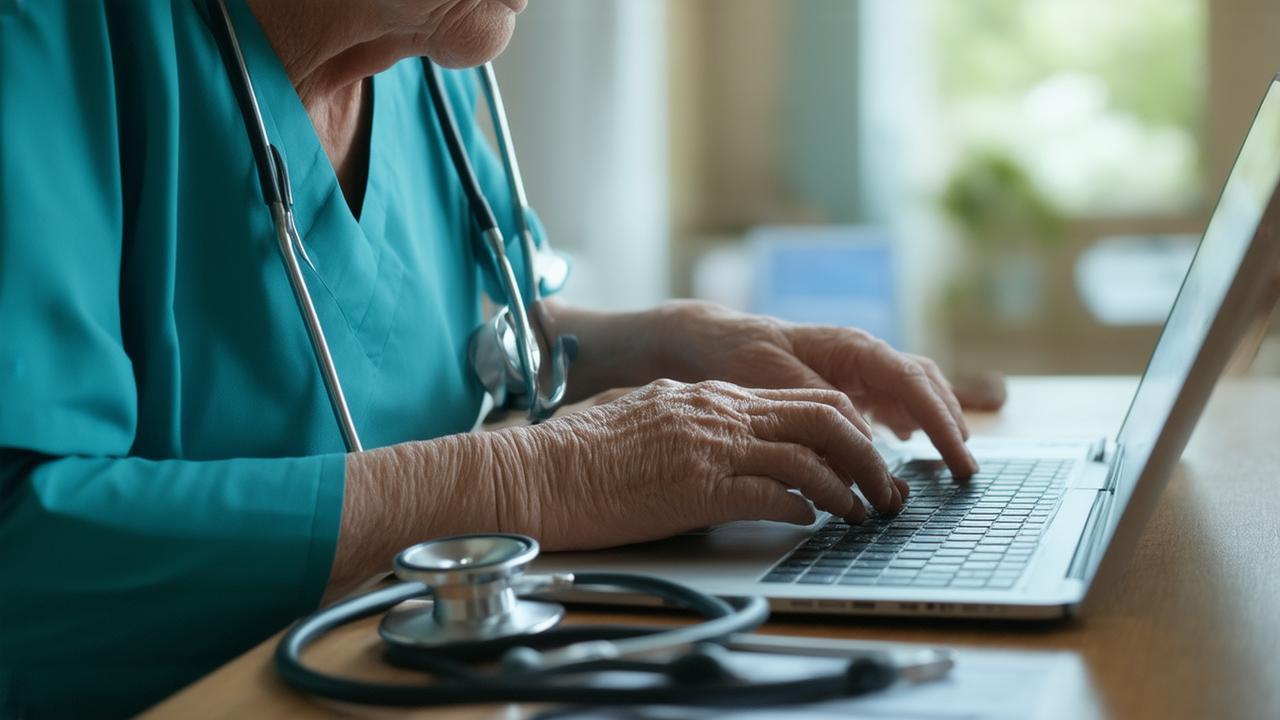
The wind on the high plains starts most mornings before the sun has fully made up its mind. It moves through the cottonwoods with a soft, rushing hush, rattles the rusted gate in front of the clinic, and sends a small swirl of dust across the gravel parking lot—empty, except for a single pickup truck and a faded sign that reads: “Family Health Center, Walk-Ins Welcome.” Inside, a nurse in green scrubs wheels a cart toward an exam room, its centerpiece not a tray of gleaming instruments, but a laptop, a ring light, and a headset. The doctor this patient is about to meet is almost 200 miles away, in a windowless office lined with monitors. In places like this, this is what seeing a specialist looks like now: a doorway made of pixels, held open by a tenuous thread of broadband.
When the Specialist Is a Screen
By the time Mrs. Garza shuffles into the exam room, the chair already faces the laptop, angled toward the glow. The nurse adjusts the volume, takes a quick blood pressure reading, and taps in a password with the ease of repetition. The screen flickers, then resolves into the face of a cardiologist sitting in a city most of the clinic’s patients have never visited. Behind him is a wall of framed diplomas; behind her, the muffled sound of a tractor passing by outside.
“Buenos días, señora Garza,” the cardiologist says, his Spanish careful but warm. It travels through a fiber line, through servers and switches and copper buried under old riverbeds, before arriving in this small room that smells faintly of antiseptic and cedar. The nurse translates when the doctor fumbles a phrase, but mostly, the conversation flows. Mrs. Garza describes a heaviness in her chest when she climbs the steps to her porch. Her hands twist in her lap as she speaks, and the camera catches every movement, every pause.
Five years ago, the nearest cardiologist closed his outreach clinic after retiring, and no one came to replace him. The population was aging, the reimbursements were thin, and the drive from the regional hub to this town took two hours each way, longer in winter. That empty space—the years without a heart specialist—grew like a shadow across the valley. People missed follow-up appointments. They put off checkups until the pain was too sharp to ignore. Some simply “managed,” as they called it, which usually meant learning how to live with a simmering, unmeasured risk.
Now, with a decent internet connection and a cart that can roll from room to room, the clinic sees a cardiologist here twice a week, an endocrinologist once a month, and a mental health counselor almost every day. None of them share the same air as their patients. But they share something else: presence, mediated by video, but presence all the same. It is an imperfect answer to a deepening crisis, but in places like this, imperfection is a familiar companion.
The Quiet Emergency of Specialist Shortages
Across much of the world, particularly outside major cities, the story echoes in different accents and under different skies. In rural North America, in outback Australia, in the islands and the highlands and every narrow peninsula at the end of a road, specialist shortages are no longer a looming possibility; they are a lived fact.
Demographics drive part of it. Many specialists are older, eyeing retirement just as the population they serve grows older, sicker, and more complex. Others are drawn to urban centers where professional networks, research opportunities, and personal conveniences cluster together. The math is cruel in its simplicity: more people needing advanced care, fewer people able—or willing—to deliver it in far-flung places.
For local clinics, it feels like trying to hold back the tide. Directors write job postings that gather digital dust. They call recruiters, tweak salary packages, and pitch the romance of a slower life under big skies. They offer relocation bonuses, flexible hours, even housing. Still, the CVs arrive in a trickle, often from candidates who ultimately choose somewhere else. In that long, quiet waiting, communities begin to understand that they may never again have a neurologist down the street or a pediatric pulmonologist within an hour’s drive.
And so, increasingly, they turn to video. Not as a futuristic experiment, but as a last, practical bridge across a widening gap.
The Exam Room Rewired
On most days now, the little family health center hums with a rhythm that is part clinic, part call center. Between the exam rooms and the reception area is a corner that used to hold filing cabinets. Those are gone. In their place: a small tangle of routers, labeled cables, and a flat shelf with chargers lined up like resting dragonflies. The nurses call it “the cockpit.” From here, they launch their video consults.
Patients still check in at the front desk, still sit in chairs upholstered in a brown patterned fabric that’s seen decades of strangers’ worries. But when their names are called, they might find themselves facing a screen instead of a local specialist. A young mother might cradle her wheezing toddler as a pediatric pulmonologist appears from a hospital across the state line. An older rancher might lift his stained baseball cap in a nod to a dermatologist who leans closer to the camera, studying a stubborn lesion on his sunbaked forearm.
The basic choreography repeats with small variations. Vital signs are taken by a nurse or medical assistant on-site. Digital stethoscopes send heart and lung sounds across the connection. High-resolution cameras zoom in on rashes, swollen joints, healing wounds. The specialist listens, asks, instructs. The nurse becomes both hands and translator—of language, of culture, of context.
In this reimagined exam room, the objects feel familiar, but their significance shifts. The blood pressure cuff is no longer just a tool; it is proof, a shared data point tying two distant observers together. The laptop becomes a portal. Even the plastic chairs take on a new role: anchors to the physical world in a space where so much now happens in the intangible realm of bandwidth and signal strength.
What Changes—and What Doesn’t—With a Video Visit
For patients, the differences are subtle and glaring all at once. They still tell their stories. They still feel the vulnerability of describing private aches and fears. But instead of watching a specialist scribble notes on a clipboard, they watch their own face in the corner of the screen, see their shoulders rise and fall as they speak. Some are self-conscious at first, pulling at their clothes, glancing away. Others lean close, marveling at the immediate intimacy of seeing someone who, until now, might have belonged only to city billboards and hospital brochures.
Trust, though, doesn’t travel automatically through a fiber optic cable. It has to be built, and it’s built in small, human ways: a cardiologist who remembers a grandchild’s name; a psychiatrist who pauses long enough after a difficult admission for silence to feel respectful, not rushed; a neurologist who notices that a patient rests her hand on the table differently than she did last visit and gently explores why.
In those moments, the distance shrinks. The screen is still a screen, but it becomes less of a barrier and more of a window. People walk out of the room saying “I saw the specialist today,” not “I was on the computer today.” That difference in language tells its own story.
Balancing the Promise and the Gaps
Still, for all its promise, video cannot do everything. No one pretends it can. It cannot replace a surgeon’s hands or the complex choreography of an operating room. It cannot palpate an abdomen with the subtlety of a seasoned clinician, feeling for that barely-there tension that sends a chill up the spine. Sometimes, it cannot replace the simple reassurance of a hand on a shoulder.
When remote clinics talk about video consultations, they talk in the careful language of triage and tradeoffs. Something is better than nothing, they say—and they’re right—but the “something” must be honest about its edges.
To keep that balance clear, many clinics use video in targeted, structured ways—follow-ups after surgery, medication adjustments, chronic disease management, mental health counseling, diagnostic interviews, and the kind of visual inspections that lend themselves well to a camera’s scrutiny. They lean on local staff to do what only in-person care can do: draw blood, give injections, change dressings, perform hands-on exams, and notice the way someone walks down the hallway when they think no one’s watching.
In a small office off the main hallway, the clinic’s director keeps a simple chart taped to the wall, stained with coffee rings and thumbtack holes from being moved and revised. It’s not a policy document, not really. More like a living promise about when they’ll say, “Yes, we can see you here by video,” and when they’ll say, “No, for this, you need to travel, and we’ll help you get there.”
| Type of Need | Good Fit for Video Consult | Better In Person |
|---|---|---|
| Chronic disease check-ins (diabetes, heart failure) | Yes – medication review, symptom tracking, lab follow-up | Only if physical exam findings are concerning or unclear |
| Mental health and counseling | Very well-suited – talk-based, flexible scheduling | In person if there is immediate safety risk or crisis |
| Skin conditions | Often – rashes, moles, wound checks via high-res video | Biopsies, procedures, or unclear lesions |
| New, severe pain or acute symptoms | Sometimes – triage and initial assessment | Likely – emergency evaluation, imaging, surgery |
That chart is not just logistics; it’s ethics on a piece of paper, an acknowledgment that video is powerful but partial—and that pretending otherwise would betray the very people it aims to serve.
Learning to See Through a Lens
On the other side of the connection, specialists are learning new ways of seeing. They ask patients to stand back from the camera, to walk across the room, to press a finger into a swollen ankle and count how long the indentation remains. They rely more heavily on descriptions: Is the pain sharp or dull? Constant or fleeting? Worse in the morning or evening?
Skills that once felt secondary—listening, pattern recognition in stories rather than in scans—move back to the foreground. Many discover that they must narrate more of what they are doing and thinking. “I’m going to ask the nurse to listen to your lungs again,” a pulmonologist might say. “I’m hearing something on the left side that I want to understand better.” That narration, in turn, becomes its own form of reassurance. The patient knows, at least, that someone is paying careful attention.
➡️ Australia’s changing rainfall patterns are altering the nation’s wheat belt predictions
➡️ How Australia’s museums are rethinking colonial collections and repatriation pathways
➡️ Australia’s housing design is shifting toward passive cooling as summers grow harsher
➡️ What Australian doctors are learning from long COVID clinics in major cities
➡️ Australia’s space industry is quietly expanding beyond satellites into deep tech exports
➡️ Emergency wards are reporting a sharper spike in dehydration cases during prolonged heatwaves
➡️ Bushfire smoke is turning air quality monitors into everyday household essentials
Remote work reshapes the clinicians’ days, too. A cardiologist in a regional center might spend the morning in a physical clinic and the afternoon traveling, by video, to three small towns in three different counties. Their mental map of service is no longer a circle drawn around one building, but a constellation of tiny clinics, each with its own flavor of light, accent, and landscape.
Beyond Convenience: The Stakes of Distance
It would be easy, from a distance, to frame all of this as mere “convenience.” Less driving, less waiting, more flexibility. And those things matter. But in remote clinics where specialist shortages have become the norm, the stakes of distance are not measured in minutes saved, but in outcomes altered.
Consider the farmer who ignored the creeping numbness in his fingers for months because the neurologist was three hours away and “the cattle wouldn’t feed themselves.” When he finally made the trip, the damage was more advanced than it might have been if he’d spoken to a specialist sooner, even by video. Or the teenager with recurring stomach pain whose family didn’t own a reliable vehicle; each missed day of school to travel for care felt like a stone added to the growing pile of worry about her future. A remote consultation led to basic testing done locally, and a simple treatment that eased both her symptoms and her parents’ fear.
There is another layer, quieter but no less profound: the way regular access to specialists shifts a community’s sense of what is possible. When the clinic posts a schedule of “cardiology video days” on the bulletin board next to flyers for quilting groups and cattle auctions, it signals that advanced care is not only for “people in the city.” It belongs here too, among the grain silos and the long, empty roads.
For the staff, that shift brings a different kind of relief. They are no longer forced to be everything at once: stand-in cardiologists, substitute psychiatrists, part-time neurologists. They can lean on partnerships that extend beyond what their own training, and their own two hands, can hold. In the small breaths between consults, their exhaustion softens into something closer to hope.
The Future Written in Small Rooms
On a gray afternoon, as rain taps against the clinic windows, a high school student sits in one of those exam rooms waiting for a laptop to connect. She wants to be a doctor, she tells the nurse, but she doesn’t want to leave home forever to do it. The screen lights up, and a young internist appears, hair still damp from a city downpour miles away. For half the visit, they talk about lab results and medication side effects. For the other half, they drift into stories of training and pathways, of how one might, someday, come back to a town like this with a stethoscope and stay.
Somewhere in that conversation, there is the outline of a longer story: one in which today’s reliance on remote video care could, if we choose, become a bridge rather than a permanent stand-in. A bridge that buys time while new models of training, incentives, and community-rooted careers take shape.
But for now, in this present moment, the reality is simpler and more urgent. The sky over the clinic will darken earlier in winter. The roads will ice. Specialists will remain scarce. In the quiet of those long seasons, a nurse will turn on a laptop, adjust a camera, check a microphone. A face will appear. A connection will hold. Somewhere between the crackle of the clinic’s old heater and the soft, digital chime announcing that a doctor has joined the call, care will happen—imperfect, mediated, and utterly real.
Frequently Asked Questions
Are video consultations as effective as in-person specialist visits?
For many types of care—follow-ups, chronic disease management, mental health, medication reviews, and visual assessments—video consultations can be highly effective and clinically sound. They are not a full replacement for all in-person visits, especially when procedures, complex physical exams, or emergencies are involved. In well-run remote clinics, video is used alongside in-person care, not instead of it.
How do remote clinics handle exams that require physical touch?
Local staff, such as nurses and physician assistants, act as the hands of the distant specialist. They perform physical exams, take vital signs, use digital stethoscopes or cameras, and follow the specialist’s instructions in real time. When a hands-on assessment goes beyond what can safely be done this way, the team arranges in-person referrals or transfers.
What happens if the internet connection is unreliable?
Most clinics plan for technical disruptions with backup options: alternative connections, phone-based consults if video fails, and the ability to reschedule quickly. Some invest in improved broadband or dedicated medical networks over time. In truly low-connectivity areas, clinics often blend occasional video visits with periodic in-person outreach from traveling specialists.
Is patient privacy protected during video consultations?
Yes. Clinics use secure, encrypted platforms designed for medical use, and visits typically occur in private exam rooms just like traditional appointments. Staff are trained on confidentiality, and screens or speakers are positioned to prevent conversations from being overheard in public areas.
Will video consultations replace local healthcare workers?
No. In remote clinics, video consultations usually increase the importance of local staff rather than diminish it. Nurses, primary care providers, and support staff become essential partners in each virtual visit, performing exams, explaining plans, and providing continuity. The screen brings the specialist into the room, but it is the people physically present who hold the system together.





