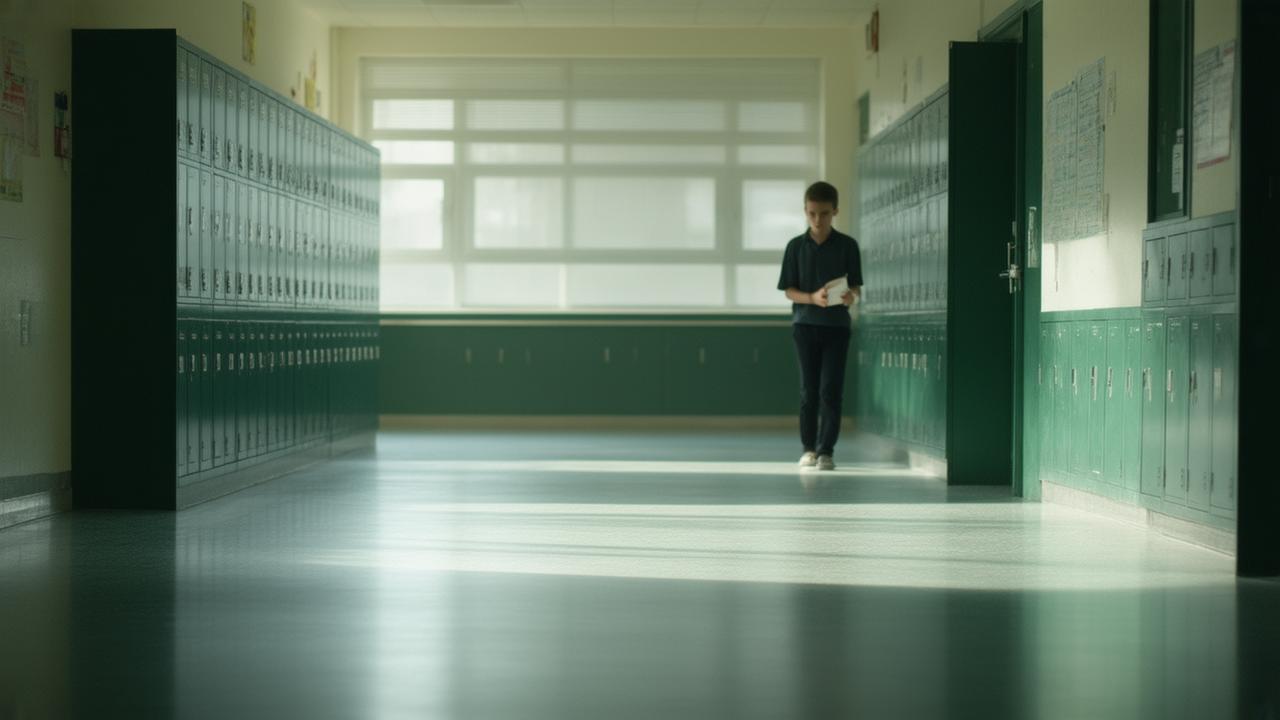
The bell rings the way it always has—shrill, insistent, the start of another school day—but in the narrow hallway leading to the counselling office, the air feels different. It’s not just the usual hum of gossip and laughter; it’s heavier, as if the walls have been quietly absorbing every whispered panic, every swallowed sob. Backpacks bump against one another, sneakers squeak against the linoleum, and somewhere down the corridor a locker slams shut with a hollow metallic echo. Outside, beyond the glass doors, the morning light is soft on the oval and the gum trees sway, but in here the atmosphere pulses with a quieter, invisible storm.
On a corkboard near the office door—a clutter of posters about resilience, mindfulness, self-care—someone has pinned a handwritten note: “It’s okay to ask for help.” The words tilt slightly on the page, blue ink pressing hard into the paper, as if whoever wrote them was trying to push comfort into existence. And every day, more teenagers file into this room, clutching hall passes like tiny, official permission slips to fall apart.
The New Queue Outside the Counsellor’s Door
The queue begins before the first class. A boy in a grey hoodie stares at his shoes, shoulders curved inwards. A girl with mascara smudged under her eyes scrolls on her phone, not really seeing anything. Two friends lean on opposite walls, speaking in low, brittle voices. They are here, all of them, for the same quiet reason: something inside hurts more than they know how to handle alone.
School counsellors across cities, suburbs, and small towns are talking about this new normal in almost the same language: “We are seeing more students, and they’re coming in with heavier stuff.” Anxiety that claws like a wild animal. Depression that settles behind the eyes, dulling everything. Suicidal thoughts whispered into small offices where blinds are half-drawn, not to hide the students, but to soften the light.
It isn’t that teenagers suddenly discovered sadness. What’s new is the density of it, the way it piles up. A counsellor from a coastal high school describes how her appointment book used to have open spaces, gaps where she could tidy notes, sip tea, take a breath. Now, every line is filled. Students are double-booked, squeezed into recess, lunch, any sliver of time that can be carved out of the day. She keeps a waiting list that makes her stomach twist.
Invisible Backpacks: What Teens Are Carrying
Watch students walking through a courtyard and you see their physical backpacks: the faded canvas, the dangling keyrings, the notebooks and crushed snack wrappers. But there’s another bag, the invisible one. It hunches their shoulders and drags at their steps, packed tight with things you can’t see on a roll call sheet.
Some of that load is digital. Night-time is no longer quiet; it pulses with notifications. Group chats explode in the small hours with drama, arguments, performative happiness, the subtle pressure to keep up, keep replying, keep existing in a space where you can be judged minute by minute. Counsellors describe students who sleep with their phones under their pillows “just in case” someone needs them, or just in case they miss something and become the next in-joke.
Others carry responsibilities far beyond their years: translating for parents, working jobs to help with bills, caring for siblings, navigating family illness or conflict. Then there is academic pressure, that constant drumbeat of expectation: be exceptional, be ready, be more. The world they are growing into feels uncertain—climate anxiety, cost of living, unrest streaming straight into their hands via news feeds—and yet the demand remains: decide your future, get good grades, make it work.
Inside the counselling office, these threads tangle together into a language of headaches, stomach aches, tears in bathrooms, students who stop turning in homework not because they don’t care, but because their minds have become fogged with exhaustion. And behind the numbers and trends are individual moments: a hand twisting a sleeve; a long silence before a confession; a cracked voice saying, “I don’t know what’s wrong with me, I just feel…done.”
What Counsellors Are Actually Seeing
Every school is different, but when counsellors talk, patterns rise like tide lines. There are more crisis sessions—those sudden, urgent conversations that must happen right now because a student is at risk of self-harm. There are more safety plans, carefully written agreements that map out who to call, where to go, what to do when the dark thoughts come. There’s a sharper edge to the stress, a sense that the baseline has shifted.
To make sense of this shifting landscape, some counsellors collect simple, anonymous snapshots of what they’re seeing. Numbers can’t hold the whole story, but they can sketch the rough outline.
| Observation from Counsellors | “Before” (Approx. 5 years ago) | “Now” (Recent School Years) |
|---|---|---|
| Average number of students seen per day | 4–6 students | 10–15 students |
| Students presenting with moderate–severe anxiety | Occasional, often exam-related | Daily, across all year levels |
| Crisis or safety-plan sessions | Rare, a few times a term | Regular, several times a week |
| Time left for proactive wellbeing work | Frequent classroom workshops, group programs | Often crowded out by urgent one-on-one sessions |
| Common student concerns | Friendship issues, study stress, family changes | Anxiety, depression, self-harm thoughts, identity stress, online bullying |
The table is not a research study; it’s a chorus of impressions from the people sitting face-to-face with teenagers every day. They describe the same ache: a sense of always catching water with cupped hands while the stream rushes faster.
Many counsellors talk about compassion fatigue—the way their own emotional batteries sometimes flicker under the constant stories of pain. They are trained, resourceful, deeply committed, but they are also human. Behind their calm nods and carefully chosen words there are moments, later at night, when a student’s sentence echoes back at them: “If I disappeared, I wonder if anyone would notice.”
Listening Between the Lines
Spend some time in a school and you’ll notice how much happens between the lines. The student “just running late” every morning whose stomach knots before they leave home. The high achiever who looks perfect on paper but clutches their pen so tightly their fingers hurt. The class clown who keeps everyone laughing because silence would mean hearing their own thoughts.
School counsellors are trained to listen beneath the words. A shrug that comes too quickly. A joke about “being dead inside” that doesn’t land as a joke. The way someone describes their exhaustion not as tiredness but as emptiness, like they’ve stepped outside themselves. These subtle signs matter, because teenagers rarely walk in and announce, “I am struggling with my mental health.” More often, they say, “I’m just really stressed,” or, “I don’t feel like myself lately.”
Parents, teachers, even friends can learn to notice these quieter signals too. When the door to the counsellor’s room is always busy, the school becomes part of the front line of mental health support, whether it was ready or not. And in that busy, bustling environment, small acts of attention carry a surprising weight: a tutor checking in privately, a teacher adjusting a deadline, a friend saying, “Hey, I’ve noticed you’ve been quieter. Want to talk?”
This is not about turning every conversation into a therapy session. It’s about cultivating what counsellors call “psychological safety”—the feeling that if you confess you’re not okay, the world around you won’t fracture or look away. Teenagers are exquisitely sensitive to judgment; they read micro-expressions like weather. When adults flinch at vulnerability, or dismiss it with “You’ll be fine,” the message is loud: keep your storms to yourself.
Small Human Interventions in a Big System
The problems feel huge—global, structural, far beyond the four walls of a classroom—and yet change often begins in the smallest human interventions. A quiet corner in the library where students know they can breathe. A wellbeing lesson that doesn’t just talk about “resilience” in abstract terms but shows how to name a feeling without shaming it. A principal deciding that mental health is not an add-on but a core part of what education means in this era.
Many schools are experimenting: student-led wellbeing committees, peer support programs, mindfulness clubs, therapy dogs padding down the hall with soft eyes and wagging tails. These are not cures, but they are signals—declarations that emotional pain is not an inconvenience to be brushed aside but a reality to be held with care.
➡️ Australia’s space industry is quietly expanding beyond satellites into deep tech exports
➡️ Emergency wards are reporting a sharper spike in dehydration cases during prolonged heatwaves
➡️ Bushfire smoke is turning air quality monitors into everyday household essentials
➡️ How Australian parents are navigating a new era of digital childhood boundaries
➡️ East coast councils are rewriting heat plans as pavement temperatures climb year after year
➡️ Ancient rock shelters in the Kimberley are forcing new debates about heritage enforcement
➡️ Seawall upgrades are accelerating as coastal communities brace for stronger storm surges
Counsellors, too, are learning to stretch the support web outward. They collaborate with local health services, brief teachers on warning signs, encourage parents to take that first, sometimes frightening step of booking an outside psychologist. When the queue outside the door is too long, they look for ways to help entire cohorts at once: workshops on managing social media, strategies for exam stress, honest conversations about depression where the word itself is spoken, not tiptoed around.
None of this erases the hard days. There will still be mornings when a student sits in the plastic chair opposite the counsellor’s desk and stares at a spot on the carpet because making eye contact feels like too much. But wrapped around that moment, there can be a culture that says: you are not a problem to be solved; you are a person to be accompanied.
Reimagining What It Means to “Be Okay”
The phrase “mental health crisis” floats across headlines and staff meetings, but inside the daily texture of a school it translates into something more intimate. It is a teenager walking slowly toward a door with a glass panel, wondering if stepping through it will change how people see them. It is a counsellor pausing with their hand on the doorknob at 8:29 a.m., knowing that once they open it, the day will be full of other people’s storms.
Perhaps part of the shift we’re seeing is not just more distress, but more willingness to name it. There is still stigma, still silence, but there is also a growing number of students who say, “I think I need help,” earlier than they might have a decade ago. That is both a sign of strain and a thin, bright line of hope.
Reimagining what it means to “be okay” might look like this: not a constant state of calm, but the knowledge that when you’re not okay, you’re not alone. That there are adults who will listen without flinching, peers who will stay, systems that won’t punish vulnerability with labels or exclusion. For school counsellors, this is the quiet mission under all the paperwork and phone calls and stacked appointments: to help build a world where their office is not the last thin barrier against collapse, but one small, steady part of a much wider net.
Walk back down the hallway at the end of the day. The queue is gone, the posters on the corkboard curl slightly at the corners, and the note that says “It’s okay to ask for help” still tilts on its pin. Somewhere, a student is walking home, feeling a little lighter because they finally said something out loud in that small room with the soft chairs and the ticking clock. The larger forces haven’t changed overnight. The digital world still hums, expectations still press, the future is still uncertain. But a conversation happened. A story was heard. And in a time when the mental health load on teenagers is heavier than ever, those small, honest exchanges might just be where something begins to shift.
Frequently Asked Questions
Why are school counsellors seeing a heavier mental health load now?
Counsellors report a mix of factors: increased academic pressure, constant online connection, social media comparison, family stress, and global uncertainty. These elements stack together, leaving many teenagers feeling overwhelmed, anxious, and exhausted in ways that are more intense and more frequent than in previous years.
Does this mean more teenagers are “broken” than before?
No. It means more teenagers are struggling in a demanding environment and more are willing to speak up about it. The load is heavier, but so is awareness. Teens today are navigating challenges previous generations didn’t face at the same scale, especially around technology and information overload.
How can parents support teenagers who are under this kind of stress?
Parents can start by listening without rushing to fix or minimise. Regular, calm check-ins, predictable routines, and genuine curiosity about their teen’s world help build trust. If a young person seems persistently low, anxious, or withdrawn, reaching out to the school counsellor or a health professional for guidance is an important step.
What can schools do beyond offering counselling?
Schools can weave wellbeing into everyday life: training staff to recognise warning signs, creating safe spaces, teaching emotional literacy, adjusting unrealistic workloads, and encouraging peer support. When mental health becomes part of the culture, not just the counsellor’s job, students feel safer to seek help early.
How can students help their friends who are struggling?
Students don’t need to become therapists. They can listen, stay kind, and gently encourage friends to talk to a trusted adult or the school counsellor. If they ever worry a friend might hurt themselves, it’s important not to keep that a secret—telling a responsible adult can be a life-saving act of courage and care.





