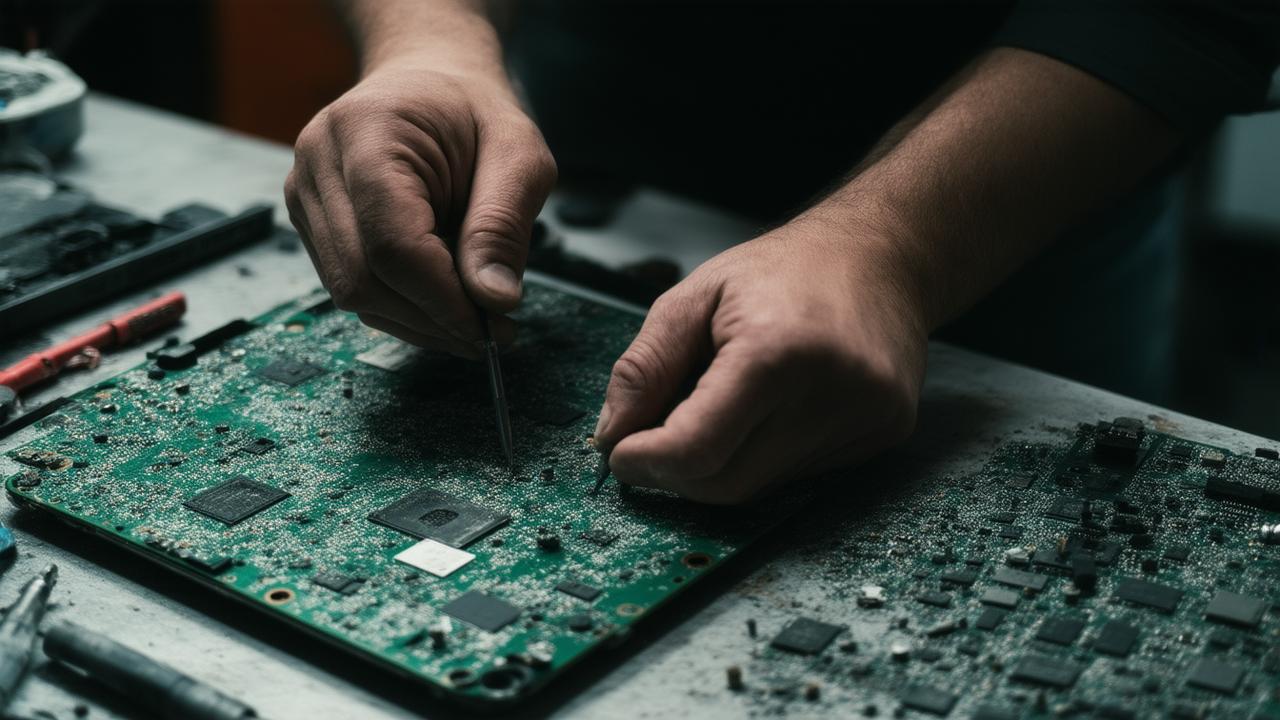
The broken radio arrived wrapped in an old dish towel, as if it were something fragile and alive. It wasn’t, of course—it was a scratched plastic box the color of wet cardboard, its antenna bent like a question mark. But the way its owner cradled it through the door of the community hall made it feel like a rescue mission. Coffee was already brewing. A low murmur of conversation mixed with the faint buzz of fluorescent lights and the soft clink of screwdrivers in porcelain bowls. It was Saturday morning at the repair café, and nothing here was meant to be thrown away.
The Quiet Rebellion in a School Gym
The room smells faintly of solder, sawdust, and instant coffee—an oddly comforting blend that feels part workshop, part church hall, and part neighborhood living room. Folding tables form loose islands around the room, each one a small stage for a different kind of brokenness: lamps whose cords have frayed, laptops that refuse to wake up, vacuum cleaners that scream instead of hum, toasters stuck in an eternal half-toast purgatory.
At one table, a teenager in a faded band T-shirt is peering into the guts of a blender with the same intensity some kids reserve for game screens. Across from him sits an older man in a cardigan, fingers hovering anxiously near the power button. Between them: screws the size of freckles, a faded user manual, and a tangle of wires that looks, at first glance, beyond redemption.
“We’ll figure it out,” the teen says, voice calm, almost casual. “Let’s start by opening it. Have you ever seen the inside of one of these?”
The older man shakes his head, already leaning in. In that moment, the blender isn’t just an appliance; it’s a story, and they’re reading it together for the first time.
This is how the pushback against disposable culture often looks—not like protest marches or viral campaigns, but like a borrowed screwdriver, a shared laugh, and a small, stubborn belief that broken does not have to mean done.
Inside the Culture of “Throw It Away”
Most of us can feel it in our homes, even if we don’t name it: a quiet avalanche of stuff. Drawers jammed with old chargers, earbuds with one dead side, phones that still light up but can’t hold a day’s worth of charge, printers that blink mysterious error codes as if speaking in tongues. We live with these objects long enough to form habits around them—and then, one day, they simply stop.
The modern script is simple: replace, upgrade, move on. Devices are built thin, shiny, and sealed shut with proprietary screws. Battery glued, screen fused, warranty void if opened. On the outside, the promise of sleek progress; on the inside, an architecture of planned obsolescence.
The result? Mountains of “e-waste” that don’t vanish when the garbage truck pulls away. They leach into soil and riverbeds, smolder in open dumps, or get stripped for valuable metals in hazardous working conditions half a world away. But for many households, the damage feels closer and more intimate: the sense that we no longer have any real relationship with the things we own.
Once, a radio with a loose connection meant a trip to the local repair shop, where someone in a blue apron knew how to coax it back to life. Those places still exist, but they’re fewer, pushed aside by a market that finds it more profitable to sell us new devices than to fix the ones we already have.
Repair cafés began as a gentle refusal of this script. No slogans, no shouting. Just lots of small, ordinary questions: What if we tried to fix it? What if we learned how? What if we did that together?
The Table Where Waste Turns Into Stories
Walk through a repair café and you start to notice something: people don’t just bring objects; they bring memories. A lamp that belonged to a grandmother. A sewing machine that stitched school uniforms and wedding dresses. A Bluetooth speaker that survived three moves and one breakup, until its power port snapped.
The volunteers—often retirees, hobbyists, engineers, tinkerers, and the simply curious—don’t just reach for tools. They ask questions. How long have you had it? What happened when it stopped working? Any idea what might be wrong?
There’s a pause, a shift. The owner stops being a “consumer” and becomes a co-investigator in the fate of their belongings. Fingers trace plastic seams, batteries are tested, lids are pried open. When a device finally yields to a careful twist of the screwdriver, there’s often a gasp. Wires, boards, circuits, gears—a whole inner world revealed.
“So that’s what’s inside!” someone will say, half embarrassed, half delighted. We’ve been living alongside small, sealed mysteries for decades. Now, in rooms like these, those mysteries are being politely, patiently undone.
Where Community and Circuit Boards Meet
These cafés, despite the name, aren’t businesses at all. They’re volunteer-run gatherings, usually non-profit, often held in borrowed spaces: school gyms, church basements, community centers, libraries. There is usually coffee and, if you’re lucky, a plate of homemade cookies near the check-in table. You put your name and your broken item on a list, and you wait until a volunteer with the right skills is free.
Some people bring one item and leave as soon as it’s done. Others stay for hours, drifting from table to table, drawn by the low-level magic of transformation. A lifeless lamp flickers back, and the table next to it breaks into applause. A child watches, wide-eyed, as the vacuum cleaner that has always been a sealed, humming beast becomes an explodable lesson in airflow and filters.
What’s happening here isn’t just repair; it’s a subtle rewiring of relationships—between people, and between people and their possessions. Repair cafés are places where the hierarchy of “expert” and “user” blurs. Volunteers don’t just fix; they teach. Owners don’t just wait; they learn.
At one table, a woman in her thirties holds a stubborn toaster. “I always thought I was just bad with appliances,” she jokes, watching as a volunteer shows her how to open the casing safely and clean out a wad of crumbs that could have started a fire. “Turns out it’s just… full of yesterday’s bread.” They laugh, but the lesson hangs there: it wasn’t magic, just knowledge she’d never been offered before.
A Movement Measured in Small Victories
Repair cafés rarely shout their statistics, but the impact is easier to see when you zoom in. Consider a single monthly gathering in a mid-sized town. Over a few hours, dozens of objects pass through the room: lamps, radios, phones, toys, headphones, mixers, small heaters. Some can’t be saved. Many can.
Imagine a year in the life of such a café, and then imagine hundreds of similar gatherings multiplying in cities and villages around the world. The total number of items saved from landfills climbs into the tens of thousands, then hundreds of thousands. Each one is a small victory—material saved, carbon footprints reduced, money kept in pockets, memories preserved.
But the real shift is cultural. People leave these spaces carrying not just a working device, but a new sense of competence. The idea that electronics are inscrutable, delicate black boxes begins to crack. A generation raised on “do not open” stickers is starting to ignore them.
| What You Bring | What Often Happens | What You Take Home |
|---|---|---|
| A broken device and some quiet frustration | A guided exploration of what’s inside | A repaired item—or at least real understanding |
| Your morning’s worth of time | Conversation, coffee, shared problem-solving | New connections in your local community |
| A sense that “I’m not techy” | Patient explanations, hands-on learning | More confidence to open and fix things yourself |
Right to Repair: From Cafés to Courtrooms
While soldering irons warm up on folding tables, another form of resistance is happening in quieter, more formal spaces: legal debates over the “right to repair.” Behind many of our sleek devices lie design choices that deliberately limit repair. Special screws require special tools. Software locks block third-party parts. Replacement pieces cost nearly as much as a new device.
Advocates argue that if you own something, you should be allowed—and enabled—to fix it. That means access to spare parts, repair manuals, and diagnostic software. Some regions have begun to pass right-to-repair laws, nudging manufacturers toward more open and repairable designs. Others are watching closely, testing language, counting votes.
Repair cafés sit at the human end of this legal machinery. They transform abstract rights into lived experiences. When a volunteer has to improvise a fix because a crucial part or manual is locked away by a manufacturer, it becomes a tangible story to tell policymakers. When a family saves hundreds of dollars by repairing instead of replacing, the numbers behind right-to-repair arguments gain faces and names.
➡️ Australia’s space industry is quietly expanding beyond satellites into deep tech exports
➡️ Emergency wards are reporting a sharper spike in dehydration cases during prolonged heatwaves
➡️ Bushfire smoke is turning air quality monitors into everyday household essentials
➡️ How Australian parents are navigating a new era of digital childhood boundaries
➡️ East coast councils are rewriting heat plans as pavement temperatures climb year after year
➡️ Ancient rock shelters in the Kimberley are forcing new debates about heritage enforcement
➡️ Seawall upgrades are accelerating as coastal communities brace for stronger storm surges
And when a twelve-year-old replaces a cracked smartphone screen for the first time at a community table, the future audience for “sealed, disposable everything” quietly shrinks.
Learning to Listen to Our Stuff Again
In a world of constant notifications and rapid upgrades, a broken device can feel like a personal failure, a small shame we hide in drawers and closets. Repair cafés invite us to treat those fractures differently—not as endings, but as openings.
They ask simple, radical questions: What if our things broke down and, instead of being embarrassed or annoyed, we got curious? What if malfunction became an invitation to learn, rather than a reason to shop? What if repair was not a niche hobby, but a normal, almost expected part of everyday life?
There’s a strange intimacy in handling your broken belongings with care, in laying them gently on a table among strangers and saying, “Can you help me understand this?” It’s an act of humility and also of trust—in people, in process, in the idea that not everything has to be tossed the moment it stumbles.
How to Step Into the Repair Café World
If you’ve never set foot in a repair café, the idea might feel intimidating—like you need to bring at least a basic grasp of electronics, or a toolbox of your own. You don’t. You can arrive with nothing more than your broken thing and your curiosity.
Expect to wait a bit. Expect to be asked to participate, even in small ways: holding a flashlight, turning a screwdriver, pressing a button at just the right time. Expect the occasional honest “We can’t fix this,” too. Not every story gets a happy ending.
But also expect small, vivid moments: the hush when a screen flickers back to life; the collective groan when a hidden clip snaps; the shared delight when a stubborn radio finally crackles with sound. Some people come alone. Others bring children or friends, turning repair into a subtle kind of family ritual.
You might leave with a renewed toaster or a verdict that your aging laptop has truly reached its end. Either way, you’ll likely carry home a different way of seeing your possessions. You’ll have watched strangers transform frustration into learning, and waste into possibility. And you might find yourself, next time something breaks, reaching not first for your wallet—but for a screwdriver.
FAQs About Repair Cafés and Repair Culture
What exactly is a repair café?
A repair café is a volunteer-run, community event where people bring broken household items—like electronics, small appliances, clothing, and toys—and work alongside skilled volunteers to try to repair them. The focus is on learning, sharing knowledge, and reducing waste rather than making a profit.
Do I have to pay to use a repair café?
Most repair cafés are free to attend, though many accept donations to cover costs like tools, parts, and space rental. Some may suggest a small voluntary contribution, but participation is usually not conditional on payment.
What kinds of items can I bring?
Each repair café may focus on slightly different things, but commonly accepted items include small electronics (radios, phones, laptops), kitchen appliances (toasters, kettles, blenders), lamps, toys, and sometimes clothing or textiles. Larger items like refrigerators or washing machines are usually not accepted due to space and safety reasons.
Will my item definitely be fixed?
No, there is never a guarantee. Volunteers do their best within time, safety, and parts constraints, but some items are too damaged, poorly designed for repair, or missing components. Even when something can’t be fixed, you usually leave with a clearer understanding of why it failed and what your options are.
Do I need technical skills to participate?
No prior skills are required. In fact, many people come specifically to learn. Volunteers guide you through the process at a level that matches your comfort. Over time, frequent visitors often pick up enough knowledge to attempt simple repairs on their own.
Is it safe to open up electronics in a community setting?
Safety is a priority in repair cafés. Volunteers are generally experienced with basic safety practices, and many cafés have guidelines to ensure dangerous items or repairs are handled carefully or refused if too risky. You’ll usually work with power disconnected and use appropriate tools and precautions.
How are repair cafés connected to the right-to-repair movement?
Repair cafés put right-to-repair ideas into everyday practice. They highlight how design choices and restricted access to parts or manuals can make repair difficult, and they provide real-world examples that support policy changes. Both aim to make repair normal, accessible, and legally protected.





