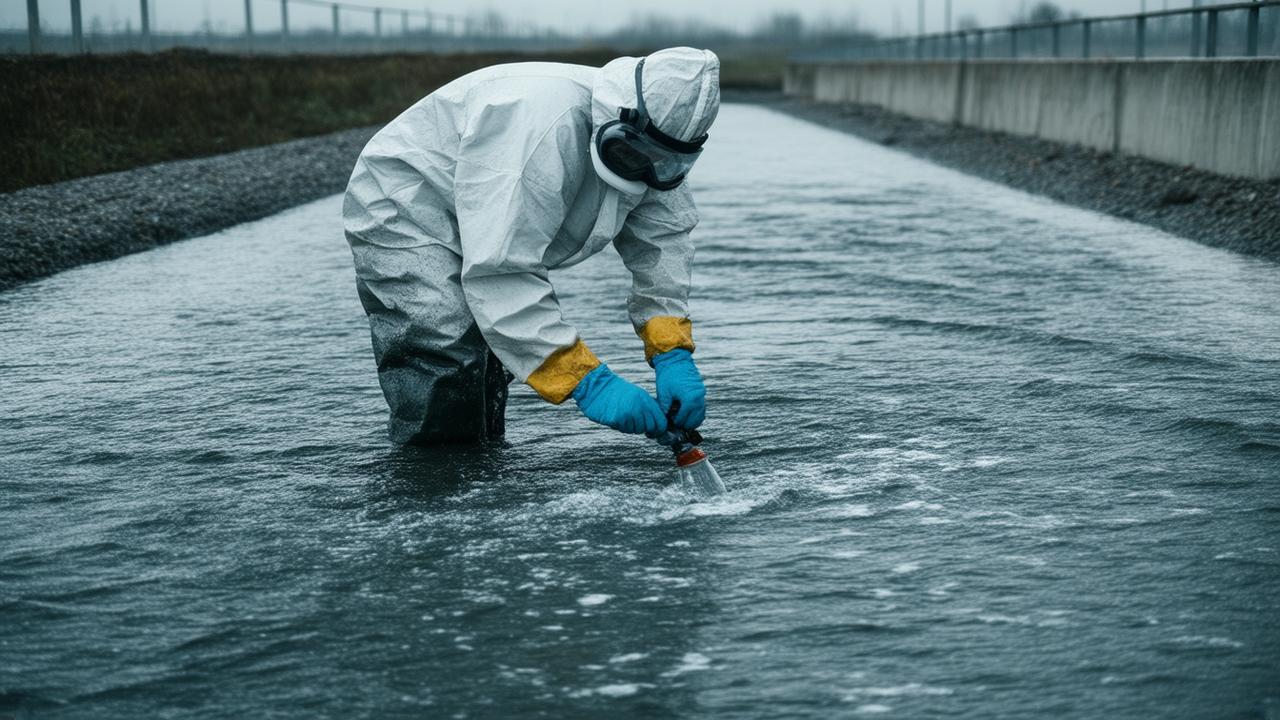
The first thing you notice is the smell. Not the sour stench you might expect from the place where a city’s secrets are rinsed away, but something oddly neutral—metallic, damp, a little like a wet basement after a rain. Below the grated walkway, a slow, brown-green river swirls through concrete channels. This is the bloodstream of the city, and today, someone is taking its pulse.
The Hidden Story Flowing Under Our Feet
On an overcast morning, a researcher in a yellow rain jacket leans over a metal railing at a wastewater treatment plant, a long sampling bottle dangling from a pole. Trucks rumble in the distance, birds ride the air currents above, and the steady churn of pumps provides a low industrial heartbeat. It looks mundane, almost boring. But inside that plastic bottle, a quiet revolution in public health surveillance is unfolding.
For years, scientists dipped into wastewater to track viruses like polio and, more recently, COVID-19. But now another, more subtle threat is swirling beneath our feet: antibiotic resistance. Inside this murky flow are fragments of bacterial DNA that tell a story of survival, adaptation, and our own overuse of life-saving medicines. And lately, that story is getting louder.
Researchers around the world are detecting stronger, clearer signals of antibiotic resistance in wastewater—signals that suggest resistant bacteria and resistance genes are not only more common, but also more diverse, than they were even a decade ago. It’s as if the microbial world has turned up the volume, and the pipes are echoing with their defiance.
The River of Everything We Flush Away
Walk along the edge of a treatment basin and you can literally smell the complexity of human life—kitchen sink grease clinging to detergent foam, faint traces of perfume, the sour tang of decomposing food, the earthy note of soil washed from boots and tires. Everything we use, touch, swallow, rub on our skin, or rinse down a drain eventually finds its way here.
In that mix is an invisible cloud of antibiotics: from pills taken for ear infections and urinary tract infections, to powerful drugs used after surgery, to the steady, less-visible stream coming from clinics, hospitals, and even livestock operations upstream. Not all of those medicines are fully metabolized by the body. Some pass through us still active, ready to meet the teeming communities of bacteria thriving in this nutrient-rich broth.
You can think of wastewater as an enormous, swirling experiment set up entirely by accident. Millions of bacteria, a constant flow of low-level antibiotics, and the chaotic mixing of microbes from homes, hospitals, farms, and industry. Under this steady pressure, any microbe with a mutation or borrowed gene that helps it survive gains an edge. Over time, those survivors—and the resistance genes they carry—accumulate, mingle, and spread.
Listening to the Microbial Signals
In a quiet, fluorescent-lit lab several miles from the treatment plant, those murky samples turn into data. Technicians filter the water, concentrate the microbes, and then crack their cells open to get at their DNA and RNA. The air smells faintly of alcohol, plastic, and warmed electronics. Computers hum. The real action happens invisibly, inside vials no bigger than a thumb.
Once, detecting antibiotic resistance meant growing bacteria in petri dishes, exposing them to different antibiotics, and seeing which survived. That still happens, and it’s incredibly useful. But it’s slow and limited to the bacteria you can coax into growing. The new era belongs to genetic tools—methods that read the instructions etched into microbial DNA.
Now, researchers use targeted molecular tests to scan for known resistance genes—like those that let bacteria shrug off penicillins, cephalosporins, or last-resort drugs like carbapenems. Others rely on high-throughput sequencing, essentially reading massive swaths of all the genetic material in the sample at once. It’s less like listening to a few soloists and more like recording the entire orchestra, background hum and all.
Those techniques have revealed an unsettling pattern: resistance markers are not just present, they are intensifying. Stronger signals. More types. Wider spread. It’s as if the DNA of resistance has woven itself into the very fabric of the city’s wastewater, a faint but persistent watermark of our medical habits.
| Antibiotic Class | Common Use | Typical Resistance Genes Found in Wastewater |
|---|---|---|
| Penicillins | Ear, throat, skin infections | blaTEM, blaSHV |
| Cephalosporins | Pneumonia, urinary infections | ESBL genes (extended-spectrum beta-lactamases) |
| Carbapenems | Severe, hospital-acquired infections | blaKPC, blaNDM, blaOXA |
| Fluoroquinolones | Respiratory and gastrointestinal infections | qnr genes, mutations in gyrA and parC |
| Macrolides | Bronchitis, sinusitis, some STIs | erm, mef genes |
Wastewater as a Global Early-Warning System
What’s emerging from these labs is not just a grim statistic, but a powerful new kind of map. Each treatment plant, sewer outfall, or sampling station becomes a data point. Over time, researchers can trace how resistance shifts through seasons, how it responds to outbreaks, or how it flares near hospitals and industrial zones.
From a public health perspective, this is gold. Instead of waiting for people to show up at clinics sick with hard-to-treat infections, you can glimpse the threat weeks or months earlier in the city’s wastewater. You start to see patterns: Perhaps a spike in resistance to a widely prescribed antibiotic after flu season, when secondary infections lead to a rush of prescriptions. Or a slow but steady rise in genes linked to last-resort drugs, hinting at overuse in intensive care wards.
Wastewater doesn’t lie. It can’t forget, or downplay symptoms, or decide not to see a doctor. It samples everyone, silently and without judgment—the insured and uninsured, the cautious and the reckless, the young and the old. In a world where health data is often fragmented, biased, or delayed, that universality is powerful.
And increasingly, that universality is being recognized. Cities and regions are building networks of sampling sites. International collaborations are sharing methods and data. In some places, wastewater readings of resistance genes are being layered onto maps of hospital infections and prescription patterns to build a fuller, more dynamic picture of how antibiotic resistance really moves through the world.
Where the Wild Bacteria Meet the Human World
Antibiotic resistance is often portrayed as something that happens inside hospitals: white coats, harsh disinfectant smells, patients hooked to IV lines. But wastewater reminds us that the story is much bigger and spills well beyond clinical walls.
Downstream of treatment plants, resistant bacteria and their genes can slip into rivers, estuaries, and coastal zones. Some are filtered out or inactivated by treatment processes, sunlight, and time. Others linger, hitching rides on tiny particles or joining microbial communities in sediments. Eventually, some of that water may be reused to irrigate crops, recharge groundwater, or support urban wetlands.
In that mingling, the boundaries blur between environmental microbiomes and human ones. Wild bacteria—those that live in soils, sediments, and waterways—can pick up resistance genes from human-derived microbes. Later, some of those environmental bacteria may find their way back to us through food, recreational waters, or close contact with animals. The genes move even when the bacteria themselves do not, shuttled on mobile genetic elements like plasmids that act like microscopic USB drives, plugging new capabilities into whichever microbe happens to receive them.
Standing beside a slow, sunlit river downstream from a city, it’s hard to imagine that invisible threads link this tranquil scene to a humming hospital ward or a bustling subway station. But the genetics of resistance do not respect our categories. They flow where the water flows, and they thrive wherever we give them opportunity—through unnecessary prescriptions, incomplete courses of antibiotics, and heavy use of drugs in agriculture.
What Stronger Signals Really Mean for Us
It might be tempting to think that stronger signals of antibiotic resistance in wastewater are only a problem for scientists and policymakers, something vaguely worrying but comfortably abstract. Yet those signals are really messages about our own habits, reflected back to us in the language of microbial evolution.
➡️ East coast councils are rewriting heat plans as pavement temperatures climb year after year
➡️ Ancient rock shelters in the Kimberley are forcing new debates about heritage enforcement
➡️ Seawall upgrades are accelerating as coastal communities brace for stronger storm surges
➡️ Small coral recovery zones are giving reef scientists a rare moment of cautious optimism
➡️ Coffee roasters are quietly adjusting blends as climate shocks disrupt bean supply lines
➡️ Public health campaigns are shifting tone as vaccine confidence becomes more uneven
➡️ Loneliness is being treated less as a feeling and more as a measurable health threat
Each spike in resistance genes is a shadow of decisions made in exam rooms, veterinary clinics, and feedlots. It’s the trace of a prescription given “just in case” for a viral infection that antibiotics cannot cure; the livestock raised with routine antibiotic use to prevent disease in crowded conditions; the forgotten half-finished pack of pills left in a bathroom cabinet and eventually flushed.
At the same time, those signals are not all doom. They are also opportunity. Because they are early, because they are broad, they give us a chance to act before the worst-case scenarios—before routine surgeries become high-risk affairs, before simple cuts once again carry mortal danger. Wastewater data can guide smarter stewardship: which drugs to reserve, where to focus infection control, when to adjust guidelines before resistance spills over into widespread clinical failure.
And crucially, wastewater doesn’t just measure our failures; it can measure our progress. If a city tightens antibiotic stewardship programs, or a hospital changes prescribing practices, or a region reforms agricultural antibiotic use, researchers can look for the echo of those changes in the sewers. Does the signal grow quieter? Does the diversity of resistance genes shrink? In a future where we’re serious about preserving antibiotics, that feedback loop will be priceless.
A New Way of Seeing the City
As the researcher in the yellow rain jacket pulls up the sampling bottle, droplets fall back into the churning flow, tiny comets vanishing on impact. The bottle, now cloudy and faintly odorous, is sealed, labeled, and carried off—a small, plastic time capsule of everything a community has excreted and rinsed away in the last few hours.
Once you know what’s in that bottle, it becomes impossible to see a city’s drains, gutters, and treatment plants as mere infrastructure. They are sensory organs, tuned not to sound or light, but to the swirling chemistry and biology of urban life. Through them, we glimpse not just what people eat or which viruses are circulating, but how our most powerful medicines are shaping the unseen worlds that live with us and within us.
Detecting stronger signals of antibiotic resistance in wastewater is a warning, yes—but it is also a kind of invitation. An invitation to pay attention to what we usually ignore. To follow the quiet paths that connect our bathrooms to our rivers, our hospitals to our harbors, our personal choices to planetary consequences.
Down in the concrete channels, the water continues its slow, determined journey, past filters and aerators, through clarifiers and outfalls. Above ground, trucks still rumble, birds still circle, life goes on. Yet those invisible strands of DNA keep telling their story in tiny, repeated fragments. For the first time, we are learning to listen carefully enough to understand what they are saying—and to decide what we’ll do next.
Frequently Asked Questions
Why are scientists sampling wastewater for antibiotic resistance?
Wastewater captures microbial material from entire communities, including bacteria shed from humans, animals, hospitals, and industry. By analyzing this mixed sample, scientists can monitor how common and diverse antibiotic resistance genes are, without needing to test individual patients. It provides a broad, early snapshot of resistance trends.
Does stronger resistance in wastewater mean infections are getting worse?
Not always directly, but it is a warning sign. Higher levels of resistance genes in wastewater suggest that resistant bacteria are more widespread in the community. This can correlate with increasing difficulty in treating some infections, especially if the same resistance patterns are seen in hospitals and clinics.
Can wastewater treatment remove antibiotic-resistant bacteria?
Modern treatment plants reduce the number of bacteria overall and can decrease some resistance signals, but they rarely eliminate them completely. Some resistant bacteria and free-floating resistance genes can survive treatment and enter natural waterways, where they may interact with environmental microbes.
Is it safe to live near a wastewater plant if resistance is present there?
Living near a treatment plant is generally considered safe when facilities are properly managed and regulated. Most risks are controlled through engineering, disinfection, and environmental regulations. The main concern with resistance in wastewater is at the larger scale—how these genes move through ecosystems and back into human and animal populations over time.
What can individuals do to help reduce antibiotic resistance?
Use antibiotics only when prescribed and necessary, follow the full course exactly as directed, never share leftover antibiotics, and avoid pressuring doctors for antibiotics for viral illnesses like colds or flu. Properly disposing of unused medications through take-back programs, rather than flushing them, also helps reduce the drug load entering wastewater.





