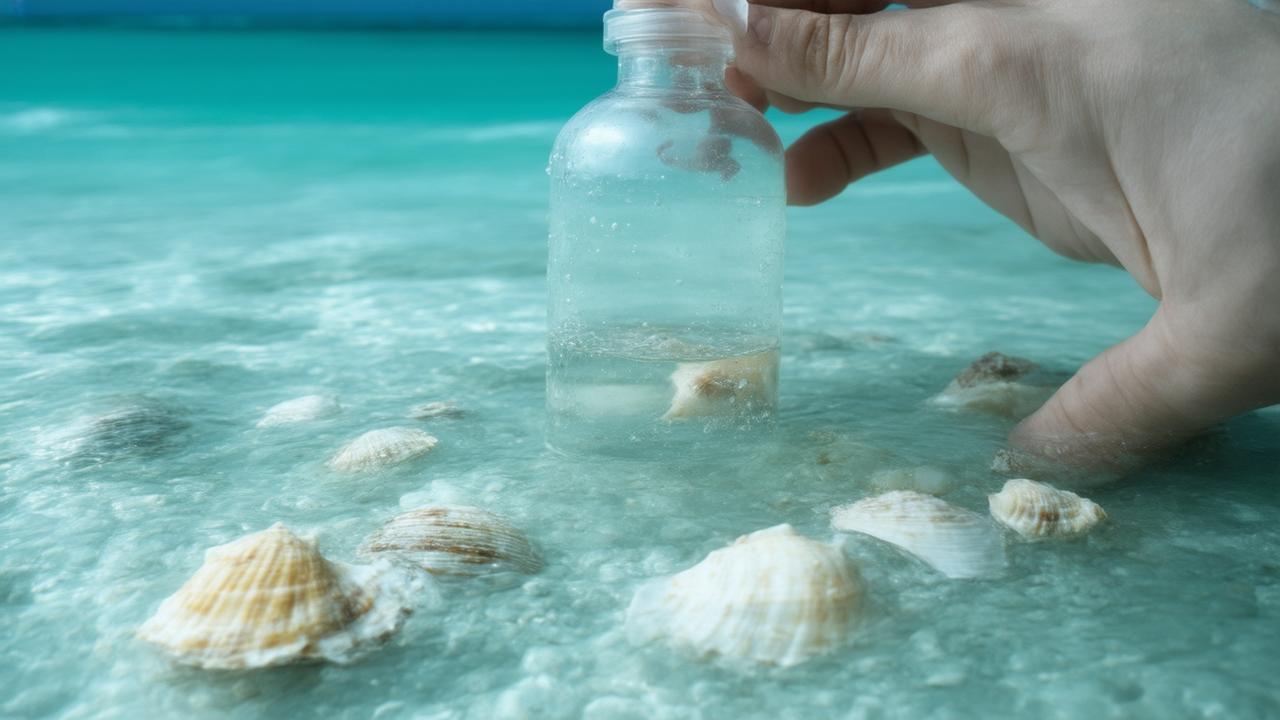
The first thing you notice is the silence. Not the human kind—no traffic, no phones—but the underwater hush that comes when you submerge just beyond the crashing surf. Your body cools, your ears fill, and the world becomes a muted watercolor of blues and greens. A school of silver fish pivots in one smooth gesture; a sea star clings patiently to a rock. Everything seems timeless, enduring. But the water itself is telling a different story—one of change that is happening faster than our senses can perceive.
Listening to the Ocean’s Hidden Chemistry
If you could hold a cup of seawater close to your ear the way you might a seashell, you’d hear more than the echo of the waves. You’d hear the soft tick of chemistry at work: carbon dioxide dissolving, molecules rearranging, pH sliding ever so slightly downwards. For years, scientists have been tracking those tiny shifts, bottle by bottle, buoy by buoy, sensor by sensor. And now the data are starting to speak in a single clear voice.
Across coral reefs, kelp forests, polar shelves, and coastal estuaries, ocean chemistry data show a pattern that’s hard to ignore: acidification is advancing faster than researchers once predicted, especially in habitats that are already stretched thin. The ocean, that great blue buffer of our climate, has quietly absorbed about a quarter to a third of the carbon dioxide we emit. That kindness has a cost. When CO₂ meets seawater, it forms carbonic acid, which nudges the ocean toward the acidic side of the scale—small numerical changes with huge biological consequences.
To a chemist, this might look like a subtle downward line on a graph. To a mollusk larva trying to build its first thin shell, it can feel like the difference between surviving and dissolving. The strange part is that while our eyes still see shimmering reefs and swaying eelgrass beds, the math says the foundation beneath them is beginning to wobble.
The Numbers Beneath the Waves
Scientists don’t just dip a test strip into the sea and call it a day. They anchor instruments to seafloors, attach them to moorings, and deploy sleek robotic gliders. Some sensors ride the backs of migrating animals, logging chemistry as whales, seals, or sharks carve their routes through the water column. Off remote islands, tiny weather-beaten stations quietly record CO₂ in the air above and in the water below, hour after hour, year after year.
The story told by these instruments is remarkably consistent. Average surface ocean pH has fallen from about 8.2 in preindustrial times to roughly 8.1 today. On paper that seems trivial. In practice, this represents about a 30 percent increase in acidity. In some sensitive regions, especially near coasts, the numbers swing even more wildly—high CO₂ one day, slightly lower the next, in sync with tides, winds, and upwelling currents that draw old, CO₂-rich waters up from the deep.
It’s along these margins—where cold, nutrient-rich waters surface, or where wetlands and rivers feed the sea—that the changes are most dramatic. Here, living things have always ridden out extremes, but what used to be temporary swings are now trending in one direction: toward conditions that make it harder for anything with a shell or skeleton of calcium carbonate to thrive.
| Region / Habitat | Approx. pH Trend | Key Vulnerable Species | Main Drivers |
|---|---|---|---|
| Tropical Coral Reefs | Steady decline over last 40–50 years | Corals, reef-building algae, mollusks | Rising CO₂, warming, local pollution |
| Temperate Kelp Forests | Increasing short-term low-pH events | Urchins, snails, abalone, juvenile fish | Upwelling, runoff, global CO₂ |
| Polar Seas | Rapid decline, some waters seasonally corrosive | Pteropods, cold-water corals, plankton | High CO₂ solubility in cold water, sea ice loss |
| Coastal Estuaries | Highly variable, more frequent low-pH spikes | Oysters, clams, larvae of many species | Nutrient runoff, respiration, global CO₂ |
Where Habitats Feel the Squeeze First
Picture a coral reef at dawn. Parrotfish nibble noisily at coral heads, damselfish hover over their algae gardens, and the water glows with the first slanting light from above. Hidden within the coral skeletons is a constant quiet effort: individual coral polyps pulling carbonate ions from the water to build their stony homes. As acidification progresses, those carbonate ions become harder to come by. The water still looks clear and inviting, but chemically, it’s turning more hostile to builders.
The same story is unfolding in temperate kelp forests, where fronds sway like underwater forests in a gentle storm. Beneath their shade, snails and urchins wear shells that must resist not just predators but a surrounding sea that is becoming more corrosive to their very structure. In polar waters, tiny pteropods—transparent “sea butterflies” that form a crucial link in polar food webs—are already showing signs of shell thinning in areas where low pH conditions now show up more frequently.
These are not distant, isolated curiosities. Many coastal communities depend on the animals that now find themselves on the front line of chemical change. Oyster hatcheries have watched entire seasons of larvae fail in years when upwelling brought particularly sour water to the surface. Data loggers on their intake pipes, once afterthoughts, have become lifelines, helping them time their operations around the worst of the low-pH pulses.
Why Sensitive Places Are Changing Faster
Not all parts of the ocean experience acidification in the same way. Sensitive habitats act like magnifying glasses for global change. Along coastlines, rivers drain nutrients and organic matter from land, fueling blooms of plankton. When that plankton dies and decomposes, it releases CO₂ into the surrounding water, dropping the pH even further. Add in wastewater, fertilizer runoff, and industrial emissions, and you have a cocktail that turbocharges acidification close to shore.
In upwelling regions, wind-driven currents haul cold, deep water to the surface. That water has spent decades in the dark, accumulating CO₂ from the respiration of countless organisms. It arrives already primed with acidity. Layer modern atmospheric CO₂ on top, and those waters can cross the threshold from merely stressful to actively corrosive for calcium carbonate shells.
Polar seas face their own set of amplifiers. Cold water naturally holds more CO₂ than warm water, and the loss of sea ice changes how gases move between ocean and atmosphere. As ice melts and retreats, more surface area is exposed to absorb CO₂, accelerating local chemical changes. In these environments, the “fast-forward button” on acidification is pressed down by physics, not just by human behavior—but our emissions are what provide the fuel.
The Ocean’s Subtle Alarms
Acidification doesn’t crash into an ecosystem like a storm. It seeps in. The alarms it triggers are subtle, biological, and often visible only in controlled experiments or long-term records. Researchers have watched larvae grow slower, shells form thinner, and behavior shift in surprising ways. Some fish exposed to low pH conditions, for instance, show altered responses to smells, making it harder for them to find safe habitat or avoid predators.
These responses may sound small, but nature is a web of small connections. A shell a little thinner, a larva a little weaker, a predator a little more efficient—that’s how ecosystems quietly tilt. Chemical data and biological observations together suggest that some habitats are already passing into a new normal. The ocean of the mid-1900s, chemically speaking, is gone. What replaces it will still be blue, still vast, but the texture of life inside it may shift in ways we’re just beginning to foresee.
And yet, all is not simply unraveling. Some species show resilience: seaweeds that draw down CO₂ during photosynthesis, seagrass meadows that locally raise pH during the day, certain lineages of shellfish that seem hardier than their cousins. In tidal zones, creatures have always weathered swings from rain to drought, cold to heat, and they carry a kind of built-in flexibility. The question is whether that flexibility can keep pace with the speed of the chemical change now underway.
➡️ Australia’s space industry is quietly expanding beyond satellites into deep tech exports
➡️ Emergency wards are reporting a sharper spike in dehydration cases during prolonged heatwaves
➡️ Bushfire smoke is turning air quality monitors into everyday household essentials
➡️ How Australian parents are navigating a new era of digital childhood boundaries
➡️ East coast councils are rewriting heat plans as pavement temperatures climb year after year
➡️ Ancient rock shelters in the Kimberley are forcing new debates about heritage enforcement
➡️ Seawall upgrades are accelerating as coastal communities brace for stronger storm surges
Charting a Future in a Changing Sea
When scientists speak of “ocean chemistry data pointing to faster acidification,” they’re not just describing a trend line; they’re sounding a navigational warning. The ocean is our planet’s largest habitat, climate regulator, and pantry. What we are watching is not only a change in numbers but a reshaping of opportunity—for coral larvae, for fisheries, for coastal villages, for entire cultures knit to the sea.
Responses are emerging in equally varied forms. In some regions, shellfish farmers are experimenting with buffering their intake water, adding crushed shell or other materials to temporarily raise pH and give delicate larvae a window of more favorable conditions. Conservation planners are mapping “refugia”—pockets of ocean where local conditions may slow acidification—and prioritizing them for protection. Efforts to restore seagrass meadows and kelp forests are now framed not just as habitat projects but as potential living shields against the harshest pH swings.
Ultimately, though, every dataset returns to the same core truth: the most powerful lever is still the one above the waterline. Reducing carbon dioxide emissions slows the pace of chemical change everywhere at once, easing the burden on the most sensitive corners of the sea. The ocean will keep absorbing our choices, just as it has absorbed our carbon. But unlike the quiet, slow breathing of the tides, the decisions we make in the coming years will ripple quickly through its chemistry.
The next time you wade into the surf, feel how the waves tug at your ankles, how the sand shifts under your feet, how the salt dries on your skin. The ocean feels eternal in those moments, but inside each drop, reactions are unfolding that tie your breath to the slow building—or unbuilding—of shells half a world away. Ocean chemistry data are not just numbers on a screen; they are the ocean’s way of telling us that the timeline has sped up, especially where life is most delicate. The question lingering in the hush beneath the waves is whether we’ll listen while there is still time to change the story.
Frequently Asked Questions
What exactly is ocean acidification?
Ocean acidification is the ongoing decrease in the pH of seawater caused primarily by the uptake of carbon dioxide from the atmosphere. When CO₂ dissolves in seawater, it forms carbonic acid, which makes the water less alkaline and reduces the availability of carbonate ions needed by many organisms to build shells and skeletons.
Why are some marine habitats affected faster than others?
Sensitive habitats like coastal estuaries, upwelling zones, and polar seas experience added local drivers such as nutrient runoff, decomposition, and natural upwelling of CO₂-rich deep water. Cold temperatures in polar regions also increase CO₂ solubility. These factors amplify the effect of global atmospheric CO₂, making acidification advance more quickly in those areas.
Which marine organisms are most vulnerable?
Organisms that rely on calcium carbonate to build shells or skeletons are among the most vulnerable. This includes corals, oysters, clams, mussels, some plankton like pteropods, and certain types of algae. Early life stages—eggs and larvae—are often particularly sensitive to low pH conditions.
How do scientists measure changes in ocean chemistry?
Researchers use a combination of water samples, moored instruments, autonomous floats and gliders, and ship-based surveys. They track parameters such as pH, dissolved inorganic carbon, alkalinity, and partial pressure of CO₂, often alongside temperature, salinity, and oxygen, to build detailed records of how ocean chemistry is changing over time.
Can anything be done to slow or reverse ocean acidification?
The most effective long-term solution is to reduce global CO₂ emissions, which directly slows acidification. Locally, improving water quality, restoring seagrass and kelp, and protecting resilient habitats can help buffer pH changes and support ecosystem resilience. While we cannot roll back the clock entirely, we can significantly influence how fast and how far ocean chemistry shifts in the decades ahead.





