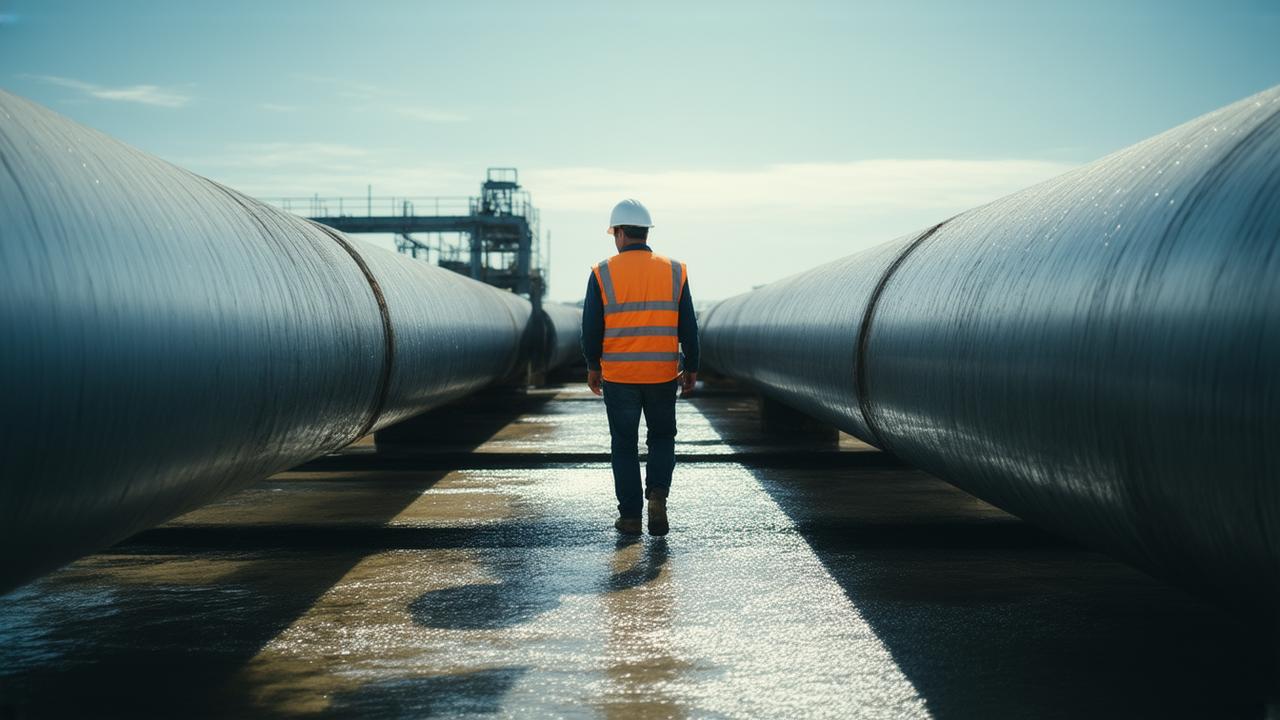
The air tastes of salt and machinery. On the edge of the city, where asphalt softens into scrub and sea, a low silver building hums like a distant beehive. Inside, under bright white lights, seawater is being turned—almost alchemically—into something you can pour into a glass. Outside, beyond the chain-link fence, waves keep rolling in, as they always have. But here, behind concrete walls and a tangled forest of pipes, a new story of water is being written—one built less on rivers and rain, and more on membranes, pressure, and the restless energy of a warming world.
When the Rain Stops Coming
Walk through any city in the middle of a drought and you can feel the tension in the air. Lawns crackle underfoot, fountains sit bone-dry, and conversations at corner cafés turn quietly, inevitably, to water: Do we have enough? Will there be restrictions? What happens if the dams keep dropping?
For decades, conventional wisdom said that water security meant reservoirs, rivers, canals, and careful conservation. You captured the rain when it fell, and you stretched it as far as it could go. But that logic is fraying. The rain is no longer where we expect it to be—or when. Monsoon patterns are shifting. Snowpacks are thinning. Seasons are slipping off their old schedules.
In some regions, the same storm that used to be a lifeline has become a violent outburst—dumping too much water in a few days and then leaving months of dust in its wake. Hydrologists now use phrases like “non-stationarity” and “climate whiplash” to describe a reality where the past is no longer a reliable map for the future. In boardrooms, at city councils, and in coastal villages, the anxiety is simple: the tap still needs to run, no matter what the sky decides to do.
That’s where desalination steps into the frame, no longer a futuristic curiosity or a last resort reserved for oil-rich nations in hot deserts, but a central character in the new story of water security.
The Sea as a Reservoir You Can’t See the Bottom Of
Desalination starts with something deceptively ordinary: a wave breaking on a shore. That same water, given enough pressure and precision, can be stripped of its salt and impurities until it meets the standards of drinking water. The core magic happens in a process called reverse osmosis, where seawater is pushed through incredibly fine membranes—filters so tight that salt molecules are left behind, while freshwater slips through.
Step inside a modern desalination plant and it feels like walking into the inside of a mechanical sea. There’s the low roar of pumps moving thousands of liters per second, the rhythmic hiss of valves opening and closing, the neat arrays of pressure vessels lined up like torpedoes in a science-fiction submarine. There’s the faint tang of ocean in the air, mixed with metal and the ozone scent of electrical rooms.
At first glance, it might feel oddly sterile, almost disconnected from the natural world it serves. But viewed another way, it’s simply a new kind of river—a manufactured one—flowing from the sea instead of a mountain snowfield. Pipes replace riverbanks. Pumps replace gravity. Engineers and operators take on the role once held by watersheds, glaciers, and seasonal rains.
The appeal is obvious: the ocean is vast, and its volume—though not truly infinite—feels like a kind of stability in a time when other sources are trembling. Coastal cities from Australia to the Middle East to the Mediterranean have begun to treat the coastline as a backup reservoir, one they can tap when drought chokes off all other options. Increasingly, desalination is not just a backup; it’s being designed in from the start, as a permanent pillar of a region’s water portfolio.
Why Desalination Plants Are Moving to Center Stage
Behind this global shift lies a handful of hard, practical reasons. Most of them come down to risk, timing, and control—three things climate change is rapidly rearranging.
- Reliability in a shifting climate: Rain-fed systems are hostage to increasingly unreliable seasons. Desalination offers a source of supply that isn’t directly tied to rainfall patterns.
- Urban growth on the coast: Many of the world’s fastest-growing cities sit near the ocean. It’s far easier to draw seawater through an intake pipe than to build hundreds of kilometers of new canals and aqueducts.
- Speed of deployment: While large dams or inter-basin transfer projects can take decades to permit and construct, desalination plants can often be brought online more quickly, especially when built in modular phases.
- Strategic independence: Regions that rely on upstream neighbors for river flows face political vulnerability. Desalination plants, by contrast, are located firmly within local control.
The result is a quiet but profound shift: instead of asking, “Can we afford desalination?” more governments are now asking, “Can we afford not to have it?”
The Cost You Don’t Taste in the Glass
But no glass of desalinated water is truly clear, not once you look upstream into the energy that made it possible. Every liter must be pried from the grip of salt using pressure or heat, and that means power—lots of it.
In energy terms, reverse osmosis has improved dramatically over the past few decades. Early plants guzzled electricity; modern ones are far more efficient, equipped with energy recovery devices that scavenge pressure from the outgoing brine stream and feed it back into the system. Yet even with all these gains, desalination still tends to require more energy than importing water from a distant river or recycling urban wastewater.
If the local power grid is still heavily tied to fossil fuels, then each liter of fresh water carries a carbon footprint. That invisible cost raises a troubling paradox: one tool we’re relying on to adapt to climate change can, if poorly managed, contribute to the very warming that’s driving the crisis.
Then there’s the issue of brine—the concentrated salty byproduct that must go somewhere. Discharged carelessly, it can smother life on the seafloor, reducing oxygen levels and changing the chemistry of nearshore waters. Designing better diffusers, blending brine with other effluents, and choosing plant locations with strong currents are all part of the mitigation toolkit, but they require vigilance and rigorous monitoring.
The trade-offs can be summarized, in simple terms, like this:
| Aspect | Benefits of Desalination | Key Concerns |
|---|---|---|
| Water Security | Reliable supply independent of rainfall | Can create overconfidence, less focus on conservation |
| Energy Use | Technology improvements steadily reducing demand | High electricity consumption; potential CO₂ emissions |
| Environment | Reduces pressure on rivers, aquifers, and wetlands | Brine discharge, intake impacts on marine life |
| Economics | Predictable, controllable production costs | Capital-intensive infrastructure; energy price sensitivity |
Can the Wind and Sun Carry the Load?
So the critical question becomes: if desalination is moving to the center of water security plans, can renewable energy move to the center of desalination?
In some places, you can already see the outlines of that answer in the landscape. Solar arrays tilt toward the sun near coastal plants, feeding their electrons directly into pumps. Offshore wind farms spin on the horizon, their power cables snaking under the waves to shore-based facilities. Battery banks and smart controls allow plants to ramp production up and down in harmony with the availability of wind and sun, storing excess water in reservoirs when energy is plentiful.
There is a kind of quiet poetry in the idea: using the energy of the very climate—its sunlight, its wind—to buffer us against the extremes that same climate now delivers. In practice, it’s a complex engineering puzzle. Matching intermittent renewables to the steady thirst of cities requires careful planning, investment, and a willingness to think beyond the old model of “always-on” baseload power.
Yet the trend is clear. As the cost of solar and wind continues to fall, the share of desalinated water produced with low-carbon electricity is rising. Some planners now argue that any new desalination plant should be paired from the start with a serious renewable strategy, baking climate responsibility into the project rather than treating it as an optional upgrade.
Desalination as One Strand in a Larger Web
To imagine a future where desalination plants quietly underpin water security, it helps to zoom out beyond the plant fence. No city or region will thrive if it bets everything on one technological card. True resilience lies in diversity—a mosaic of strategies woven together.
Recycled wastewater, for example, is increasingly stepping out from the shadows of “yuck” reactions and into mainstream acceptance. Advanced treatment can turn sewage into ultra-clean water suitable for recharging aquifers or even direct potable use. Stormwater capture, green roofs, and permeable pavements are helping cities treat rain not as a flood problem to be disposed of, but as a resource to be soaked up and stored.
➡️ River allocations are becoming a political flashpoint as drought pressure returns upstream
➡️ New apartment builds are reviving debate about ventilation and indoor health outcomes
➡️ A new generation of filmmakers is reshaping national culture through intimate documentary work
➡️ School counsellors are reporting a heavier mental health load among teenage students
➡️ Tourism operators are rethinking wildlife encounters as visitor numbers rebound strongly
➡️ Home cooks are rediscovering fermentation as flavour and health trends converge
➡️ Repair cafés are spreading as households push back against disposable electronics culture
Traditional conservation—low-flow fixtures, leak detection, smarter irrigation—remains one of the cheapest “sources” of new water. Agricultural efficiency, from drip irrigation to precision moisture sensors, offers vast potential to do more with less in the sector that uses the most water of all.
In this wider context, desalination looks less like a silver bullet and more like one strand in a web. Its role is not to replace rivers, aquifers, and careful stewardship, but to backstop them. To offer a kind of insurance policy when drought drags reservoir levels down and heatwaves linger. To guarantee that hospitals can still operate, taps can still run, and ecosystems don’t need to be bled dry just to keep cities alive.
The art of smart planning lies in balancing these options: using desalination for base load or emergency supply, blending it with recycled water, and maintaining enough flexibility to scale production up and down as conditions change.
Living Beside a Machine That Makes Rainfall Moot
There’s a moment, standing on the observation deck of a desalination plant, when the whole operation feels both awe-inspiring and unsettling. Below, water that was in the ocean just hours ago now moves through pipes labeled “potable,” on its way to homes, schools, and gardens. Out beyond the breakwater, clouds gather or fail to gather; storms build or fizzle. But in here, under the bright lights, the weather matters less.
That shift—decoupling a portion of our water supply from the whims of the sky—is powerful. It can save lives in drought-stricken regions, stabilize economies, and protect ecosystems from over-extraction. It can also, if mishandled, encourage complacency: the illusion that technology alone can outrun ecological limits.
In truth, desalination plants do not free us from the need to live within our means. They simply redraw where those means lie. Energy, materials, coastlines, and marine ecosystems become the new frontiers of responsibility. The real measure of success will be whether we can fold this technology gently into the fabric of the living world, rather than bulldozing our way through it.
As water security plans around the globe increasingly circle the word “desalination” in thick red ink, the task is not to argue whether these plants will be built. Many already are; many more are coming. The deeper question is how we will power them, site them, regulate them, and fit them into a broader ethic of care—for rivers and reefs, farms and cities, people and the more-than-human world that shares our coasts.
Out at the shoreline, the waves keep breaking, indifferent to our worries and our ingenuity. On the other side of the fence, the humming machines coax a small trickle of that endless water into a form that can sustain a thirsty species living through a century of change. Between those two edges—wild surf and engineered flow—lies the story we are now writing, one membrane, one megawatt, one cautious glass of water at a time.
FAQ
Is desalinated water safe to drink?
Yes. Properly operated desalination plants produce water that meets or exceeds drinking water standards. Minerals are often added back to improve taste and prevent pipe corrosion.
Why is desalination considered energy-intensive?
Removing salt from seawater requires high pressure or heat, both of which demand significant electricity. Even with modern efficiency improvements, desalination typically uses more energy than importing or recycling water.
Does desalination harm marine life?
It can, if not carefully managed. Intakes may affect small organisms, and concentrated brine discharge can impact local ecosystems. Modern designs use screens, low intake velocities, and diffusers to reduce these impacts.
Can desalination run fully on renewable energy?
Yes, in principle. Some plants already integrate solar, wind, or hybrid systems. The main challenge is matching variable renewable output with constant water demand through storage and smart operation.
Will desalination solve global water scarcity on its own?
No. Desalination is a powerful tool, but it works best as part of a broader strategy that includes conservation, recycled water, stormwater capture, and sustainable groundwater and surface water management.





