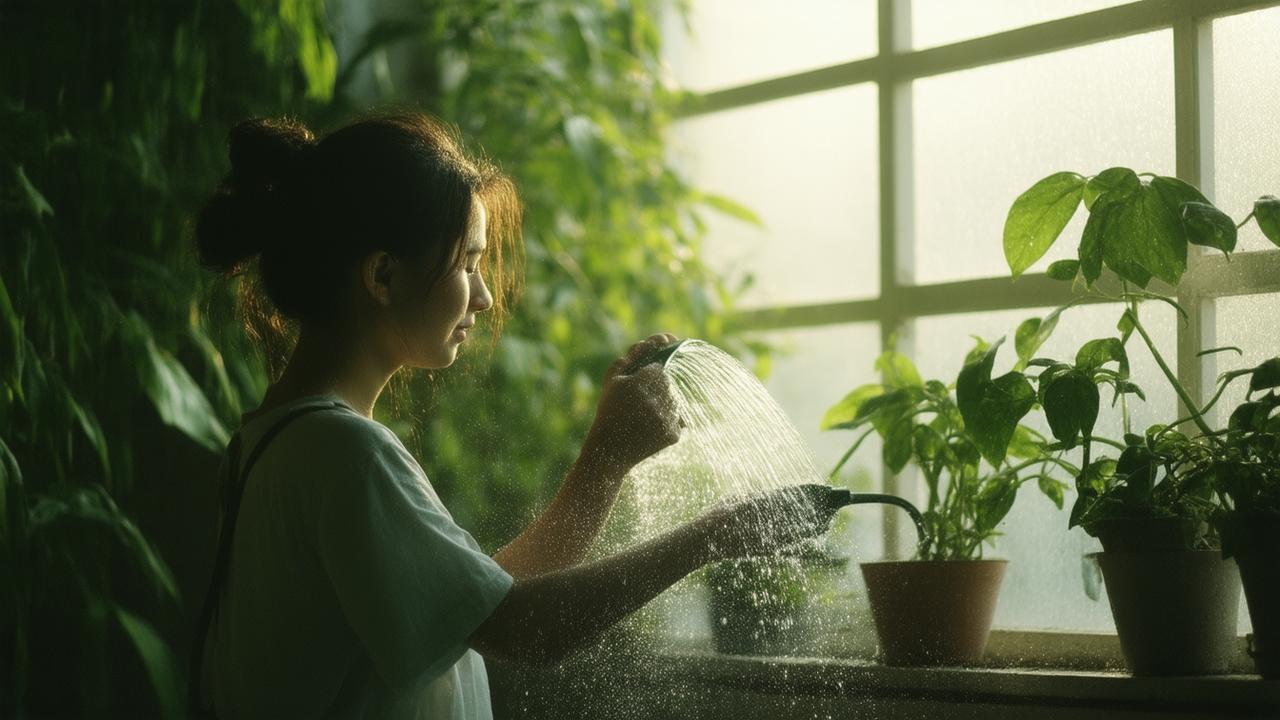
The first thing you notice is the sound. Not of traffic or neighbors or someone’s television bleeding through the wall, but the soft hiss of a mister, the rustle of leaves brushing a window, the faint drip of water into a saucer. The apartment is still an apartment—white walls, a narrow hallway, the quiet hum of a fridge—but it feels different, thicker somehow, like the air has weight and intention. Vines trail down from a curtain rod, a rubber plant leans companionably toward the couch, and there’s a fiddle-leaf fig stationed like a sentry by the balcony door. You step inside and your shoulders drop before you’ve even put down your keys. This is the new city living: the age of the indoor forest.
The Quiet Revolution Happening in Living Rooms
For years, urban apartments were defined by what they lacked: space, light, quiet, greenery. They were places you passed through on your way to somewhere else. But a quiet revolution has been sprouting on windowsills, bookcases, and kitchen counters. Indoor plants, once an afterthought—a dusty fern, a sad pothos drooping in the corner—are now reshaping how small spaces feel, and how we feel inside them.
Step into almost any city apartment today and you’ll notice it: plants are no longer decor, they’re characters. The monstera in the corner is “him,” the trailing philodendron is “her,” and cuttings passed between friends are treated the way people once treated mix tapes or secret recipes. Entire weekends are built around repotting, pruning, and rearranging, as though tending a miniature, portable landscape.
There’s a reason for this boom, and it runs deeper than the need for Instagrammable backdrops. As cities grow denser and lives more digitized, people are turning toward something startlingly simple and ancient: living with other living things. A spider plant on a shelf cannot fix the world’s problems, but it can, in its own quiet way, change the emotional climate of a room.
The Emotional Weather of a Green Room
Walk into a plant-filled apartment after a long day and you can almost feel the temperature shift. Not in degrees, but in mood. Harsh angles soften when a trailing vine curves over them. Morning light, filtered through large leaves, hits the floor in watery patterns instead of a sterile rectangle. Even the smell is different—a damp, earthy undertone that suggests somewhere outside of concrete exists, even if you can’t see it from your fifth-floor walk-up.
Psychologists have long talked about biophilia, the idea that humans have an innate tendency to seek connection with nature. You don’t need to read the research to know what your body already tells you: breathing feels easier in a room full of plants. Your eyes have somewhere gentle to land. Your thoughts slow down just a notch, the way they might when you’re walking through a park, except now the park is your living room.
Curiously, this shift isn’t just visual. Plants introduce a kind of quiet responsibility that reshapes how home feels. There is soil to check, new growth to celebrate, yellowing leaves to let go of. You become attuned to tiny, nonverbal cues—slightly droopy stems, a patch of crisping edges, a sudden flush of buds. Unlike the digital notifications that demand attention with pings and banners, these ones whisper. Your reward for listening is not a dopamine spike from a like or a message, but the slow, steady satisfaction of watching something grow because of your care.
From Houseplants to Housemates
For a growing number of city dwellers, plants are no longer ornamental—they’re relational. In apartments where roommates rotate and landlords change, plants become the constant. They outlast leases, relationships, sometimes even jobs. A single cutting can follow someone through three, four, five addresses, each new pot layered with a little more history.
Spend time with a devoted “plant person” and you’ll hear it in the way they talk. They’ll tell you about the peace lily that sulks for days after being moved, the calathea that unfurls its leaves every morning like a tiny prayer, the hoya that finally bloomed after years of patient care. These aren’t merely anecdotes; they’re proof that attention matters. In a world that often feels too big to influence, the small, manageable drama of a plant’s life gives people back a sense of agency.
There’s comfort in that. When outer life feels chaotic or uncertain, tending a windowsill forest becomes a form of emotional ballast. The daily ritual—water, observe, adjust, repeat—creates a rhythm that anchors the day. For some, especially those living alone, there’s an extra layer: the faint but real sense of not being entirely alone. There’s someone, or something, waiting behind that door when they come home.
Micro-Jungles in Macro-Cities
The new wave of plant-filled apartments is not limited to lofty spaces with floor-to-ceiling windows. It’s happening in cramped studios, basement units, and narrow walk-ups with a single north-facing window. People are turning whatever sliver of light they have into a stage for chlorophyll to perform. They’re stacking plants on stools, suspending them from the ceiling, coaxing vines to snake along picture rails and door frames.
Light, space, and commitment all shape what kind of “micro-jungle” can realistically thrive in an apartment. Different setups create different emotional textures, too. A kitchen crowded with herbs and small succulents feels lively and practical, like a tiny urban homestead. A bedroom shaded by tall palms and monsteras takes on a softer, retreat-like energy. Even a single well-placed plant on a desk can shift the emotional tone from “workstation” to “workspace with a view.”
| Apartment Type | Plant Style | Emotional Feel |
|---|---|---|
| Small studio with one window | Few easy-care plants (snake plant, pothos) | Calmer, less cluttered, a softening of edges |
| Shared apartment | Mixed collection in common areas | More communal, lived-in, welcoming |
| Loft or bright corner unit | Large statement plants, hanging vines | Lush, airy, almost resort-like |
| Basement or low-light space | Low-light species, strategic placement | Cozy, cocoon-like, unexpectedly alive |
This is perhaps the most surprising part of the plant boom: it’s not about having the perfect “Pinterest apartment.” It’s about paying attention to what is possible in the space you have, then nudging that space just a little closer to the feeling of an outdoor refuge.
Rituals of Care in a Restless World
There was a time when “home” was a pause between commutes, dinners out, and social obligations. Recent years have flipped that equation. As people spent more time inside their own walls, many started to notice the emotional gaps in their living spaces—the blank corners, the sterile surfaces, the sense that their apartment was a container, not a companion.
Indoor plants slid quietly into that gap. Caring for them created small rituals where there had previously been only routine. Sunday morning became less about scrolling in bed and more about moving from pot to pot, coffee in one hand, watering can in the other. Each plant demanded a slightly different touch: this one likes to dry out completely, that one hates drafts, the other needs misting on dry days. Without fanfare, these micro-practices taught people to pay closer attention to their environment, and to respond gently.
There’s a kind of mirror effect here. The more closely you observe your plants, the more you start to notice fluctuations in your own internal weather. That tight feeling in your chest when the to-do list swells; the way your shoulders inch upward when the inbox pings for the fifth time in a minute. Plant care, with its slow pace and unapologetic focus on basic needs—water, light, nourishment—can act as a subtle reminder to check in with your own.
The New Social Currency: Cuttings, Not Status
Alongside the quiet, personal rituals, there’s a very social side to this new indoor greenery. Visit friends and you may find yourself leaving with a small cutting in a paper towel, roots just beginning to feather out, like a promise in plant form. Entire communities have sprung up—offline as much as online—around trading, gifting, and rescuing plants.
What’s interesting isn’t just the exchange itself, but what it replaces. Once, the bragging rights of city life might have revolved around reservations, gadgets, the latest place to be seen. Now, it might just as easily be about whether someone’s monstera finally put out a fenestrated leaf, or whether a notoriously finicky calathea has decided to settle in and stay. The status symbol is still there, in a way—but it’s tempered by the fact that plants don’t care who owns them. They respond only to conditions: light, water, air, time.
Plant swaps in community spaces, casual meet-ups in apartments, and shared Google Docs of care tips all add up to something unusual in a culture that often treats home as a private stage. Plants have become a reason to open doors, to invite people into the messy, in-progress version of our living rooms, not the curated one. The emotional tone of apartment living shifts again, bending toward connection instead of isolation.
➡️ Nightlife venues are adjusting as sober socialising becomes a mainstream choice
➡️ Farmers are experimenting with regenerative grazing to rebuild soil after decades of depletion
➡️ Ocean chemistry data is pointing to faster acidification along sensitive marine habitats
➡️ Fashion labels are returning to wool as demand grows for durable climate smart fabrics
➡️ Archaeologists are returning to old shipwreck sites with new imaging technology
➡️ Households are embracing minimalism as rising costs challenge traditional consumer habits
➡️ Space startups are expanding beyond satellites as deep tech exports gain momentum
Where the Apartment Ends and the Forest Begins
Not every plant story is a happy one. There are the overwatered succulents, the spider mites that show up uninvited, the tomatoes that never quite ripen on a too-shady balcony. There are the inevitable small griefs: the plant that slowly withers despite your best efforts, the one you forget on vacation, the one that doesn’t survive a winter of weak light and strong heaters.
But even those losses shape the emotional life of a home. There’s humility in realizing that you can’t control everything, that growth isn’t guaranteed. There’s a quiet resilience in trying again—repotting, propagating, shifting something closer to the window. For many, this trial and error becomes a gentle training in patience, an antidote to the instant feedback of screens.
Over time, the boundary between “apartment” and “ecosystem” starts to blur. The living room doesn’t just contain plants; it orbits around them. Furniture is arranged to give them light. Schedules adjust to remember watering days. Windows become less like glass borders and more like portals, connecting an interior jungle to whatever slice of sky is visible beyond the neighboring building. The emotional feel of the space changes from “temporary box” to “tiny living world.”
And in that world, something subtle but important happens: people remember that they, too, are living things. Not merely workers, consumers, or profiles with curated feeds, but organisms that respond to light and air and care. Indoor plants may not be able to fix traffic or rent prices or global unease, but they can, leaf by leaf, create small pockets of sanity and softness inside the concrete.
In the end, the boom in indoor plants is not just about aesthetics or trend cycles. It’s about re-learning how to be at home. To come back at the end of the day, step across the threshold, and feel the presence of quiet, green life breathing with you. To look around and think: this isn’t just where I live. This place, in its own fragile way, is alive with me.
Frequently Asked Questions
Why are indoor plants becoming so popular in apartments?
Indoor plants offer a simple way to soften small, urban spaces and bring a sense of nature indoors. As people spend more time at home and on screens, plants provide a calming, tangible presence and a daily ritual of care that many find emotionally grounding.
Can plants really change how an apartment feels emotionally?
Yes. Plants change light, texture, and even sound in a room. They introduce organic shapes and colors, which can reduce visual harshness and stress. Caring for them also creates small, mindful routines that can make an apartment feel more like a nurturing, lived-in space than just a place to sleep.
What if my apartment doesn’t get much natural light?
Low-light apartments can still support certain species, such as snake plants, pothos, and ZZ plants. Placing them near the brightest available spot and avoiding overwatering is usually enough. Some people also supplement with simple grow lights to expand their indoor “forest.”
Do I need to be “good with plants” to start?
No. Most plant lovers began with at least one failed plant. Starting with hardy, forgiving species and learning through observation is usually enough. The process of experimenting, adjusting, and sometimes starting over is part of what makes plant care emotionally rewarding.
Can indoor plants improve my mental well-being?
Many people report feeling calmer and more grounded in plant-filled spaces. Studies suggest that interaction with plants—watering, pruning, simply being around them—can reduce stress and support a sense of connection. Even a few well-chosen plants can make an apartment feel more soothing and alive.





