The first time you slide open the door, the scent hits you before the view does: that new-car mix of soft upholstery, clean plastics and something almost like the inside of a brand‑new tent. Outside, the magpies are throwing their morning warble across a suburban Brisbane street, and you’ve got a takeaway flat white going cold on the fence post. Inside, though, there’s a different kind of quiet — the kind that says: this isn’t just a car. This is the family’s next chapter, parked right in the driveway.
The Return Of The Big Family Adventurer
For years, it felt like Australian families had to make a choice: squeeze everyone into an SUV that groaned under the weight of bikes and beach gear, or resign themselves to a boxy people-mover that drove like a reluctant bus. Somewhere along the line, we started to accept that family life meant compromise — knees jammed into seatbacks, snack crumbs welded into the upholstery, and an eternal battle over who gets stuck in “the back-back”.
Now, the seven-seat family vehicle is having a serious glow‑up. Not just a return, but a rethink. A new breed of family car is rolling into Aussie driveways with the quiet confidence of something that knows it’s been missed: a proper, spacious, long‑wheelbase people‑mover that feels less like a van and more like a travelling lounge room. It’s the vehicle so many were waiting for — back with seven seats and living space that redefines on‑board comfort.
You notice it first in the proportions. Long, low, quietly assertive. It doesn’t loom the way a big 4WD does; instead, it stretches, invitingly, like a good sofa. Slide into the driver’s seat and there’s that sense of air and light. The windscreen seems to open up more sky than you’re used to. You can almost feel the tension leave your shoulders before you’ve even turned the key.
A Moving Lounge Room For Real Australian Life
The Art Of Real Space, Not Just Seat Counts
Seven seats sounds impressive on paper, but if you’ve ever tried to wedge a lanky teenager into the third row of a so‑called “family SUV”, you know the reality can be very different. The new generation of family mover is unapologetically honest about what it is: a proper people carrier with a long body, clever layout and the sort of interior space that makes road trips feel less like a siege and more like a slow exhale.
Middle-row captain’s chairs slide and recline with a satisfying, almost aircraft‑style smoothness. The third row is no longer a padded afterthought — it’s shaped for real humans, not just primary-schoolers. Tall kids, grandparents, and that extra cousin who always seems to tag along on holidays all fit without the theatrical sighing and shuffling. Knees have room. Feet have space. Shoulders aren’t pressed into window glass.
Then there’s the “living space” feel, that intangible shift from car to room. Wide door openings, a flat floor, smart storage cubbies tucked into armrests and doors — everything adds up to an interior that feels more like a small city apartment than a vehicle. You can imagine changing a nappy on the fly, sorting out school bags, or laying out the picnic gear as you hunt for the perfect patch of shade at a roadside rest stop.
Sensory Calm In A Chaotic World
Out on the road, Australia doesn’t do half measures. From the sticky, cicada‑thick summers of the Hunter to the winds that knife across the Nullarbor, every trip is a small adventure. Inside this seven‑seater, though, the elements feel strangely far away. The cabin insulation hushes tyre hum and cross‑winds down to a soft backdrop, like white noise on a sleep app. The air‑conditioning reaches all three rows, sending cool or warm air along the length of the cabin so there’s no “hot in the back, freezing in the front” argument.
Surfaces matter, too. Where older people‑movers could feel like plastic lunchboxes on wheels, this new era leans into touch. Armrests are padded where elbows naturally fall. The steering wheel has a gentle give to it, a subtle grain under your palms. Ambient lighting — nothing flashy, just a soft glow along the dash — lets night‑time drives feel less clinical, more cocoon-like. The audio system doesn’t just blast from the front; sound washes evenly through the cabin so a kids’ podcast in row three is just as clear as the radio in the front.
It’s not luxury in the flashy sense; it’s comfort in the lived‑in sense. The sort of thoughtful sensory design that means you arrive at a beach house after a five‑hour push up the coast and realise, with a little surprise, that you’re not bone‑tired and sore. You just feel… fine. Ready to unload, not collapse.
Designed For Weekend Escapes And Weekday Chaos
From School Run To Sand Dunes
Australian family life runs on contrast. Monday might be a blur of school runs, after‑school sport and a dash to Coles. By Friday afternoon you’re cramming in tents, boards, and that one extra bag of “just in case” clothes and aiming the bonnet straight towards the coast or the bush.
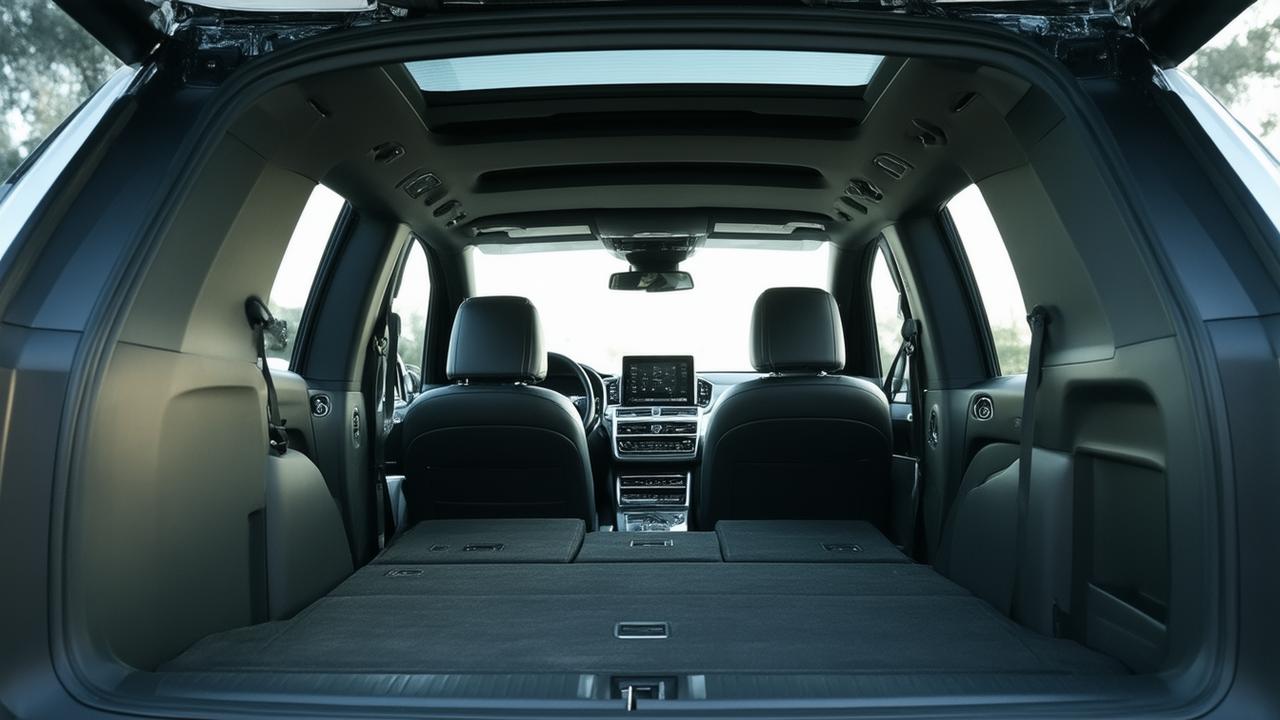
This is where a thoughtfully designed seven‑seater really earns its keep. With all three rows up, there’s still enough boot space for the realities of life: a pram, a week’s worth of shopping, or an entire team’s worth of footy gear. Drop the third row flat and suddenly the rear opens like a gear cave — swags, eskies, camp chairs and the inflatable flamingo all line up without needing advanced Tetris skills.
Sliding doors — often overlooked until you’ve been wedged in a tight underground carpark — glide open without the wide arc that makes kids nervous about dinging the car next door. Loading is a one‑handed job, even with a toddler hanging off your hip. And when the boot opens, the low load height means even the heavier bits of gear don’t feel like a deadlift PB.
Out on those long, shimmering highways, the chassis feels settled and planted. You’re high enough to see over smaller cars but not so tall that corners feel like a balancing act. Cruise control hums away, lane‑keeping systems gently nudge you back from white lines if your attention drifts, and wide side mirrors give a clear view of caravans or trailers if you’ve hitched up for a bigger adventure.
The Cabin As A Shared Space, Not Just A Row Of Seats
One of the quiet joys of this new wave of family vehicle is how it changes what happens between point A and point B. The cabin starts to feel like a shared space rather than seven isolated seats. Conversation flows more easily when everyone can actually sit comfortably, see out, hear one another and reach their drink holders.
The second row often becomes the social hub: kids trading snacks, colouring in, or sprawled out watching downloaded shows on tablets plugged into USB ports that are actually where they need them. Cup holders aren’t an afterthought; they’re everywhere — in doors, armrests, sometimes even tucked away in the side of the third row for the kid who always ends up in the back corner with a book.
Parents in the front have the strange but welcome feeling of control and separation. A wide centre console, maybe a raised dash and digital display, gives the driver a sense of command without walling them off from the rest of the family. The front passenger can swivel slightly, chatting with the kids or passing back snacks, without stretching awkwardly over a handbrake or gear lever.
Comfort Measured In Moments, Not Just Millimetres
The Little Things That Change The Whole Trip
When people talk about comfort, they often fall back on numbers: legroom in millimetres, headroom in centimetres, seat width down to the last fraction. Useful, sure — but the true test of family comfort is far more practical. How many times did you hear, “Are we there yet?” on the last trip? How many squabbles broke out over space, snacks, or someone’s elbow going rogue?
This new generation of seven‑seat family vehicle tackles those everyday battles in small, clever ways. Multiple charging points so no one’s battery becomes a crisis. Rear climate controls so kids can fine‑tune their own comfort instead of yelling forward. Deep door bins that swallow drink bottles, sand‑covered thongs, and the odd shell treasure picked up from a beach in Yamba or Esperance.
Seats aren’t just soft, they’re properly shaped, with enough support for adults on longer slogs down the Hume or the Bruce. ISOFIX points and top tether anchors are right where stressed new parents need them, reducing that sweaty, contorted wrestle with child seats in a narrow garage. And when daylight fades on a long return leg, soft interior lighting stops the cabin from plunging into cave‑like darkness, without glaring directly into sleepy eyes.
➡️ Psychology explains that people who prefer being alone are often recharging their energy, not withdrawing from others
➡️ Say goodbye to gray hair with this 2?ingredient homemade dye
➡️ Scientists discover the body’s natural “off switch” for inflammation, opening new paths for treatment
➡️ Psychology teams identify three recurring color preferences linked with fragile self-confidence
➡️ Tenant fails to return keys at end of lease, court rules landlord cannot charge extra rent
➡️ Sheets shouldn’t be changed monthly or every two weeks: an expert gives the exact frequency
➡️ Social Security 2026 new monthly payment figures, payment boost for confirmed : new monthly amounts for retirees, spouses, survivors, and disabled beneficiaries explained
| Everyday Need | How The 7‑Seater Helps |
|---|---|
| School runs and sport drop‑offs | Seven usable seats mean friends, cousins and team‑mates all fit without juggling cars. |
| Weekend road trips | Flexible seating and boot space absorb bags, boards, eskies and camp gear. |
| Long highway drives | Supportive seats, quiet cabin and driver aids keep fatigue at bay. |
| Growing kids and teens | Genuine third‑row space and rear air‑conditioning mean fewer arguments. |
| Big family events | Grandparents, prams and presents all travel together in one comfortable cabin. |
Built For Australian Conditions, From City Streets To Country Dust
Australia is a testing ground like few others. We ask a lot of our family cars: city commuting in summer gridlock, dusty detours down corrugated country backroads, surprise storms that roll in off the Southern Ocean and hit the windscreen like a bucket of marbles. The new wave of seven‑seat family movers is engineered with that breadth of experience in mind.
Suspension is tuned to cope with patched‑up suburban bitumen and the hard, rutted edges of rural lanes. Ground clearance is enough that you don’t wince every time you ease off a friend’s steep driveway in the Blue Mountains or the Adelaide Hills. Stability control, multiple airbags and modern collision‑avoidance systems add a quiet layer of protection you hope never to test, but are deeply grateful for if a roo darts out at dusk.
Even fuel efficiency and drivetrains are evolving to match modern expectations. Depending on the model, there are options that balance torque for hauling the family and their gear with the sort of economy that makes regular trips between cities less daunting at the servo. For many Aussies, that might mean diesel; for others, hybrid technology or efficient petrol engines. The common thread is this: long distances, big loads, and real‑world conditions are baked into the design brief.
The Family Vehicle We’ve Been Waiting For
In the end, what makes this seven‑seat, lounge‑like family vehicle so compelling isn’t just the specs, or the clever storage solutions, or the shiny tech on the dash. It’s the way it gently expands what feels possible for a normal Australian family week.
Suddenly, the idea of a spur‑of‑the‑moment weekend up the coast feels achievable, not exhausting. Visiting grandparents a few hours away isn’t a negotiation over who draws the short straw in the cramped back. The after‑school juggle of music, netball, swimming and last‑minute dinner runs is simply… easier. There are seats for everyone. There’s space to breathe. There’s room to grow.
As you close the sliding door at the end of the day, the interior holds a soft echo of everything it’s hosted: the chatter, the spilled chips, the sand on the mats from an impromptu detour to the nearest beach. This is what it was built for — not perfection, but life. Messy, joyful, busy, sprawling Australian family life, carried comfortably from one memory to the next.
The family vehicle everyone was waiting for isn’t just back. It’s grown up. And as it waits in the driveway under a sky buzzing with lorikeets and late‑afternoon heat, it feels less like a machine and more like part of the family — ready to go, whenever you are.
Frequently Asked Questions
Is a seven‑seat family vehicle too big for city driving?
Most modern seven‑seat people‑movers are surprisingly manageable in the city. They’re often only slightly longer than a large SUV, with good visibility, reversing cameras and parking sensors that make tight spots and multi‑storey carparks much easier to handle.
Will adults be comfortable in the third row?
In newer designs, yes. The third row is built with real legroom, better seat shapes and proper access. Adults can sit there comfortably on regular trips, not just short emergency runs.
Are seven‑seater vehicles fuel‑efficient enough for long Australian drives?
Fuel use varies by model and drivetrain, but many modern seven‑seaters are significantly more efficient than older people‑movers and large 4WDs. Diesel and hybrid options in particular are well‑suited to long‑distance Australian touring.
How safe are these large family vehicles?
Most current seven‑seat family vehicles come with a full suite of safety features: multiple airbags, stability control, anti‑lock braking and often advanced driver‑assistance systems like autonomous emergency braking and lane‑keeping support.
Is a seven‑seater worth it if we only have two or three kids?
For many Australian families, yes. The extra row gives flexibility for friends, grandparents, car‑pooling and future growth, while the additional space makes everyday life — shopping, sport, holidays — much easier and more comfortable.





