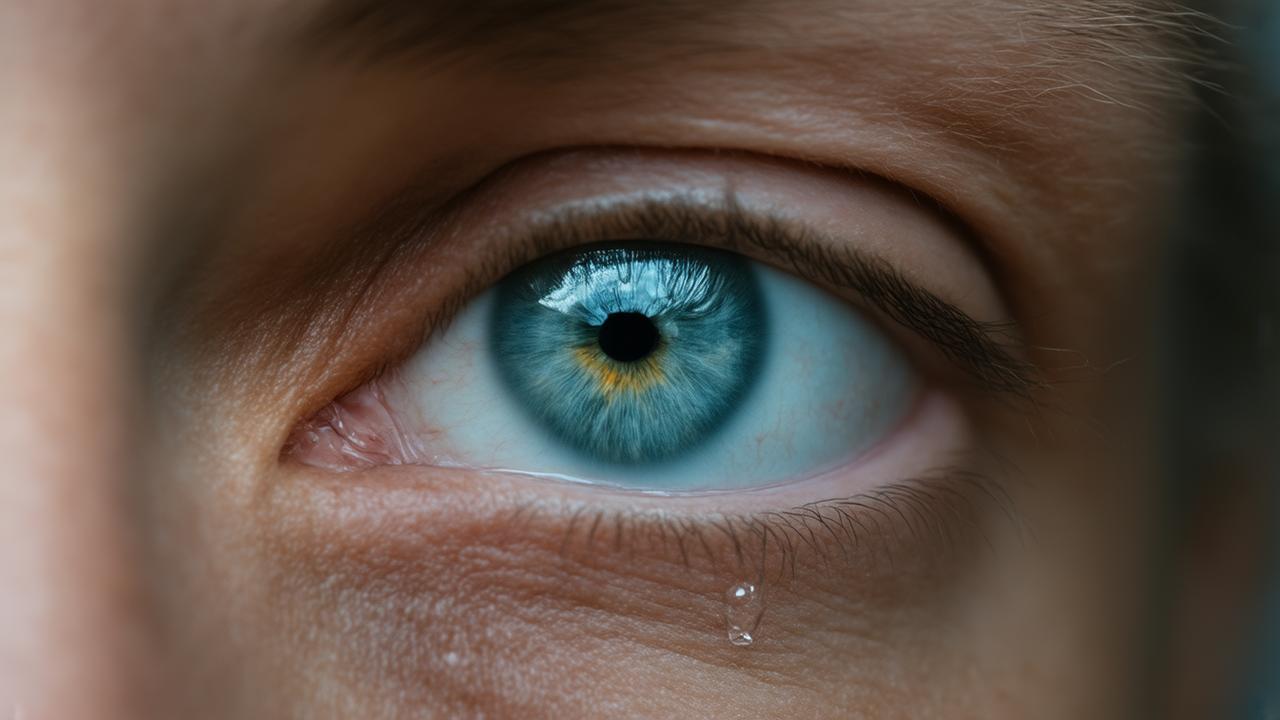
Dawn over the Coral Sea comes on slow and soft, like someone lifting a veil. On a bluff above the water, an elderly woman named Merle squints toward the horizon. For decades she’s watched the same line of blue-grey, read the weather from the shape of the clouds, picked out the flash of dolphins running close to shore. Now the light bleeds into a milky haze. The horizon is no longer a line but a smudge.
“It’s like looking through cling wrap,” she tells her daughter. “Everything’s there. I just can’t quite catch it.”
For many older Australians, Merle’s description is painfully familiar. Cataracts – that slow clouding of the eye’s natural lens – affect hundreds of thousands of us. Traditionally, the story has only one clear ending: major eye surgery, a hospital gown, bright theatre lights and the unmistakable tang of antiseptic. But in labs from Melbourne to Brisbane, a quieter chapter is being written – a clear, cool gel that might one day restore sight without the drama of the operating theatre.
A silent fog on the nation’s vision
Cataracts don’t arrive with fanfare. They slip in on the edges of vision – a touch more glare off the bitumen, headlights at night ghosting into starbursts, colours losing their punch. In a country where the sun feels close enough to touch, that creeping blur hits hard.
By their seventies, the majority of Australians will have some level of lens clouding. We notice it behind the wheel on the Bruce Highway, or reading the cricket scores on a faded paper, or following the flight of a wedge-tailed eagle circling over a paddock. Out bush, where optometrists can be days away, the shift is easier to ignore and harder to address.
At the heart of the problem is the eye’s lens: a tiny, flexible disc sitting just behind the coloured iris. When we’re young, it’s as clear as fresh rainwater in a rock pool. Over time, exposure to UV, changes in lens proteins and the slow grind of age turn that pristine transparency into something closer to frosted glass.
Today, the gold standard is surgery: the clouded lens is removed and replaced with a plastic one. It’s fast, incredibly effective and wildly common. Across Australia, cataract surgery is one of the most frequently performed procedures. But it’s still surgery. You need the equipment, the surgeon, the sterile theatre – and the courage to let someone work on the one organ you’d most like to protect.
The promise of a gel: no scalpels, just clarity
Now picture something different. No buzzing machines, no lying still under a surgical microscope. Instead, an optometrist or ophthalmologist applies a cool, clear gel to your eye – a quick outpatient treatment. Minutes of quiet, perhaps a faint chemical scent, then you’re done. Over hours or days, your lens gradually clears, like mist lifting off a dam at first light.
This isn’t science fiction. Around the world, and here in Australia, researchers are working on injectable and topical gels designed to slip into the eye’s internal spaces and gently restore the lens’s natural clarity. One experimental approach uses a transparent gel that replaces or supplements the old, stiff lens material, bending light properly again without needing to remove the entire lens.
Another strand of research looks at gels that can carry tiny drug molecules directly into the lens, coaxing misfolded proteins back into line so they stop scattering light. Think of it as steaming the creases out of a crumpled shirt, except the shirt is made of living, transparent tissue no thicker than a couple of millimetres.
These gels are being designed to be as unobtrusive as possible: matching the lens’s refractive index (how it bends light), staying optically clear, and settling into place without distorting the delicate structures around them. A good gel, scientists like to say, should disappear – not literally, but in the sense that you can’t feel it, see it, or notice where it stops and your own lens begins.
The quiet revolution in an Australian lab
In a fluorescent-lit lab corridor in Melbourne or Sydney, the revolution doesn’t look like much. There’s the soft hiss of air conditioning, the clean click of doors sealing shut, the scent of ethanol and latex gloves. A researcher peers down a microscope at a sliver of animal lens tissue bathing in a tiny drop of clear fluid. Somewhere, a fridge doors thumps closed; a centrifuge hums into life.
Here, on a bench crowded with pipettes and petri dishes, the new eye gels are born. Australian teams, often in collaboration with international groups, are testing how these materials behave: Do they stay clear under harsh light? Do they hold their shape through the heat swings of an outback summer and the chill of a Tasmanian winter? How do they interact with the lens capsule – that delicate, bag-like membrane that holds the lens in place?
In one experiment, a synthetic gel is injected into a mock lens capsule, designed to mimic the eye’s inner environment. Researchers shine laser light through it, measuring how much scatters. On a nearby monitor, graphs bloom in blue and gold. Less scatter means a clearer path for light – and potentially a clearer world for a future patient.
A few doors down, a clinician-scientist in a white coat scrolls through anonymous patient data: cataract severity, age, other health conditions, geographic location. The goal is simple but ambitious – to imagine how this technology might roll out in real Australian lives. Could a portable device and a vial of gel travel in the back of a 4WD to a remote Aboriginal community? Could a visiting eye team treat dozens of patients in a single day, without a full surgical theatre?
How a clear gel might change real lives
To understand what’s at stake, consider three Australians:
- A truck driver in regional Queensland, eyes stinging from glare off the highway, watching the road turn fuzzier each year.
- A retired teacher in suburban Perth, who’s been putting off cataract surgery because hospitals make her anxious.
- An Elder in a remote Northern Territory community, where visiting surgeons only arrive a few times a year and flights to a city hospital are expensive and disruptive.
A non-surgical or minimally invasive gel-based treatment could rewrite their options. It may not replace surgery entirely – at least, not at first – but it could delay it, soften the progression of cataracts, or help those who aren’t good candidates for a full operation. And for people living far from major centres, it could literally bring clearer vision closer to home.
What’s actually in this mystery gel?
“Gel” doesn’t sound particularly scientific, but behind the word is some very sophisticated materials engineering. These are usually soft, water-rich substances known as hydrogels – think of the material in a soft contact lens, but tuned specifically for the inside of the eye.
Developers have to nail a few critical features:
- Optical clarity: The gel has to be as transparent as, or clearer than, the natural lens material.
- Refractive index: It must bend light just right so images focus sharply on the retina.
- Biocompatibility: The eye is exquisitely sensitive. Anything that triggers inflammation is a non-starter.
- Stability: It should hold up for years, maybe decades, in a warm, salty environment bathed in light.
Some candidate gels are fully synthetic; others mix synthetic backbones with biological components. Some are injected as a liquid that “sets” into a gel once in place, responding to body temperature or the chemistry of the eye. Others stay as a soft fluid, held neatly where they’re needed by the lens capsule itself.
Alongside them are drug-loaded gels – more like slow-release reservoirs that can sit on the eye’s surface or in internal spaces, delivering anti-cataract compounds directly to the lens. If you’ve ever used artificial tears from a fridge and felt that instant soothing cool – now imagine a more advanced cousin of that drop, with a far deeper mission than simple comfort.
A quick look: surgery versus emerging gel approaches
| Aspect | Conventional Cataract Surgery | Emerging Clear Eye Gel Approaches |
|---|---|---|
| Invasiveness | Lens removed and replaced via surgical incision | Injection or topical application; lens often left in place |
| Setting | Hospital or surgical day centre | Potentially clinic-based or outreach setting |
| Recovery | Rapid for many, but involves post-op care and follow-up | Could be even quicker and less disruptive, if proven safe |
| Stage of Development | Long-established, widely available | Largely experimental; in preclinical and early trial phases |
| Potential Impact in Remote Areas | Limited by surgical infrastructure | Could expand access if equipment and training needs are low |
Australia’s unique stake in clear vision
Australians live under some of the harshest UV levels on the planet. We know the drill: hats on, sunnies, sunscreen. But while we’ve become more vigilant about skin cancer, the sun’s slow work on our eyes is easier to overlook.
For First Nations communities, there’s another layer: connections to Country that rely deeply on sight – reading subtle changes in water, recognising patterns in the land, passing on visual knowledge through art and ceremony. Vision loss isn’t just a medical issue; it can be a cultural and social rupture.
That’s part of why Australian researchers are leaning into solutions that might work outside big-city hospitals. Imagine an eye-care van pulling up in a remote community, carrying a portable imaging device, sterile syringes of clear gel, and a trained clinician. A few days later, people who had resigned themselves to a dimming world could be back on Country seeing its details sharply again: spinifex blades in the wind, the shimmer of heat on the red earth, the faint track of an animal across sand.
➡️ Place your jade plant in this exact spot: the simple Feng Shui positioning trick said to boost wealth, harmony and lasting happiness at home
➡️ People in their 60s and 70s were right all along: 7 life lessons we’re only now beginning to understand and appreciate
➡️ Put A Lemon Slice In Your Cold Oven : Why People Are Doing It And When It Actually Helps
➡️ Plumbers reveal the half-cup household trick that clears blocked drains fast Plumbers reveal the half-cup household trick that clears blocked drains fast: without vinegar, baking soda or harsh chemicalswithout vinegar, baking soda or harsh chemicals
➡️ Psychology explains why overthinking at night is closely linked to the brain processing unresolved emotions
➡️ People who feel productive but achieve little often follow this pattern
➡️ People who follow this evening habit wake up feeling more rested
Of course, equity doesn’t magically appear with new technology. Gels can only help if they’re funded, distributed and explained in ways that respect local languages, traditions and healthcare realities. Still, the possibility that clear sight might one day be restored with a quick visit from a mobile team – rather than a daunting trip to a southern city – feels like something worth working for.
We’re not there yet – but we’re closer than you might think
If this all sounds almost too good to be true, that’s healthy scepticism. Most gel-based cataract treatments are still in the research pipeline. Before they reach your local optometrist, they’ll need to pass through the tight hoops of safety testing, clinical trials and regulatory approval.
There are hard questions to answer. How long do the benefits last? Can a gel reverse moderate cataracts, or only early ones? What happens if you need conventional cataract surgery down the track – does the gel complicate things? And how do we ensure long-term safety in the eye, where even minor inflammation can cause trouble?
The story so far suggests a likely future where gels don’t immediately replace surgery, but sit alongside it. For some, they might buy time – delaying the need for an operation by years. For others, they could offer a non-surgical option when surgery is high-risk or logistically difficult.
In the meantime, for Australians living with early lens changes, the best tools are still the classics: regular eye checks, good sunglasses that block UV, managing conditions like diabetes, and not shrugging off changes to night driving or reading as “just getting old”.
The feeling of first light, again
Back on that headland above the Coral Sea, imagine Merle a few years from now in a different version of her story. She sits in a small coastal clinic, the whirr of a ceiling fan above her. An eye specialist explains that her cataracts are at an early stage, and that she could try a newly approved gel treatment before considering surgery.
She feels the cool touch of anaesthetic drops, then a faint pressure – more peculiar than painful – as a tiny amount of gel slips into place. Afterwards she rides home in the passenger seat, blinking in the salt-bright light, the familiar squeak of her old Hilux’s suspension crossing every bump in the road.
Over the next days, the fog in her vision begins to thin. The glare softens. Edges sharpen. Early one morning, standing again on that bluff, she watches the horizon line snap back into focus. The clouds are no longer a blur of white but distinct shapes she can read like an old friend’s face.
Restoring sight has always felt like something heroic – a dramatic intervention, a surgeon’s steady hand. The new gels being shaped in Australian labs suggest another path: quiet, precise, almost invisible. A clear drop of science that might one day let more of us see our country as it truly is – vivid, detailed, and gloriously bright.
Frequently Asked Questions
Are these clear eye gels available in Australia yet?
Most cataract-targeting gels are still in preclinical research or early clinical trials. They are not yet part of routine care. Conventional cataract surgery remains the standard and widely available treatment.
Could a gel completely replace cataract surgery?
It’s too early to say. Current thinking is that gels may first be used to slow or partly reverse early cataracts, or help people who are not good candidates for surgery. Surgery is likely to remain important, especially for advanced cataracts.
Would a gel treatment hurt?
Researchers aim for minimally invasive procedures, using anaesthetic drops so you feel little more than mild pressure or brief discomfort. Exact sensations will depend on the final technique and product, which are still being developed and tested.
Will this be suitable for people in remote or regional Australia?
That’s one of the big hopes. If the procedure can be done safely without a full operating theatre, it could be delivered through outreach clinics and mobile eye services. But this will depend on training, equipment requirements and funding.
What can I do now if I’m worried about cataracts?
Book an eye examination with an optometrist or ophthalmologist, especially if you notice glare, haloes around lights, faded colours or trouble driving at night. Wear quality sunglasses that block UV, manage general health conditions like diabetes, and follow your eye specialist’s advice – which, for now, may include surgery when appropriate.





