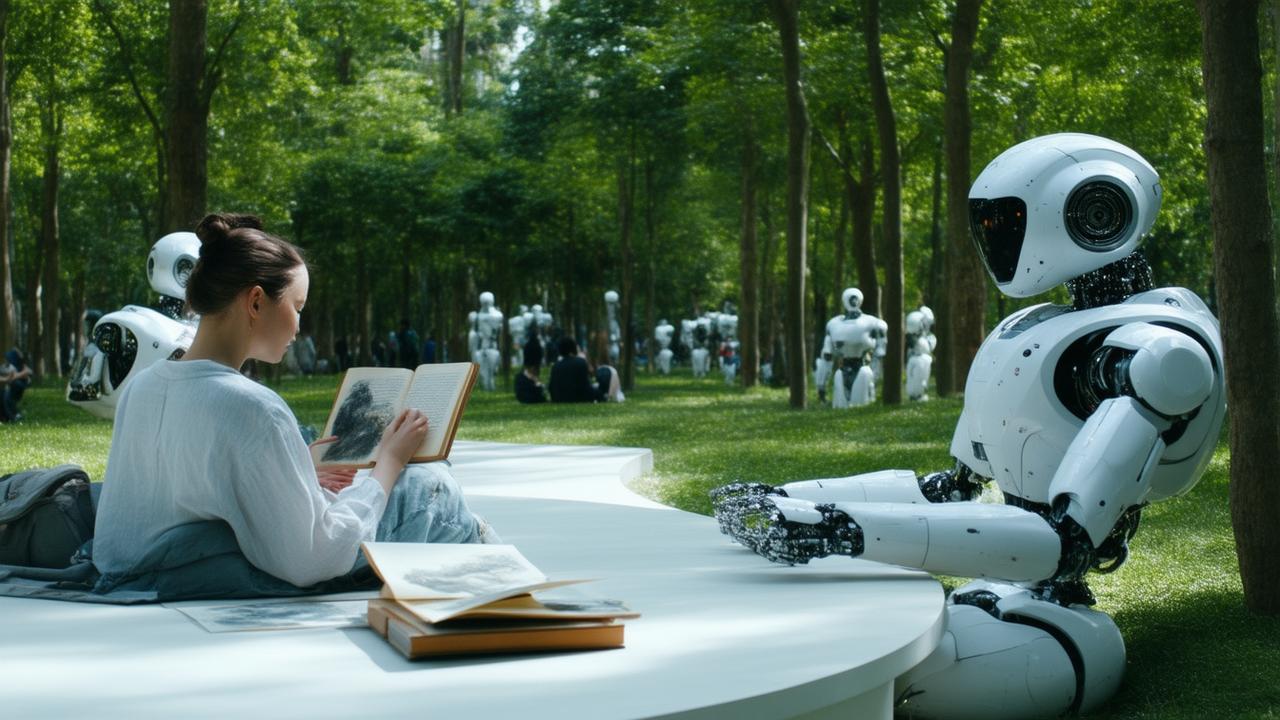
The kookaburras were already laughing in the gum trees when Sarah’s phone began to buzz on the kitchen bench. Another “urgent” email from work. Another ping from the team chat. She silenced the phone, poured a flat white, and watched the morning light spill over the back fence of her Brisbane townhouse. The cicadas were in full chorus, the air thick with that familiar subtropical hum. Somewhere between the steam of her coffee and the first sip, a thought landed with surprising weight: What if this constant rush, this 40-hour week, this juggling act… simply vanished?
Not because she won the lotto. Not because she retired early. But because the job itself was gone—done better, faster, and cheaper by a machine that never slept, never complained, and never needed a mental health day.
It sounds like science fiction, until you hear it from the lips of Nobel Prize–winning physicists and some of the richest tech leaders on the planet—people like Elon Musk and Bill Gates—who say a future of abundant free time is not only possible, but likely. The catch? It may not come bundled with the traditional idea of “having a job.”
The Calm Before the Automation Wave
In Australia, we feel these global predictions a little differently. We’re a nation that romanticises the “Aussie fair go,” the dignity of work, the beachside long weekend. Yet our cities—Sydney traffic, Melbourne office towers, Perth mining camps, Brisbane call centres—are quietly wiring themselves for a different era.
Think about a typical weekday in any capital city. Buses and trains are full of workers scrolling through emails, tradies queuing at the servo, nurses finishing night shifts under fluorescent lights. Behind the scenes, algorithms are routing our food deliveries, predicting our energy use, scanning our medical images. That’s the quiet drumbeat of automation, already shaping our days whether we notice or not.
Now crank that drumbeat up a notch—or ten.
Nobel Prize–winning scientists and economists have been warning that as AI and robotics move from specialised tools to general-purpose workers, entire categories of jobs could be redefined or disappear. Elon Musk predicts that, eventually, “no job is needed.” Bill Gates talks about taxing robots and using the funds to support people whose roles have been automated. To many ears, it sounds dramatic—until you walk through an automated warehouse or watch a large language model write passable business reports in seconds.
In Australia, where mining trucks already drive themselves in parts of the Pilbara and virtual assistants answer customer queries 24/7, the future isn’t on the horizon. It’s parked quietly in the driveway.
The Paradox: More Free Time, Less “Work”
Here’s the strange twist: these experts aren’t predicting a post-apocalyptic wasteland of unemployment. They’re predicting a world of abundance—where machines handle much of the physical and cognitive heavy lifting, giving humans more free time than we’ve had since… well, ever.
Picture this: your mortgage still gets paid, the fridge is full, the lights stay on, but your calendar—currently blocked out with back-to-back meetings and deadlines—is suddenly wide open. Instead of fighting for a week’s annual leave to drive up the coast, you find yourself with days, even weeks, unclaimed.
This isn’t just idle speculation. Economists talk about “decoupling” income from labour—essentially, finding ways for people to live decently even if traditional jobs become scarce or highly unstable. Musk and Gates suggest that productivity gains from automation could, in theory, fund systems like universal basic income, shorter workweeks, or government-supported retraining programs.
But if you’re sitting at the kitchen table in Adelaide or Hobart, running the numbers on your HECS debt and your rent, these grand visions can feel a world away. It’s one thing to be promised more free time. It’s another thing entirely to trust that the bills will still be paid when your job title goes the way of the milkman.
Will Australian Jobs Really Disappear?
Some will. Some already have. And some will change beyond recognition. Take a look at how different roles might shift as automation ramps up:
| Type of Role | What Automation Is Likely To Do | Possible Future in Australia |
|---|---|---|
| Admin & Data Entry | AI handles routine paperwork, reporting, scheduling. | Significant reduction in traditional roles; rise in oversight and coordination jobs. |
| Call Centres & Customer Service | Chatbots & voice AIs solve most basic issues. | Humans focus on complex, emotional, and high-value cases. |
| Transport & Logistics | Autonomous vehicles, drones, smart routing systems. | Fewer drivers; more roles in maintenance, regulation, system control. |
| Healthcare & Aged Care | AI assists with diagnostics, rostering, record-keeping. | Greater demand for human carers, therapists, and specialists. |
| Creative & Cultural Work | Tools generate drafts, designs, and concepts. | Human storytellers, artists, and performers become more about authenticity, curation, and connection. |
Notice the pattern: automation doesn’t just “delete” jobs; it hollows them out, strips away repetitive tasks, and leaves the more social, creative, or complex parts. But that transition can be messy, and if we don’t plan for it, many Australians could get squeezed in the middle.
The Emotional Weather of a Jobless Future
It’s one thing to talk about productivity and policy. It’s another to reckon with how it feels, standing barefoot on your verandah, quietly wondering if your kids will ever know the security of full-time work with super and leave entitlements.
Humans are wired to tie their identity to what they do. In Australia, meet someone at a barbecue, and within two questions you’ll hit: “So, what do you do?” Our sense of worth, our contribution to the community, is often bundled up in our job titles.
So imagine a world where the honest answer becomes: “Not much, to be honest. The robots do most of it.”
For some, that sounds like bliss: more time for surfing, painting, volunteer work, camping under the stars in the Flinders Ranges, pottering in a veggie garden. For others, it sounds like an identity crisis waiting to happen—a sense of drifting, of not being needed.
Musk and Gates might be comfortable with this trade-off because they inhabit a world where “purpose” is self-chosen. They build companies, fund research, back huge ideas. Many ordinary Australians, however, find their structure and meaning in clock-on, clock-off work—the café shift, the construction site, the classroom.
Redefining “Work” in the Australian Way
To make peace with a future of more free time and fewer traditional jobs, we’ll need to broaden what we call “work”—and what we value.
- Caring for kids, elders, and community could step out from the shadows of “unpaid labour” and be recognised, funded, and respected.
- Creative and cultural contributions—music, writing, art, performance—could be seen not as side hobbies, but as central to national wellbeing.
- Environmental stewardship—revegetating bushland, restoring reefs, caring for Country alongside First Nations communities—could become core, supported activity rather than weekend volunteering squeezed around work.
In an automated world, purpose might shift from “What does my employer need?” to “What does my community and country need—and what am I uniquely drawn to do?” That’s a profound psychological shift, one that will demand new language, new rituals, and new policies.
Australia’s Crossroads: Policy, Fairness, and the Fair Go
Here’s where the Nobel laureates and tech billionaires brush up against something deeply Australian: our suspicion of concentrated power and our stubborn belief that everyone deserves a shot. If machines and algorithms are going to create vast new wealth, who owns that wealth—and who benefits?
Without thoughtful policy, there’s a risk we drift toward a two-tier society: those who own or control the machines, and those who don’t. One group floats on a cushion of investments and dividends; the other fights for scraps of remaining human labour.
But that’s not the only path. Imagine instead:
- Tax systems that channel a slice of automation-generated profits into public income support.
- Free or heavily subsidised retraining so a truck driver in regional WA can become a drone operator or renewable energy technician.
- Public investment in sectors that machines can’t easily replace: human-centric healthcare, mental health support, early childhood education, arts and culture, environmental repair.
The conversation isn’t really about whether Musk and Gates are right that more free time is coming. The physics, the computer science, the economics all point in that direction. The real question for Australia is: Who gets to enjoy that free time—and on what terms?
➡️ Boiling rosemary is a simple home tip I learned from my grandmother, and it can completely transform the atmosphere of your home
➡️ Goodbye Kitchen Islands : their 2026 Replacement Is A More Practical And Elegant Trend
➡️ Goodbye to the air fryer as a new all-in-one kitchen device introduces nine cooking methods that go far beyond basic frying
➡️ Bird lovers use this cheap February treat to keep feeders busy and attract birds every morning
➡️ A psychologist is adamant : “the best stage in a person’s life is the one where they start thinking this way”
➡️ Goodbye Kitchen Islands : Their 2026 Replacement Is A More Practical And Elegant Trend
➡️ Goodbye steaming : the best way to cook broccoli to keep nutrients plus easy recipes to try
Preparing Yourself (and Your Kids) for the Shift
So what can a single person do, sitting there with a coffee as the magpies warble outside and the news headlines blur together with warnings about AI and the future of work?
Start with three simple moves:
- Invest in human skills. Curiosity, communication, ethics, empathy, creativity. The more a skill depends on genuine human connection and judgment, the harder it is to automate.
- Stay literate in technology. You don’t have to be a coder, but understanding how AI tools work, their limits, and how to use them will be as basic as knowing how to send an email.
- Join the conversation. Whether it’s a union meeting, a local community group, or a town hall with your MP, the policies shaping this transition will be written by people who show up.
Talk to your kids about “learning how to learn” rather than just chasing a single stable career that might vanish. Help them see “work” as one part of a bigger life that includes contribution, creativity, and care.
Life After the 9-to-5: Imagining the New Normal
On a Wednesday morning in this future Australia, the streets are quieter at 8am. There’s no frantic peak hour, just a steady flow of people doing their own thing. Some head to co-working hubs for short, intense bursts of project work. Others stroll to local makerspaces, studios, community gardens.
Sarah—remember her from the start?—no longer has a job title printed on a business card. Instead, she spends three days a week coordinating volunteers for a coastal restoration project near the Sunshine Coast. Two afternoons are devoted to an online course in psychology, because she’s fascinated by how humans adapt to change. On Fridays, she leads a writing group at the local library, helping others tell their stories in a world obsessed with data.
Her income comes from a mix of a government base payment funded by automation taxes, a modest stipend for her coordination work, and small grants for community projects. She’s not rich. But the constant tightness in her chest—the scramble to prove her worth in a cubicle—has loosened.
She has time. Not idle, pointless time, but open, living time. Time to walk along the river at dusk and notice the way the bats wheel out over the water. Time to visit her ageing parents without stress. Time, even, to be a little bored—and see what comes out of that.
This is the world that haunts the speeches of Nobel laureates and tech billionaires alike. A world where our problem is no longer scarcity of stuff, but scarcity of meaning. A world where we must relearn how to be citizens, neighbours, and creators, not just employees.
Will it be easy? No. Will there be disruption, fear, and unfairness if we don’t act carefully? Absolutely. But in a country that prides itself on the fair go and the long weekend, maybe we’re peculiarly well placed to ask: if the machines are taking over the work, what deeply human life do we want to build in the space they leave behind?
Frequently Asked Questions
Will AI really take most Australian jobs?
AI is more likely to transform jobs than simply eliminate them. Many roles will change shape, with repetitive tasks automated and humans focusing on complex, social, and creative work. Some jobs will disappear entirely, and new ones will emerge. The scale and speed of this shift depend heavily on policy, investment, and how quickly businesses adopt new technologies.
Does a future with fewer jobs mean everyone will be worse off?
Not necessarily. If productivity gains from automation are shared fairly—through taxation, public services, and new income supports—people could enjoy better living standards with less paid work. The risk is that, without fair systems, the benefits accumulate only to a small group of owners and investors.
What kinds of skills should Australians focus on for the future?
Skills that are hard to automate: critical thinking, emotional intelligence, communication, creativity, collaboration, and ethical reasoning. Technical literacy—understanding and working alongside AI and digital tools—will also be essential across many fields.
How might the Australian government respond to large-scale automation?
Possible responses include funding retraining and education, adjusting the tax system to capture more from automated businesses, expanding social safety nets, and investing in human-centric sectors like health, education, arts, and environmental restoration. The exact path will depend on political choices and public pressure.
What can I do now to prepare my family?
Stay informed about technological trends, cultivate flexible and transferable skills, encourage lifelong learning, and participate in public discussions about the future of work. Talk openly with your family about different ways of finding purpose—through community, creativity, and care, as well as traditional employment.





