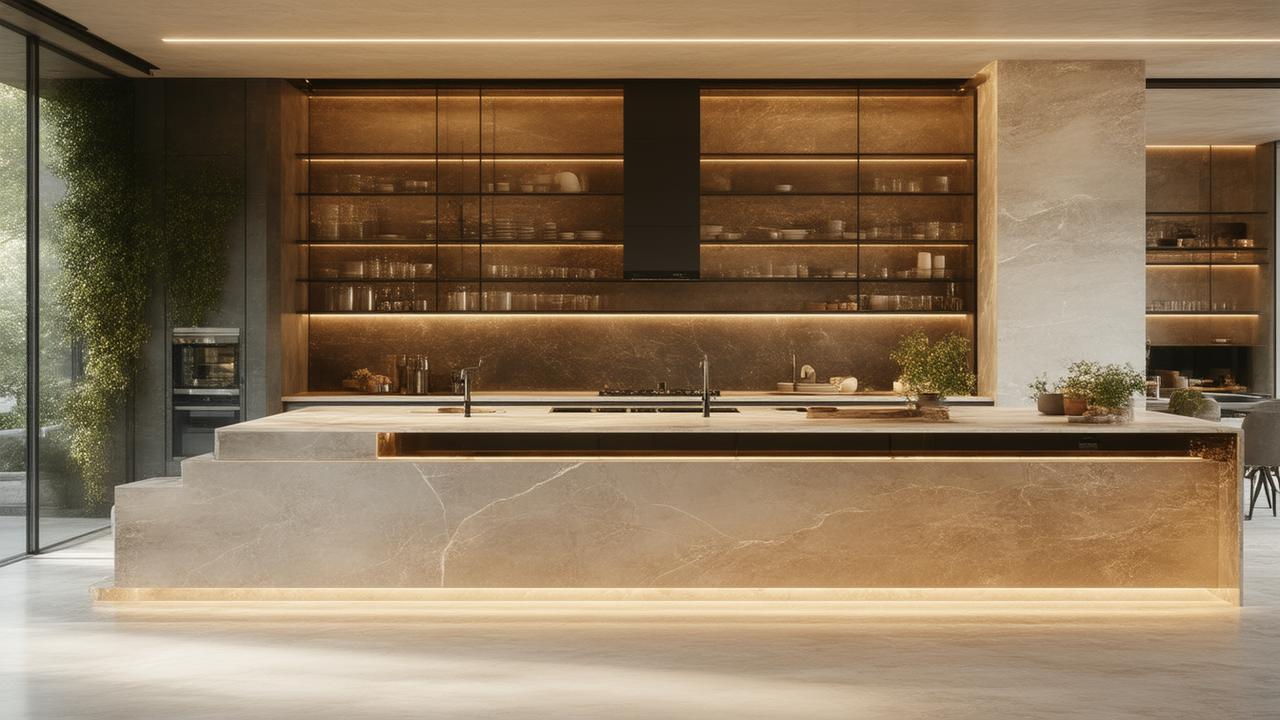
The morning light in Brisbane hits differently when it pours across a kitchen that actually works with you, not against you. No sharp island corners to hip-check on the school run. No cluttered bench becoming the drop zone for mail, keys, laptops, lunchboxes and last night’s shopping bags. Just one long, graceful flow of space – cooking, chatting, moving, living – without that hulking block in the middle. Across Australia, from city apartments to coastal homes, a quiet revolution is happening: we’re saying goodbye to the traditional kitchen island, and welcoming in something far more practical, elegant and human.
The End of the Kitchen Blockage
For nearly two decades, the kitchen island has been the poster child of “dream home” marketing. Real estate photography loved it: big slab, stone waterfall edge, a bowl of lemons, maybe a cookbook strategically open at a rustic tart. But walk into enough real Australian homes, and you hear a different story.
“It just gets in the way,” a Melbourne couple might tell you as they edge around their island to reach the fridge. A young family in Perth jokes that their island is “a very expensive dumping ground”. Empty wine bottles after a long weekend, the kids’ school projects, the dog’s lead, the groceries you still haven’t properly put away.
In theory, the island was meant to be the heart of the home. In practice, in many Aussie floor plans – especially narrower terraces, apartments, and townhouses – it has turned into a bulky traffic jam right where you most need freedom to move. Add more than two people cooking or chatting, and suddenly everyone’s doing the awkward sideways shuffle.
As our lifestyles bend towards flexibility, hybrid working, multi-generational living, and smaller urban footprints, Australians are quietly asking: is there a better way to do this?
The Rise of the “Kitchen Stage” Peninsula
The answer taking shape in 2026 is not a return to tiny kitchens hidden behind walls. It’s a gentler, more fluid design: the modern kitchen peninsula – or as some designers are calling it, the “kitchen stage”. Think of it as an island that finally realised that being attached is, in fact, an advantage.
Instead of a block plonked in the middle of the room, a peninsula runs out from a wall or cabinetry bank, forming a partial U-shape or L-shape. It opens to the living or dining area, but anchors itself to one side, freeing up the rest of the space. More flow, fewer bottlenecks.
You’re standing at a peninsula in a Sydney apartment on a mild autumn evening. On one side is a deep counter where you’re slicing tomatoes, with a wide view through the sliding doors out to the balcony. On the other side, your partner leans on the benchtop with a glass of wine, scrolling through playlists. Friends drift in and perch on stools, but no one’s blocking the fridge or boxed into a corner. Movement feels natural. The kitchen works like a stage: you can cook, chat, demonstrate, serve. The audience can gather without being right in the middle of your workflow.
This subtle shift turns the peninsula into that rare design move: more practical and more elegant. Less bulk in the middle, more connection at the edges.
| Feature | Traditional Kitchen Island | Modern Peninsula “Kitchen Stage” |
|---|---|---|
| Space Needs | Requires wide room for circulation on all sides | Fits comfortably in narrower Aussie floor plans |
| Traffic Flow | Can create bottlenecks and tight corners | Keeps one side open, smoother movement through space |
| Social Connection | People crowd around all sides, often blocking storage | Clear “cook side” and “guest side” for natural interaction |
| Cost & Services | More complex plumbing/electrical in the centre of room | Services can often run from existing wall, reducing cost |
| Visual Impact | Can feel bulky in smaller rooms | Lighter, more open, easier to style with fewer hard edges |
Why Australians Are Over Islands (Even If We Still Love Benchtops)
Part of this shift is simply down to Australian reality. Ours is a country where the idea of space often doesn’t match the actual floor plans we live in. In glossy magazines we see sprawling coastal kitchens; in real life, many of us are in compact inner-city apartments, narrow-lot builds, or renovated workers’ cottages trying to squeeze a social kitchen into a tight footprint.
The island was imported from those larger North American homes – homes that often have more square metres to play with than your entire townhouse. When dropped into a smaller Aussie layout, the island can feel like furniture that hasn’t quite adapted to the climate.
Then there’s the way we live now. Work-from-home has blurred the lines between laptop, chopping board and homework station. The kitchen is rarely just for cooking. It’s a desk, a meeting table, a bar, a craft station, a place to quietly drink tea while the dog watches you hopefully.
A peninsula answers this with a long, flexible face that can be used in different ways over a day. One end might hold your cooktop; the other becomes the go-to spot for emails or Friday-night pizzas. There’s room to slide in stools, but also enough clearance behind them to keep the room breathing.
It’s also gently better for families. Parents can stand at the working side, chopping veggies for a stir-fry, while kids sit opposite doing homework or painting. There’s a clear “do not cross” line for safety around knives and hot pans, but connection across the bench remains easy and relaxed.
The Feel of the New Kitchen: Softer, Longer, Warmer
Close your eyes and step into a 2026 kitchen in a Gold Coast townhouse that’s just been renovated. The peninsula curves ever so slightly at the end, no sharp right angle you’ll bruise yourself on in the dark. The cabinetry is a warm eucalyptus green, the benchtop a pale, softly veined stone that catches the Queensland light without glaring.
You run your hand along the edge. No thick, chunky stone waterfall here – just a slim, finely-detailed profile that feels more like furniture than infrastructure. Underneath, timber stools tuck away neatly, their legs echoing the spotted gum floorboards. Overhead, a simple linear pendant throws a gentle wash of light, emphasising that this is now the scene of many things: breakfast, late-night chats, half-finished art projects.
On the working side, drawers glide open to reveal deep, organised storage: pots, pans, spices, tupperware all calmly in their place. The peninsula doesn’t shout for attention; it quietly supports whatever the day needs it to be.
Designers across Australia are layering in tactile, locally resonant materials – warm timbers, soft neutrals, muted coastal tones, even rich clay and rust inspired by the inland. The peninsula becomes the canvas for this palette, while its attached end hides power, plumbing and storage in a way that feels elegant, not industrial.
Planning Your Island-Free Kitchen in Australia
If you’re renovating in 2026 and wondering whether to ditch the island, the first step is to walk your space and notice how you actually move. Do you constantly cut corners? Do people cluster where you’re trying to cook? Are you always walking around something?
In a narrow terrace in inner Sydney, a peninsula running out from a wall can preserve a generous walkway past the kitchen to the backyard, rather than blocking the entire centre. In a Brisbane high-rise, a peninsula can double as both kitchen prep and dining table, freeing up the rest of the living room for a sofa that finally fits your whole family.
Australian designers are also focusing on what they call “zoning with softness”: instead of using an island as a hard divider between kitchen and living, they’re using peninsulas, open shelving, and low storage that mark a transition without chopping the space in half. The kitchen becomes part of a broader living landscape rather than a separate fortress.
When planning, questions worth asking include:
➡️ Boiling rosemary is a simple home tip I learned from my grandmother, and it can completely transform the atmosphere of your home
➡️ A Nobel Prize–winning physicist says Elon Musk and Bill Gates are right about the future : we’ll have far more free time: but we may no longer have jobs
➡️ Goodbye to the air fryer as a new all-in-one kitchen device introduces nine cooking methods that go far beyond basic frying
➡️ Bird lovers use this cheap February treat to keep feeders busy and attract birds every morning
➡️ A psychologist is adamant : “the best stage in a person’s life is the one where they start thinking this way”
➡️ Goodbye Kitchen Islands : Their 2026 Replacement Is A More Practical And Elegant Trend
➡️ Goodbye steaming : the best way to cook broccoli to keep nutrients plus easy recipes to try
- Can I get at least one generous, clear pathway through the room if I choose a peninsula instead of an island?
- Where does the light come from – and will a central island block it more than a side-attached bench?
- Can I run plumbing, power and gas more easily from the wall into a peninsula, reducing costs?
- Do I need the extra circulation around all four sides of an island, or would one open side feel calmer and more intentional?
Often, the peninsula wins not just aesthetically, but financially and practically, especially in typical Australian builds where services are already on one side.
Flexible Benches, Trolleys and Tables: The Supporting Cast
The other quiet trend stepping in as islands move out is flexibility. Instead of one big immovable block, more Australians are turning to layered solutions: slim peninsulas paired with moveable benches, kitchen trolleys, or dining tables that can slide into place when needed.
Imagine a small Adelaide kitchen where the peninsula gives you your main prep space, but a lightweight timber trolley on castors can be wheeled in for big cooking sessions or wheeled out for parties. Or a Canberra home where a narrow table lines up with the end of the peninsula, forming a long communal surface for celebrations – then separates again for everyday life.
These additions acknowledge a simple truth: our lives are not static. Some weeks you’re batch-cooking and need every square centimetre of bench space. Other weeks the kitchen is mostly a coffee station, and what you crave is clear floor, not more surfaces to clean.
Instead of a monolithic island defining the room forever, you get pieces that respond to seasons, guests, kids growing up, even career changes. The kitchen becomes less of a fixed monument, more of a living, adjustable space.
Goodbye, Kitchen Island. Hello, Kitchens That Breathe.
In the end, saying goodbye to kitchen islands in 2026 isn’t really about rejecting the past. It’s about recognising that our homes are telling us what they need. Australian kitchens are asking for room to exhale. They’re asking for spaces where cooking, working, parenting and relaxing can blur without turning into chaos.
The new peninsula-based “kitchen stage”, paired with flexible furniture and thoughtful zoning, gives us that breathing space. It honours our love of gathering around food, our need for openness, our coastal and suburban light, and even our national tendency to carry on the conversation long after the plates are cleared.
One day, you might look back on the old island in your memory and realise it always felt a little like a roadblock. And you’ll stand at your new, elegant, practical peninsula, coffee mug warming your hand, morning light running the length of the bench, and wonder how that big stone block ever felt like progress.
Frequently Asked Questions
Are kitchen islands really “out” in Australia by 2026?
Not completely, but they’re no longer seen as the default. In many new builds and renovations, especially where space is limited, peninsulas and more flexible layouts are becoming the preferred choice because they work better with real Australian floor plans and lifestyles.
Is a peninsula suitable for a small apartment kitchen?
Yes. In compact apartments, a peninsula can act as prep space, casual dining, and a work-from-home spot all in one. Because it’s attached to a wall or cabinet run, it usually takes up less circulation space than a full island.
Will I lose storage if I remove an island?
Not necessarily. A well-designed peninsula can include deep drawers, corner solutions, and overhead storage that often equals or exceeds what a bulky island provided, especially when combined with smarter wall cabinetry.
Is a peninsula cheaper than an island to build?
It often can be. Because a peninsula connects to existing walls, running plumbing, gas and power is usually simpler and more cost-effective than bringing all those services into the centre of the room.
Can I still have bar stools without an island?
Absolutely. Peninsulas are perfect for stools on the living-room side, and can be designed with comfortable overhangs for knees and feet, just like a traditional breakfast bar – often with better traffic flow around them.





