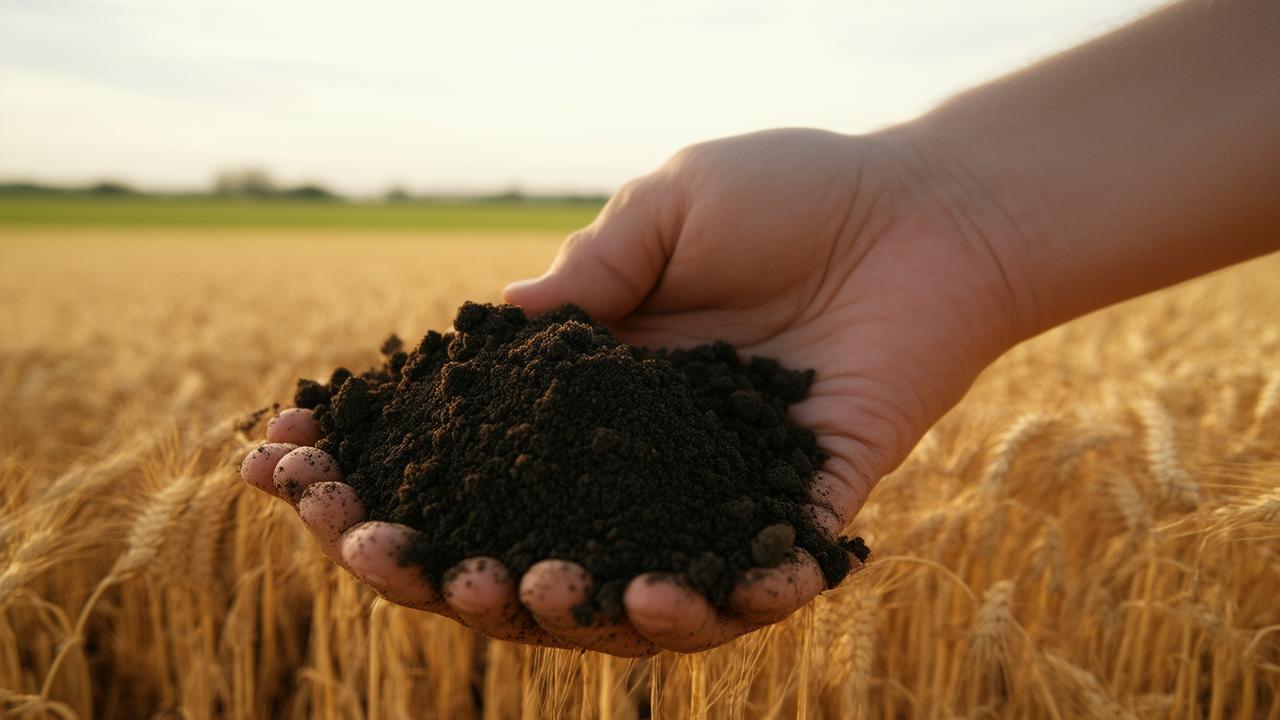
The first time you hold chernozem in your hands, it feels like a trick of the light. Soil isn’t meant to be this black, this soft, this alive. It pours through your fingers more like ground coffee than dirt, smelling of rain and fallen leaves and distant storms. In the endless plains of Ukraine, Russia and Kazakhstan, this “black gold of agriculture” lies in layers up to a metre deep, a dark skin stretched over a continent. It’s helped feed empires, build fortunes and shape geopolitical strategies. And from the other side of the world, in Australia’s sunburnt paddocks and sandy soils, it raises a quietly unsettling question: what does it mean when the richest soil on Earth becomes a strategic asset?
The Day the Earth Turned Black
Imagine flying low over the Eurasian steppe at dawn. Below you, the land rolls away in vast, treeless waves, stitched with fields of wheat and sunflowers. There are no fences as far as you can see, only long, neat bands of colour: pale gold, fresh green, the dark raw brown of freshly turned ground. It’s that bare soil that catches the eye. Instead of the familiar red-brown that most Australians know, this earth is almost ink-black, as if someone has turned down the brightness of the land.
This is chernozem – from the Russian words cherniy (black) and zemlya (earth). It didn’t form overnight. It’s the product of thousands of years of deep-rooted grasses, cold winters, slow decay, and patient microbes. Over time, layer upon layer of organic matter built up, mingling with mineral particles until the topsoil thickened into a springy, carbon-rich sponge that can run a metre deep. Walk across a freshly ploughed chernozem field and your boots leave soft, rounded prints instead of hard-edged cuts. It’s like walking on a duvet.
For farmers, chernozem is as close as nature gets to a guarantee. It holds water yet drains well, clings to nutrients yet makes them easily available to plants. In places, it’s so rich that fields can be cropped for years with far less fertiliser than Australian farmers are used to spreading. If soil were currency, chernozem would be the gold standard – except it doesn’t sit in vaults. It lies out in the open, across some of the most contested landscapes on Earth.
The Breadbasket that Feeds the World
Australia, with its proud identity as a major grain exporter, knows the quiet power of wheat. We know the feeling of watching skies for rain, the rumble of harvesters, the satisfaction of a good season reflected back in world prices. Now multiply that feeling across a region where the ground itself gives farmers a head start every year.
Ukraine’s famed “black earth belt” arcs across the country; Russia’s steppe and Kazakhstan’s plains extend it into a vast crescent. Together, these lands form one of the world’s great breadbaskets. Before recent conflicts disrupted trade, Ukraine alone produced enough grain to feed hundreds of millions of people, exporting wheat, barley, corn and sunflower oil to markets from the Middle East to Africa to Asia. Russia and Kazakhstan, too, are major wheat exporters, their grain flowing out through the Black Sea, the Caspian and deep into Eurasia.
In global trade figures, this looks like tonnage and dollars. On the ground, it looks like children in Egypt eating subsidised bread, millers in Bangladesh blending imported wheat, bakeries in Lebanon staying open one more week. It looks, uncomfortably, like whole countries leaning on the invisible stability of faraway soils they will never see, soils whose politics they don’t control.
For an Australian audience, the idea of relying so heavily on another region’s soil for global food security might sound risky. We’re used to thinking of resilience – of spreading risk across multiple climate zones, multiple suppliers. Yet the quiet truth is that chernozem has made the Black Sea region disproportionately important. When war, drought or export bans choke that supply, the ripple hits global grain markets, and from there, supermarket shelves and food aid programs. In a world with a growing population and tightening climate pressures, a single belt of high-performance soil becomes more than a natural wonder. It becomes leverage.
The Science and the Spell of “Black Gold”
Stand in a chernozem field after rain and you can smell the chemistry at work. There’s that earthy note of geosmin, the compound that tells us microbes are thriving. There’s the faint sweetness of decomposed plant matter, the ghost of past seasons feeding the next. That smell is the perfume of carbon – not the abstract villain of climate debates, but the solid, dark stuff woven into the soil’s very structure.
Chernozem typically contains high levels of soil organic carbon, often double or triple that of many Australian agricultural soils. That carbon acts like a sponge, soaking up water and holding onto nutrients such as nitrogen and phosphorus. Plant roots explore this matrix with ease, finding moisture even after weeks without rain. For a wheat plant, it’s like having a well-stocked pantry and a reliable water tank built right into your home.
For Australian farmers used to coaxing life out of sands, clays and weathered ancient soils, the sheer generosity of chernozem can feel almost unfair. Our soils are some of the oldest on Earth – leached, often acidic, short on phosphorus and organic matter. We’ve learned to work with them through careful management: no-till systems, stubble retention, crop rotations, lime applications, controlled traffic and precision fertilising. We build carbon slowly, season by season. The steppe, on the other hand, began with a balance that many agronomists would call dreamlike.
But chernozem isn’t invincible. Plough it too often, and the carbon that took millennia to build escapes into the atmosphere in decades. Leave it bare and wind strips it away. Work it without care and the structure collapses, turning soft crumbs into hard clods. The same black gold that once seemed endless has already been degraded in some regions by overuse and poor policy. Even the richest soil can be squandered.
Soil as a Strategic Asset
At first glance, it’s hard to reconcile something as humble as dirt with the cold language of geopolitics. Soil doesn’t march or negotiate. It doesn’t issue statements. It simply lies there, absorbing rain, nurturing roots, bearing the weight of tractors and tanks alike. Yet when you zoom out far enough, patterns emerge.
The countries that sit atop the chernozem belt wield a quiet, sometimes uneasy power. Their soils underpin significant shares of global grain exports. When those exports falter, world prices spike. Food-importing nations feel the shock: governments worry about social unrest, humanitarian agencies recalculate budgets, households trim grocery lists. The Black Sea region’s harvests have become woven into the fabric of global stability as tightly as oil flows or shipping routes.
Australia, too, is a major grain exporter, but we play a different role. Our yields are more variable, our seasons increasingly erratic under climate change, our soils more fragile. We’re a significant player, but not usually a swing producer on the same scale as the Black Sea during normal years. That may change as weather patterns shift, but for now, chernozem-heavy regions often act as the world’s buffer – the place everyone silently hopes had a good season.
Thinking of soil as a strategic asset shifts how we see the ground beneath our feet. It’s no longer just “where we farm”; it’s part of our national resilience, our bargaining power, our responsibility. For Australia, that means two things: recognising the geopolitical weight of other people’s soils, and looking harder at how we care for our own. If a metre of black earth can sway global grain flows, the loss or recovery of a few centimetres of Australian topsoil suddenly looks like more than a local agronomy issue.
Australia’s Soils: Old, Tired, and Full of Possibility
Drive west out of any Australian coastal city and the colours change quickly. The greens thin out, the browns and reds deepen. In the wheatbelt, freshly worked paddocks gleam pale or rust-coloured, not black. Dust lingers on the horizon after a ute passes, hanging in the dry air like a warning.
Our soils are ancient survivors. Most have been weathered for millions of years, scrubbed clean of nutrients by time and rain. They don’t hand out fertility easily. When Europeans first arrived, some regions looked deceptively lush – tall grasses, open woodlands – but the underlying soils often held only modest reserves of plant-available nutrients. The fertility we thought we saw was really a thin balance, quickly tipped.
And yet, against this backdrop, Australian agriculture has achieved remarkable yields and quality. We’ve done it not by relying on deep, dark topsoil, but by learning to manage what we have with precision and care. It’s a kind of quiet ingenuity: calibrating fertiliser spreaders by the kilogram, setting up shelterbelts to cut wind erosion, sowing directly into last year’s stubble so the soil remains armoured against sun and storm. Farmers become part engineer, part ecologist, part gambler.
That experience is increasingly valuable. While the world marvels at chernozem, climate change is testing every farming system, including those on black soils. Long-term resilience may not lie only in having the richest soil, but in having learned how to farm as if nothing can be wasted. In that sense, Australia’s tough soils have taught us hard lessons that the rest of the world may now need.
➡️ The streak-free window-cleaning method that still works flawlessly even in freezing temperatures
➡️ The quick and effective method to restore your TV screen to like-new condition
➡️ Thousands of passengers stranded in USA as Delta, American, JetBlue, Spirit and others cancel 470 and delay 4,946 flights, disrupting Atlanta, Chicago, New York, Los Angeles, Dallas, Miami, Orlando, Boston, Detroit, Fort Lauderdale and more
➡️ The sleep pattern that predicts alzheimer’s risk 15 years before symptoms
➡️ These zodiac signs are destined for major prosperity in 2026, according to astrological forecasts
➡️ The RSPCA urges anyone with robins in their garden to put out this simple kitchen staple to help birds cope right now
➡️ The RSPCA urges anyone with robins in their garden to put out this simple kitchen staple today
Table: Chernozem vs Typical Australian Cropping Soils
| Characteristic | Chernozem (Ukraine/Russia/Kazakhstan) | Typical Australian Cropping Soils |
|---|---|---|
| Topsoil depth | Up to ~1 m of dark, rich topsoil | Often 10–30 cm of lighter topsoil |
| Organic carbon content | High (thick, carbon-rich layer) | Low to moderate, often depleted |
| Natural fertility | Very high; lower fertiliser needs | Often low; heavy reliance on inputs |
| Age of soil | Relatively young, less weathered | Very old, highly weathered |
| Sensitivity to mismanagement | Can be degraded quickly if over-ploughed | Prone to erosion and nutrient loss, but often already marginal |
What the World’s Blackest Soil Teaches a Dry Continent
From a distance, it’s easy to romanticise chernozem: to imagine it as a kind of agricultural cheat code, a permanent advantage granted by nature. Stand among the stubble after harvest in a Ukrainian field, run your hand through the black crumbs, and you might be tempted to believe that some places are simply blessed and others are not.
But soils, like societies, carry their own vulnerabilities. That one-metre cushion of fertility can breed overconfidence. Policies may assume yields will always be high, exports always flowing. Farmers may feel less urgency to protect every tonne of topsoil when there seems to be so much of it. History shows how quickly that illusion can shatter – the Dust Bowl in the United States, salinity in parts of Australia, erosion on newly cleared steppe lands.
For Australians, the story of chernozem is not just about envy or wonder. It’s a mirror held up to our own relationship with land. We don’t have a metre of black earth to lean on, but we do have a growing understanding that soil is finite, fragile and foundational. The Black Sea region’s role as a breadbasket reminds us how tightly our fates are tied to places we may never visit. At the same time, our own experiences on lean, stubborn soils remind us that resilience isn’t just a gift of geology – it’s a practice.
Somewhere between a cracked red paddock in Western Australia and a black, rain-soaked field in central Ukraine lies a shared truth: without healthy soil, all our grand plans – for food security, trade, diplomacy, even peace – lose their footing. Whether the earth is dark as coffee or pale as dust, its value reaches far beyond the farm gate.
Next time you see a headline about wheat prices or conflict in a region you have to find on a map, imagine a handful of soil instead. Feel its weight. Smell the rain trapped in its particles, the ghost of old grasses and forgotten harvests. In that small, silent handful lies a story as large as any nation’s, a story that runs from the black earth of Eurasia to the weathered paddocks of Australia – and onto every plate on every table.
Frequently Asked Questions
What exactly is chernozem?
Chernozem is a type of very dark, fertile soil rich in organic carbon and nutrients. It typically forms under grasslands in temperate climates and can have a topsoil layer up to about one metre deep. It is especially widespread in Ukraine, Russia and Kazakhstan.
Why is chernozem called “black gold of agriculture”?
It’s called “black gold” because its deep black colour reflects very high organic matter content, and its fertility makes it extremely valuable for crop production. For farmers and nations, it can be as strategically important as mineral resources.
Does Australia have any chernozem?
Australia does not have classic chernozem like that found in the Black Sea region. Our soils are generally older, more weathered and less naturally fertile, though there are pockets of darker, more fertile soils in some regions.
How does Black Sea grain production affect Australia?
Grain from Ukraine, Russia and Kazakhstan influences global supply and prices. When production or exports from those regions are disrupted, prices can rise worldwide, affecting Australian grain growers, feedlots, food processors and, indirectly, consumers.
Can Australian soils ever be as fertile as chernozem?
In natural terms, it’s unlikely our ancient soils will match chernozem’s depth and inherent fertility. However, careful management – building organic matter, protecting topsoil, and using inputs efficiently – can significantly improve productivity and resilience on Australian farms.
Is chernozem good or bad for the climate?
Healthy chernozem stores large amounts of carbon, which is positive for climate mitigation. But if it is over-ploughed or degraded, that carbon can be released as CO₂. Protecting and managing these soils well is crucial for both food security and climate goals.
Why should non-farmers in Australia care about soils overseas?
Because global food systems are interconnected. Disruptions in major grain-producing regions can affect world food prices, aid programs and political stability, which in turn can influence Australia’s economy, trade, and humanitarian responsibilities.





