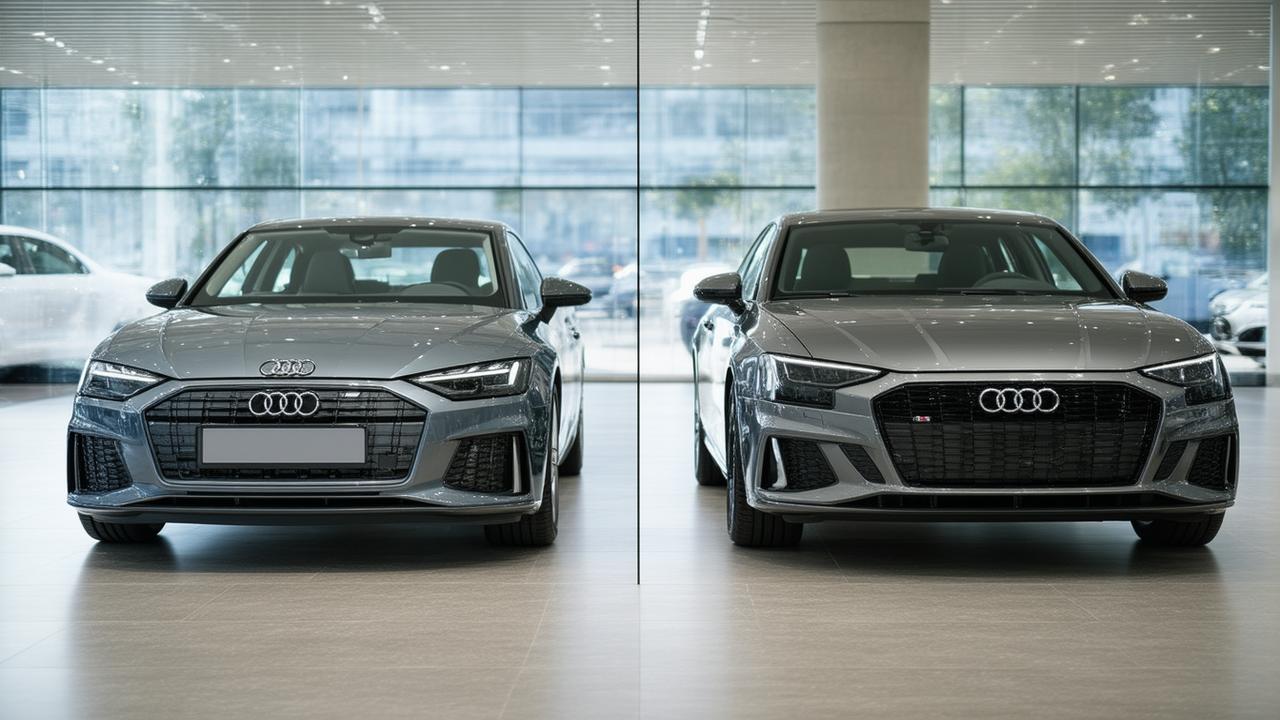
The first time you hear it, it sounds like a typo. China’s 2026 “Car of the Year” is an Audi – a sleek, tech‑stuffed, all‑electric premium model – and it costs, after subsidies, roughly what you’d pay for a base A1 in France. Not an A4, not a Q3. An A1. The baby Audi you might see zipping around inner‑city Melbourne in rideshare fleets or squeezed into a tight street park in Sydney’s Newtown. Meanwhile, here in Australia, many buyers are still doing the maths on five‑year loans for a mid‑spec Corolla. The gap you’ve felt quietly widening every time you look at overseas car news? It just cracked open like a fault line.
The Audi That Broke The Internet (And The Price Curve)
Picture Shanghai in winter: LED billboards glowing through a thin mist, the air full of that tangled scent of street food, cold metal, and faint battery whine from scooters and EVs. On a raised turntable in an exhibition hall, Audi’s China‑market electric sedan sits under hard white light. It’s not a concept car. It’s not some unobtainable halo model. It’s a real, production‑ready machine, crowned “Car of the Year” by Chinese juries who have more choice than almost anywhere else on Earth.
Its doors thunk shut with that satisfying, damped German precision. Inside, there’s a clean, tablet‑like dash, ambient lighting welded into every contour, seats that feel more business‑class than family hatch. Range figures are comfortably north of what most Aussies do in a week of commuting, and the car talks fluently with China’s dense charging network, smart traffic systems, and your phone, which is basically your key and control centre.
Then the price flashes up on the screen – converted, journalists note, to something eerily familiar. In China, with local production, incentives, and brutal competition, this Audi lands in the same price territory as a base A1 in France. A premium EV sedan for what Europe pays for an entry‑level petrol hatch. And you can almost hear Aussies at home mutter into their phones: how is that even possible?
The Global Price Gap: Australia At The Wrong End Of The See‑Saw
Australia, from the driver’s seat, has always felt a bit like a car museum that never quite caught up with the future. Yes, there are Teslas outside Woolies now, Polestars in CBD car parks, and BYDs delivering quietly from minimalist showrooms. But step back and look at the bigger picture and it’s obvious: the world is moving much faster than we are.
In China, EVs and advanced hybrids fight a knife‑edge battle for buyers. Dozens of brands. Model updates measured in months, not years. Government support woven into city planning, energy grids, and industrial policy. In Europe, tight emissions rules and hefty fuel prices have forced the market to take electrification seriously, even if it sometimes grumbles along the way.
Here in Australia? For decades we’ve coasted. No national fuel efficiency standard to speak of until very recently. Big distances, relatively cheap fuel, and a political conversation that treated climate policy like a rugby ball instead of infrastructure planning. We love utes with towering chrome grilles and diesel SUVs that can tow a caravan to Darwin, even if most of them never leave the suburbs. The result is simple and uncomfortable: carmakers send their most advanced, most aggressively priced products to the markets that move fastest and regulate hardest. We, politely, get what’s left.
Why China Gets The Bargain Audi And We Don’t
To understand why that Audi can be so cheap in China – and so out of reach in Australia – you have to imagine two very different factory floors. In China, Audi and its partners plug into an industrial ecosystem built specifically for the EV age: localised battery supply, heavily subsidised R&D, a government that doesn’t just encourage EVs but strategically orchestrates them.
Volumes are massive. A popular EV there can rack up more sales in a few months than some models manage in Australia in their entire lifetime. That scale drags costs down. So do local supply chains: from raw materials to semiconductors, many of the players sit only a few industrial parks away. Add in government incentives and you get the kind of sticker prices that keep foreign executives awake at night.
Australia operates at the opposite end of the spectrum. A relatively tiny market with scattered cities, right‑hand drive, and historically loose emissions rules. Manufacturers pay more to homologate cars for us, ship them to us, and support them here. We apply our own taxes and on‑road costs, and in some states, EV incentives come and go with election cycles. The Audi that’s a mainstream hero in China becomes a niche halo car, if it comes here at all – and its price tag swells accordingly.
| Market | Car Type | Approx. Price Band | Typical Buyer Experience |
|---|---|---|---|
| China (2026) | Premium Audi EV (Car of the Year) | Equivalent to base Audi A1 in France | High‑tech, long range, dense charging network |
| France (2026) | Entry‑level Audi A1 (petrol) | Same price band as China’s premium EV | Compact hatch, limited EV incentives compared to China |
| Australia (2026) | Mid‑range small SUV or basic EV | Often higher than both above once on‑roads added | Thinner model choice, patchy charging outside cities |
How It Feels On Australian Roads
Think about an ordinary Australian Saturday. The sun is sharp, the bitumen shimmering slightly as you weave through traffic toward Bunnings or the coast. Around you: dual‑cab utes with toolboxes and surfboards; ageing hatches; a few shiny crossovers wearing finance stickers behind their tinted glass. Every now and then an EV slips past with that eerie hush, but they’re still rare enough to turn heads in many suburbs.
Now imagine pulling up in that Chinese‑market Audi. The silence at the lights. The instant torque that nudges you forward when the arrow flicks green. Your dash softly pulsing with navigation, charging availability along your route, even dynamic traffic updates piped in from some central system. Not a luxury in Shanghai. Just… a car. A normal, mid‑market choice for an urban family.
For a lot of Australians, that gap isn’t just technical; it’s emotional. We’re used to waiting. We waited for affordable diesels, for safety tech, for hybrids, for smart cruise control. We’re waiting now for a real wave of low‑cost EVs that feel like no‑brainer purchases rather than political statements. And as we wait, we watch videos of Chinese buyers stepping into a future that, for them, comes standard.
The Policy Decisions Under The Bonnet
Car prices don’t just fall from the sky; they’re shaped by decisions that happen in quietly lit meeting rooms and noisy parliamentary debates. China’s approach has been unapologetically interventionist: long‑term planning, direct subsidies, industrial strategy that links energy security with electric mobility. The Audi that wins awards there is standing on the shoulders of battery research grants, charging infrastructure targets, and a government that wants to dominate the next century’s auto tech.
For years, Australia went another way. We leaned on market forces, shrugged at the collapse of local manufacturing, and treated cars as private purchases rather than as part of a national transport ecosystem. We’re starting to pivot – fuel efficiency standards are finally emerging, state governments are testing EV incentives, fleets are beginning to turn over – but it’s early, and the rest of the world has a big head start.
That’s why, when you compare what a Chinese buyer gets for the equivalent money of a base Audi A1 in France, and then look at what an Aussie can realistically afford, you feel that hollow space in your gut. It’s the sensation of policy lag made visible on four wheels.
What This Means For Aussie Buyers Over The Next Few Years
So where does this leave the Australian driver who just wants a safe, efficient, reasonably priced car without needing to crawl through government reports? Somewhere between cautious optimism and justified frustration.
On the optimistic side, the same forces that made that Chinese Audi possible are heading our way. As China saturates its own market, brands – including western ones that build there – will look outward. Excess capacity, fierce competition, and hungry investors all push carmakers to explore markets like Australia, particularly as regulatory frameworks stabilise.
We’re already seeing the early ripples: Chinese brands arriving with well‑equipped EVs and plug‑in hybrids that undercut established players. European and Korean makers sharpening their pencils on pricing once they realise Australians will happily cross‑shop a MG or BYD with a long‑familiar badge. Once our fuel efficiency standard really bites, manufacturers will have a stronger reason to send their cleanest, sharpest product lines here instead of treating us as a dumping ground for older tech.
But The Gap Will Get Worse Before It Gets Better
The tricky part is timing. Over the next couple of years, that headline about the 2026 China “Car of the Year” Audi will be less an exception and more a symbol. You’ll keep seeing announcements of high‑spec EVs going on sale in China and Europe at prices that feel like misprints from our vantage point. Social feeds will fill with reviews of cars that aren’t confirmed for Australia, or arrive here late wearing a much dearer sticker.
➡️ The streak-free window-cleaning method that still works flawlessly even in freezing temperatures
➡️ The quick and effective method to restore your TV screen to like-new condition
➡️ Thousands of passengers stranded in USA as Delta, American, JetBlue, Spirit and others cancel 470 and delay 4,946 flights, disrupting Atlanta, Chicago, New York, Los Angeles, Dallas, Miami, Orlando, Boston, Detroit, Fort Lauderdale and more
➡️ The sleep pattern that predicts alzheimer’s risk 15 years before symptoms
➡️ These zodiac signs are destined for major prosperity in 2026, according to astrological forecasts
➡️ The RSPCA urges anyone with robins in their garden to put out this simple kitchen staple to help birds cope right now
➡️ The RSPCA urges anyone with robins in their garden to put out this simple kitchen staple today
There’s also the question of infrastructure. China didn’t just build EVs; it built the ecosystem. Australia is improving, but if you live outside metro Melbourne, Sydney, Brisbane, Perth or Adelaide, “public charging network” can still sound more theoretical than practical. The full value of a bargain EV is only realised when you can drive it – and charge it – without planning like an expedition leader.
In that sense, the widening gap isn’t purely financial. It’s experiential. Even when similar cars eventually land in our showrooms, the ease and normality with which they slot into everyday life will lag in many parts of Australia. Closing that gap will take more than keen pricing; it will take coordinated planning across energy, roads, and regional development.
Looking Down The Road From Here
Stand for a moment on any Australian headland at dusk and watch the highway below. The hum of tyres, the scattered red beads of brake lights, the mix of old and new metal flowing past like a river of decisions made years ago. Somewhere across the ocean, a new Audi glides silently through a Chinese city, its battery sipping power drawn from a grid designed with it in mind, its price a product of policies that decided, long ago, that this is where the future would be built.
The story of that 2026 “Car of the Year” isn’t just about one model or one brand. It’s a signpost. It tells Australians exactly where we stand in the global car story: watching the next chapter being written elsewhere, while our own pages are only now being redrafted.
But stories can turn quickly. With stronger standards, better incentives, and a bit more political courage, Australia could shift from being a late recipient of yesterday’s tech to an active participant in tomorrow’s grid‑connected, low‑emissions transport web. The same sea breezes that whip your hair when you step out of the car at a coastal lookout could be pushing turbines that charge your next vehicle overnight.
Until then, that Chinese Audi will sit in the collective Australian imagination like a mirage: proof that another kind of car market is not only possible, but already driving around somewhere else. The question for us is whether we’re content to keep reading about it – or ready, finally, to catch up.
Frequently Asked Questions
Why is the 2026 China “Car of the Year” Audi so cheap compared with Europe?
Because it’s built inside a highly scaled, heavily supported EV ecosystem. Local production, massive sales volumes, dense supply chains, and government incentives all combine to drag prices down to levels that seem unreal from Europe or Australia.
Could that specific Audi ever come to Australia at a similar price?
It’s unlikely in the short term. Even if the model comes here, our smaller market, shipping costs, taxes, and lack of equivalent incentives would almost certainly push the price well above what Chinese buyers pay.
Is Australia really that far behind on EVs?
We’re not at the back of the global pack, but we’re far from the front. EV uptake is growing, yet policy, pricing, and infrastructure still trail China and much of Europe, which makes the gap feel larger every year.
Will Chinese pricing eventually pull Australian prices down?
To a degree, yes. As Chinese brands expand and competition intensifies, pressure will mount on all manufacturers to sharpen their prices here. But without strong local policy and infrastructure, we won’t see China‑level bargains anytime soon.
What can Australian drivers do right now?
Three things: stay informed about incoming models, test‑drive EVs and efficient hybrids to understand the real‑world costs, and lend your voice to policy discussions – from fuel efficiency standards to regional charging networks. The cars we drive in ten years will reflect the choices we make, and the pressure we apply, today.





