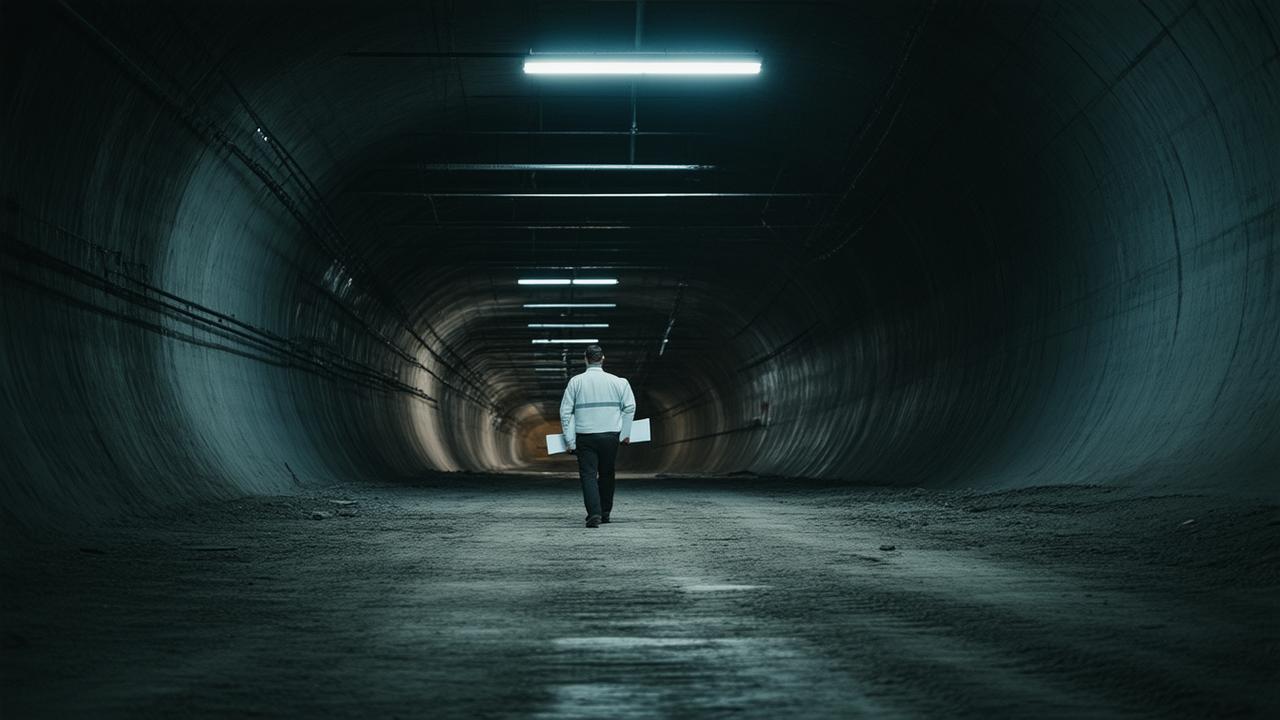
The idea was simple enough: build a machine so powerful it could peel back the fabric of reality, nudge aside the veil on dark matter, and tell us—finally—what the universe is really made of. In the quiet fields outside Beijing, sketches became blueprints, and blueprints became dreams of a new scientific superpower. China would build the biggest particle accelerator the world had ever seen, a circular tunnel a hundred kilometres around, a ring of fire in the ground hot with ideas and screaming electrons.
And now, almost as suddenly as the dream arrived, it’s gone quiet.
When a Giant Dream Meets a Giant Price Tag
In late 2025, whispers began circulating through physics departments and policy think tanks worldwide: China was stepping back from its plan to build the Circular Electron Positron Collider (CEPC), an ambitious follow-up to the Large Hadron Collider (LHC) in Europe. It was meant to be the crown jewel—twice as big, more precise, and the next big leap after the discovery of the Higgs boson at CERN.
But there was a problem. Or more accurately, an eye-watering, budget-splitting, continent-sized problem: cost. Early estimates had suggested a price tag in the tens of billions of dollars. As the plans matured, that number swelled. Land acquisition, high-precision magnets, power infrastructure, control systems, advanced cooling, seismic engineering—nothing about a machine designed to smash particles near the speed of light is cheap, and nothing stays the same price as it crawls through committees and time.
In a world still reeling from pandemic costs, climate disasters, economic slowdowns and spiralling public debt, even China—famous for its appetite for mega projects—found itself staring down a bill that was too big to swallow.
The Race with Europe That Never Quite Started
For physicists, the story has been playing out like a tense, slow-motion race. On one side, CERN’s plans for the Future Circular Collider (FCC) buried under the French-Swiss countryside: a massive new European experiment designed to build on the success of the LHC. On the other, China’s CEPC: roughly comparable in scale but with a slightly different focus, pitched as faster to build and potentially cheaper thanks to streamlined decision-making and domestic manufacturing muscle.
There was a geopolitical tinge to the whole thing. Scientific ambition and soft power curled gently together. A machine like this isn’t just about physics; it’s about prestige, influence, and the message it sends to the world: we can push the boundaries of human knowledge, and we’re willing to fund the bill.
But geopolitical pride, it turns out, still has to answer to an accountant somewhere.
Chinese planners, confronted with mounting internal pressures—from ageing demographics to slower economic growth to energy challenges—began to reassess mega-project priorities. Dams, space stations, high-speed rail, new-energy infrastructure: all compete for the same finite pot of national attention and resources. A collider, however dazzling, is harder to sell than a new hospital or a fleet of electric buses.
In the end, Beijing seems to have hesitated long enough that “delay” blurred gradually into “halt”. No official announcement thundered across the world, but funding stalled, timelines drifted into vagueness, and the once brisk march towards construction became a shuffle. The dream, for now, is shelved.
What Does This Mean for the Universe Hunters?
To most people in Australia, a particle collider in China—or under the fields of rural France—may sound remote, abstract, almost science fiction. But these sprawling underground rings are the reason we know the Higgs boson exists. They are why we have a working model—if a frustratingly incomplete one—of how matter behaves. They are tools that ask the biggest questions humans can ask: What happened just after the Big Bang? What is dark matter? Are there hidden dimensions? Why is there something instead of nothing?
As China quietly steps back, the pressure on Europe increases. If only one mega-collider gets built this century, odds are it will be on European soil. That shifts the centre of gravity of high-energy physics decisively towards CERN once again.
For young Australian physicists, postdocs, and students, this matters. Australia doesn’t have a giant collider of its own, but we are very much in the game. Our universities, from Melbourne to Sydney to Canberra, send students and researchers to CERN. Our computing centres crunch collider data. Our theorists are on the front lines of the big questions. Where the world builds the next collider defines where our brightest minds will travel, collaborate and, eventually, settle.
| Collider Project | Location | Approx. Tunnel Size | Status |
|---|---|---|---|
| Large Hadron Collider (LHC) | CERN, Europe | ~27 km circumference | Operating |
| Future Circular Collider (FCC) | CERN, Europe | ~100 km circumference (planned) | In design, seeking funding |
| Circular Electron Positron Collider (CEPC) | China | ~100 km circumference (proposed) | Effectively halted |
Australia at the Edge of the World, Looking In
On a bright winter morning in Canberra, the physics building smells faintly of burnt coffee and whiteboard markers. In a fourth-floor office, an Australian physicist pulls up simulation plots and collider designs on a screen glowing against the pale sky. For this researcher—let’s call her Leah—the news from China feels like losing a future that had been quietly, stubbornly hoped for.
“It wasn’t just a Chinese thing,” she might tell you, leaning back in her chair, fingers absently tracing equations on a notepad. “It would have been a global machine. Australian teams would’ve worked on detectors, analysis, theory. It would’ve been one more major pillar of global physics, one more place our students could go, one more way we stayed plugged into the cutting edge.”
Australia has built a reputation in “big science” without building the megastructures themselves. Instead, we’ve specialised: radio astronomy with the Square Kilometre Array precursors, leading roles in gravitational wave detection, and strong participation in collider collaborations. We’re good at showing up, at bringing sharp minds and well-honed tools to international playgrounds of physics.
But when one of those playgrounds is never built, it shrinks the map.
That doesn’t mean young Australian physicists are suddenly jobless or out of options. CERN still exists, and its future projects look increasingly like the main show. Still, fewer colliders mean a narrower funnel for curiosity to flow through. Fewer detectors, fewer experiments, fewer radically different designs that might, just might, stumble onto a new particle or a crack in the so-called Standard Model.
Too Expensive… or Too Easy to Misunderstand?
There’s something deeply human about balking at the price of a giant underground ring that does nothing “practical” in the everyday sense. You can’t live in it. It doesn’t desalinate seawater. It doesn’t grow wheat in the Mallee or shore up coastlines in Cairns. When politicians stand up in parliaments and justify spending billions, it’s simpler—safer—to talk about roads, schools, hospitals, and defence.
But consider this: if you seem to “get nothing” from a collider except knowledge, and yet that knowledge is the bedrock that underpins technologies decades down the line, what’s the real cost of not building it?
Our phones, GPS, MRI machines, radiation therapy, the internet itself—none of these sprang fully formed from a business plan. They trace back to blue-sky physics, the sort of fundamental curiosity that mega-colliders feed. The quantum world, first puzzled over in obscure labs and chalk dust, is now the heartbeat of silicon chips and lasers guiding planes into Sydney Airport on a foggy night.
Australia, with its cautious budgets and long list of urgent needs—bushfire resilience, flood defences, renewable energy grids, housing—knows this tension well. We too have to weigh curiosity against crisis. We fund telescopes looking at the cosmic dawn while also struggling to keep hospitals staffed. The question isn’t whether that tension is real. It’s whether, in the long sweep of history, a civilisation that stops asking deep questions about reality is richer or poorer for it.
➡️ The streak-free window-cleaning method that still works flawlessly even in freezing temperatures
➡️ The quick and effective method to restore your TV screen to like-new condition
➡️ Thousands of passengers stranded in USA as Delta, American, JetBlue, Spirit and others cancel 470 and delay 4,946 flights, disrupting Atlanta, Chicago, New York, Los Angeles, Dallas, Miami, Orlando, Boston, Detroit, Fort Lauderdale and more
➡️ The sleep pattern that predicts alzheimer’s risk 15 years before symptoms
➡️ These zodiac signs are destined for major prosperity in 2026, according to astrological forecasts
➡️ The RSPCA urges anyone with robins in their garden to put out this simple kitchen staple to help birds cope right now
➡️ The RSPCA urges anyone with robins in their garden to put out this simple kitchen staple today
What Comes After a Pause This Big?
So where do we go from here? China’s collider project may be stalled, but the questions it was built to answer haven’t gone anywhere. Dark matter still haunts galaxies. The Higgs boson still sits awkwardly in our equations, whispering that maybe, just maybe, the Standard Model is not the full story. Physicists are nothing if not persistent; when one door closes, they start picking at the hinges of ten others.
Smaller colliders, more focused experiments, and exquisitely precise tabletop tests might step in to shoulder some of the load. Cosmic rays, neutrino observatories buried under Antarctic ice, ultra-sensitive dark matter detectors in underground labs: these all become a bigger part of the hunt. And yes, CERN’s enormous FCC proposal looms even larger, a single towering lighthouse project instead of two.
For Australia, that likely means deepening our ties with the European effort, continuing to train students who can contribute to detector design, data analysis, theory, and accelerator physics. It might also be a moment to double down on areas where we already lead: radio astronomy, gravitational waves, quantum technologies. We might not be carving a 100 km tunnel under the outback any time soon, but we can still stand right at the edge of discovery.
There’s another possibility too. A halt is not always a funeral; sometimes it’s a long breath. Economic cycles turn. Political winds shift. International collaborations can spread cost and risk in ways that make once-impossible projects viable again. By the 2040s, when a new generation of Australian kids now trundling through primary school grows up, a revived Chinese collider might not sound far-fetched at all.
Listening to the Universe from the Southern Edge
On a still night in the outback, under skies so clean they look almost unreal, Australia feels like a listening post at the edge of the universe. Stars crowd the darkness with a quiet insistence. The Milky Way drapes itself across the sky like a river of cold fire. Somewhere out there, particles left over from the dawn of time whizz past unseen. Somewhere closer, in data farms and lab notebooks from Melbourne to Perth, Australians are trying to coax meaning out of that invisible rain.
China’s decision to step back from its collider dream is a reminder that big science is not just about equations and beams and magnets. It’s about politics, money, fear, courage, and the stories we tell ourselves about what matters. It reminds us that every leap forward—every Apollo program, every Hubble, every LHC—could easily have been the project that got cut in a bad year.
We sit here on this vast, ancient continent, feeling the heat rise off red earth and the sea nibble at sandy edges, and we decide, over and over again, what sort of species we want to be. One that looks only inward, counting immediate costs? Or one that also, stubbornly, extravagantly, lifts its gaze and spends effort on questions that won’t feed us tomorrow but might change us forever?
Somewhere beneath fields in Europe, machines may hum a little louder because one rival ring in China has gone quiet. And somewhere in an Australian classroom, a kid stares at the night sky after lights-out on a school camp, wondering what it’s all made of. Whether or not a 100 km tunnel is ever dug in Chinese soil, that question remains, bright and stubborn as the Southern Cross.
Frequently Asked Questions
Why did China halt its plan for the giant particle accelerator?
The primary reason appears to be cost. The projected expense of building and operating a 100 km collider rose into the tens of billions of dollars, at a time when China faces competing demands from healthcare, infrastructure, defence, energy transition, and demographic pressures. As priorities shifted, the collider slipped down the list and funding momentum faded.
Does this mean the world won’t build a new big collider?
Not necessarily. Europe, through CERN, is actively pursuing the Future Circular Collider (FCC), which would be similar in scale. China stepping back makes the FCC more likely to be the flagship global collider project, but it also concentrates financial and political risk in one region. The next few years of European funding decisions will be critical.
How is Australia involved in particle collider research?
Australia doesn’t host a major particle collider, but our universities and research institutes are deeply involved in international collaborations. Australian teams work on detector technology, data analysis, theoretical physics, and computing infrastructure linked to CERN and other labs. Many Australian students and researchers spend years based in Europe working directly on these experiments.
Why should Australians care about distant physics projects?
Beyond pure curiosity, fundamental physics has a long history of enabling future technologies: from medical imaging and cancer treatment to GPS, semiconductors, and the internet. Large-scale experiments also train highly skilled problem-solvers who often move into industry, finance, engineering, and technology sectors back home. Supporting these projects indirectly supports the talent pipeline that benefits Australia’s broader economy.
Will Australia ever build its own large collider?
It’s very unlikely in the foreseeable future. The financial, technical, and political demands of a multi-billion-dollar collider are enormous. Instead, Australia’s strategy has been to specialise and partner: investing in world-class facilities such as radio telescopes and gravitational wave detectors, and contributing expertise and people to collider projects overseas. This approach keeps us at the cutting edge without bearing the full cost of a mega-collider on our own soil.





