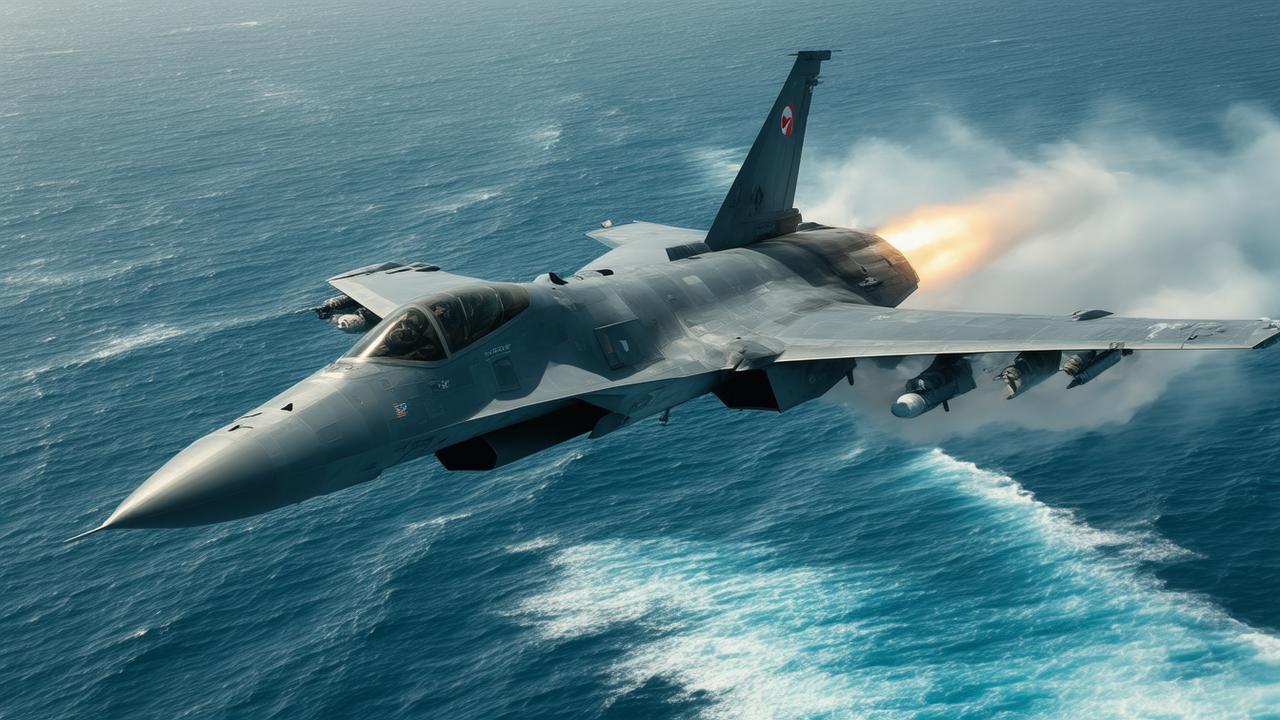
The news slipped into Australian feeds on a quiet weekday morning, somewhere between a reef bleaching update and a story about rising grocery prices: Japan, our long‑time partner and Pacific neighbour, is developing a new stealth missile able to corkscrew through the sky and hit targets over 1,000 kilometres away. For a moment, it didn’t sound real. A missile that spirals mid‑air to twist past defences, flying further than the distance from Brisbane to Melbourne? It felt more like the plot of a streaming thriller than the latest step in our region’s slow but relentless arms race.
A missile that moves like a hooked barramundi
Picture standing on a remote Northern Territory beach at dawn, the air thick with salt and humidity. Out past the mangroves, a barra hits your lure and suddenly the calm water explodes into a chaos of silver scales and spray. The fish doesn’t just pull away in a straight line; it jerks, twists, and darts unpredictably, making every move harder to read.
Japan’s new missile is being described in similar terms by those following the story closely. It’s not just about speed or range anymore; it’s about agility. Media reports suggest it will be capable of mid‑air “corkscrew” or spiral manoeuvres, intended to confuse missile defence systems that rely on predicting a target’s trajectory. Instead of flying an elegant arc through the sky like a textbook ballistic missile, it can jink, twist, and swerve—like a hooked fish doing everything it can to avoid the net.
Layered over that, there’s stealth. The design reportedly prioritises lower radar visibility, making it harder to detect in time. Combine stealth with corkscrew manoeuvres and extended range and you get something that feels fundamentally new, despite the world already being full of frighteningly advanced weapons.
For Australians used to following defence news mostly in terms of submarines and fighter jets, this is a different kind of story: one that’s less about platforms and more about the invisible lines of distance and reach that define power in the Indo‑Pacific.
What does “crossing a red line” actually mean?
When analysts say Japan has “crossed a red line,” they’re not talking about a treaty violation or illegal secret weapons. They’re talking about a political and psychological threshold.
Since the end of World War II, Japan has lived under a pacifist constitution. Its Self‑Defense Forces were, in theory, just that—defensive. It invested heavily in missile defence systems and alliances, particularly with the United States, but stayed away from long‑range offensive strike capabilities. The unspoken bargain in the region was that Japan would remain a military heavyweight in some ways, yet always seemed to hold back from the sharpest end of the spear.
That constraint has been eroding for years. A changing China, North Korea’s missile tests, and wider shifts in US focus have all pushed Tokyo to rethink what “self‑defence” means. Now, with a stealthy, manoeuvrable missile reportedly able to strike targets more than 1,000 km away, Japan appears to have stepped decisively into a realm that used to belong to a handful of major powers.
For some in the region, that feels like a red line: the moment when Japan stops being only a shield and starts carrying a truly formidable sword. For others—particularly close partners like Australia—it looks like an understandable, if unsettling, response to a more dangerous neighbourhood.
Why Australians should care about a missile we’ll never see
Australians are used to the vastness of distance. Hours in a plane just to reach another capital city. Long, empty highways that stretch between roadhouses and roadkill. We live at the spatial edge of the Indo‑Pacific, and yet our security is suddenly all about who can reach what, and from where.
Japan’s potential new missile fits squarely into this emerging geography of distance. A range of 1,000 km or more may not sound world‑shattering—other countries already field similar systems—but it shifts the map in subtle, important ways. It means that from Japanese territory, parts of the Western Pacific become more tightly woven into a web of possible strike and counter‑strike. It’s another layer in the stack of deterrents, warnings, and signals that shape behaviour long before a shot is fired.
For Australia, watching from the southern flank, this matters because we are not just bystanders. We’re increasingly tied into shared defence projects with Japan and the United States. We conduct joint exercises, share intelligence, and plan for worst‑case scenarios together. A more capable Japan changes the calculus of any future conflict in our wider region—especially around Taiwan, the East China Sea, and vital shipping lanes that carry the fuel, food, and electronics that keep Australia humming.
There’s also a more tangible layer: if Japan is pushing hard into advanced missile technology, it affects how Canberra prioritises its own defence spending. Long‑range strike, missile defence, and undersea warfare are no longer abstract talking points in White Papers; they’re live decisions about where Australia puts billions of taxpayer dollars.
A snapshot for the Australian reader
| Feature | Japan’s new missile (reported) |
| Approximate range | >1,000 km (roughly Sydney to Adelaide) |
| Key trait | Mid‑air corkscrew / spiral manoeuvres to evade defences |
| Design focus | Stealth, agility, and survivability against modern air defences |
| Strategic impact for Australia | Shifts regional balance, influences AUKUS, missile defence, and northern base planning |
The sky above Darwin: imagining future drills
It’s one thing to read about a missile that corkscrews through the upper atmosphere; it’s another to imagine how it might intersect with Australian skies, even indirectly. Look north from Darwin on a clear dry‑season night and the sky feels endless, strewn with stars and the faint smear of the Milky Way. Up there, far beyond eyesight, is increasingly crowded real estate.
In a few years, joint exercises between Australia, Japan, and the US could include scenarios built around exactly this kind of system—a stealthy, evasive missile darting toward a defended target, while ships, aircraft, and radars scramble to track and intercept it. The Northern Territory, already a hub for visiting US Marines and allied aircraft, might see more sophisticated missile defence drills: sensors scattered from the Top End to the desert interior, networks of data trying to solve a shifting, looping path in milliseconds.
For local communities, especially First Nations custodians of land used for training, the roar of jets and the distant thump of live‑fire ranges are not abstractions. They are soundtrack and disruption both. The arrival of more complex systems like this raises fresh questions: Who is consulted as the training footprint grows? How do we balance deterrence with respect for Country? What is the cost—social, cultural, ecological—of preparing for weapons built to never be used, yet always be ready?
Deterrence in the age of the corkscrew
Defence planners and diplomats will tell you that weapons like Japan’s new missile are about deterrence: convincing potential adversaries that any attack would be too costly to attempt. In that logic, the more capable and survivable your missiles, the less likely you’ll ever fire them in anger.
But deterrence is also about perception. A missile that can dance in the sky to avoid interception sends a particular message: your defences are not enough. That message can stabilise—no one wants to start a fight they’re not sure they can control—or it can unsettle, prompting neighbours to chase their own counter‑systems, radar upgrades, or rival weapons. The spiral isn’t just in the missile’s flight path; it’s in the budgets and anxieties of every country watching.
Australia, caught between comfort and discomfort
There is a quiet contradiction in how many Australians may feel about Japan’s leap forward. On the one hand, Japan is one of our closest partners: a democracy, a major trading ally, a country with which we share values, technology, and, increasingly, defence plans. If any state in our region is going to field such sophisticated weapons, we might instinctively prefer that it be Japan rather than a less friendly player.
On the other hand, there is a deep, almost subconscious unease whenever the Indo‑Pacific’s long‑range strike capabilities ratchet higher. Australians have grown used to thinking of war as something that happens “over there,” in someone else’s skies. Yet the logic of missiles is the logic of reach, and every new system inches us closer to a world in which distance no longer feels protective.
We’re also grappling with the price tag. Defence spending is climbing even as households feel the squeeze. Talk of hypersonic weapons, advanced submarines, and now evasive stealth missiles sits alongside conversations about hospital wait times and the cost of childcare. The question isn’t just “Is this missile good for our security?” but “What kind of security do we want, and at what cost to everything else we say matters?”
Japan’s decision, like many of our own, is a response to felt vulnerability. Yet the more each nation armours itself, the denser and more fragile the regional security web becomes. A misread radar track, a misunderstood test flight, or a misjudged political message could tug at those threads in dangerous ways.
➡️ The streak-free window-cleaning method that still works flawlessly even in freezing temperatures
➡️ The quick and effective method to restore your TV screen to like-new condition
➡️ Thousands of passengers stranded in USA as Delta, American, JetBlue, Spirit and others cancel 470 and delay 4,946 flights, disrupting Atlanta, Chicago, New York, Los Angeles, Dallas, Miami, Orlando, Boston, Detroit, Fort Lauderdale and more
➡️ The sleep pattern that predicts alzheimer’s risk 15 years before symptoms
➡️ These zodiac signs are destined for major prosperity in 2026, according to astrological forecasts
➡️ The RSPCA urges anyone with robins in their garden to put out this simple kitchen staple to help birds cope right now
➡️ The RSPCA urges anyone with robins in their garden to put out this simple kitchen staple today
Listening for the quiet voices
In the high‑level chatter about red lines and ranges, some voices struggle to be heard: Pacific Island nations facing rising seas more urgently than rising missile counts; younger Australians sceptical that bigger weapons mean greater safety; communities near bases who live with the daily echoes of decisions made in distant capital cities.
For them, the story of Japan’s new missile is part of a bigger question: Who gets to decide what “security” means in the Indo‑Pacific? Is it only about deterrence and distance, or also about climate resilience, economic justice, and cultural survival?
Living under a busier sky
Step outside on a still night in any Australian city and tilt your head back. You might catch the wink of a satellite sliding across the dark, or the blinking beacon of a late‑night flight arcing toward another continent. Almost none of us will ever see the kind of missile Japan is now pursuing, yet its shadow stretches across the same shared sky.
Sometimes, the future arrives not with a bang but a quiet press release, a briefing to journalists, a leaked diagram of a warhead spiralling through a target envelope at impossible speed. Japan’s new stealth missile may never be fired in combat. In a strange way, that’s the point. Its power lies as much in what it suggests as what it can physically destroy.
For Australians, the challenge is to resist numbness. To keep asking: What does it mean for us when our friends and neighbours cross these technological thresholds? How do we remain clear‑eyed about real threats without sleepwalking into an arms race that redefines our region before we’ve even had the conversation?
The waves will still break on Bondi and Cottesloe. Kookaburras will still laugh at first light in the gum trees. But above that familiar soundtrack, the Indo‑Pacific’s strategic weather is changing. Somewhere far to our north, engineers are refining a missile that can corkscrew through the sky, unseen by most of us, shaping decisions that will echo all the way to the red dirt of the outback and the cool surf of the southern coast.
We may not hear it coming. We will, however, live with the world it helps to create.
Frequently Asked Questions
Is Japan’s new missile offensive or defensive?
Technically, it is an offensive strike weapon—it can hit targets at long range. Japan frames such systems as part of “counter‑strike” and deterrence, arguing they are designed to prevent attacks by raising the cost of aggression.
Should Australians be worried about this missile?
Not in the sense of Japan targeting Australia—Japan is a close partner. The concern is broader: each new advanced weapon adds complexity and risk to an already tense Indo‑Pacific, influencing how other countries, including Australia, respond and spend on defence.
How far can the missile reportedly travel?
Reports suggest a range of more than 1,000 kilometres, roughly comparable to the distance between Sydney and Adelaide. That places a wide swathe of the Western Pacific within reach if launched from Japanese territory.
What makes the missile’s corkscrew manoeuvres important?
The spiral or corkscrew movements are designed to make its path harder to predict and intercept. Modern missile defences rely on anticipating where a missile will be; if the missile can twist and jink in flight, it becomes much harder to shoot down.
How does this affect Australia’s own defence plans?
It reinforces existing trends: more emphasis on long‑range strike, missile defence, and closer cooperation with partners like Japan and the United States. It may accelerate investment in sensors, northern bases, and advanced interceptors as Australia adapts to a busier, more contested sky.





