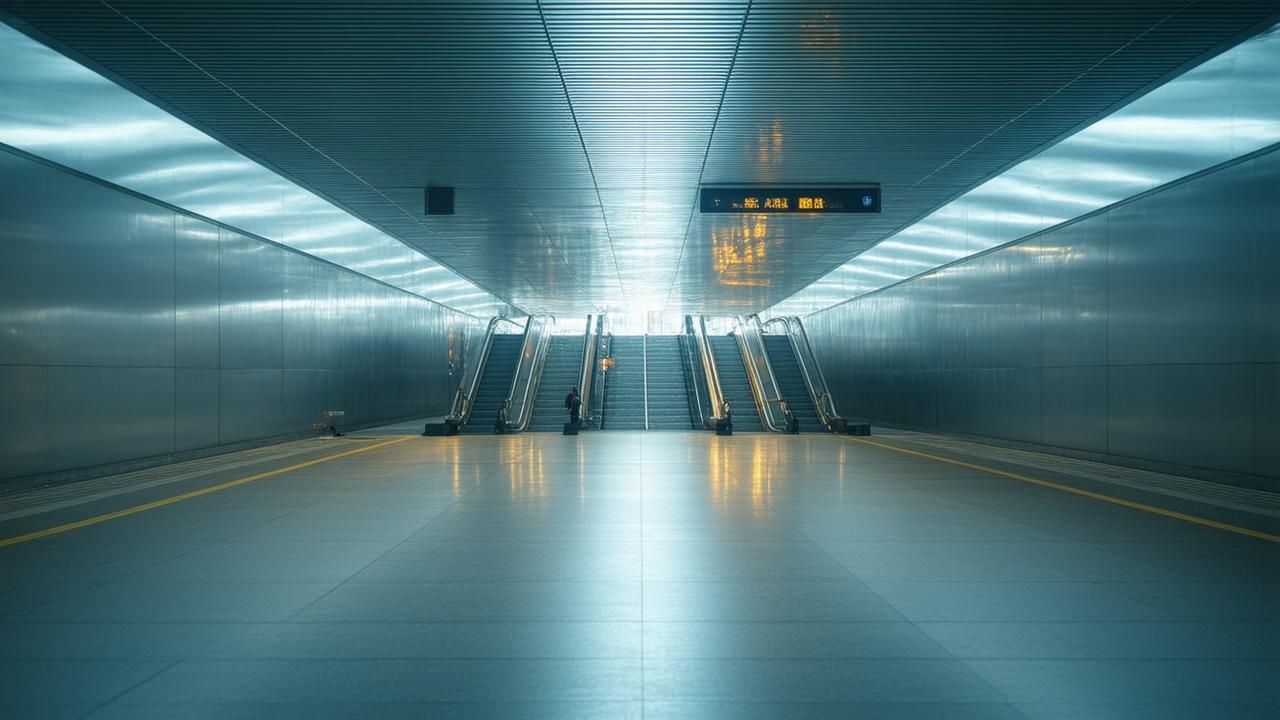
On a winter afternoon in 2008, a friend emailed me a blurry photo from the outskirts of a Chinese city I’d never heard of. In the picture, a lonely concrete platform hovered above an empty paddock, flanked by a few stubborn shrubs and a haze of dust. No crowds, no shops, not even a decent access road. Just a brand-new metro station waiting in the middle of nowhere. I remember laughing, the way you laugh at a bad investment tip. “Classic overbuild,” I typed back. “They’ve lost the plot.”
Back then, a lot of us in Australia thought that way. You could feel the smugness tucked behind the commentary. We were the sensible ones, the cautious planners, the incremental builders. China was the big, reckless gambler, pouring concrete across farmlands and rice paddies, pinning train lines on vague masterplans and hoping the people would come.
We didn’t know it yet, but we were looking at our own blind spot reflected back at us — in steel, glass and immaculate tiled platforms.
The Stations That Looked Like Miscalculations
The stories trickled in through mining colleagues, exchange students and the odd business traveller. You’d hear about a spotless metro station where the ticket machines outnumbered passengers ten to one. Or a colossal, echoing high-speed rail terminal plonked in a field outside a sleepy town, with nothing around it but half-finished apartment blocks and chickens foraging in the dust.
From a distance, and through an Australian lens, it all looked absurd. In 2008, our own cities were still gingerly debating whether public transport extensions should go ahead at all. Sydney argued about rail to the airport. Melbourne wrangled over suburban lines. Perth and Brisbane played tug-of-war with budgets and ballots. We built cautiously: a spur line here, a busway there, always hedging, always asking, “Will we really use this?”
China, by comparison, seemed to have answered that question in advance with a booming, bullish “Yes, and more.”
That “middle of nowhere” metro stop in the photo? It turned out to be one of many. In provincial cities with names we stumbled over, an invisible logic was taking shape. Transport lines were going in first, like veins laid out for a body that hadn’t fully formed yet. The suburbs, the shopping centres, the office towers — they would come later. The station wasn’t a miscalculation; it was a promise.
The Long Game We Didn’t Quite See
To understand what was happening, you had to stand at one of those seemingly isolated stations and wait — not just for the next train, but for the next decade.
If you visited again in 2018 or 2020, the transformation around many of those “nowhere” stops had become almost disorienting. The dusty paddocks had folded into dense neighbourhoods. Glassy apartment towers leaned into the sky. Supermarkets, schools and parks clustered within walking distance. The station that once served no one had become the humming heart of a suburb, its platforms finally crowded, its once-silent escalators carrying office workers, grandparents, school kids in oversized backpacks.
In those same years, Australians in booming outer suburbs were learning a harder truth: if you don’t build first, it’s brutally hard to catch up. Our growth corridors sprawled out faster than the train lines could reach them. New estates in Melbourne’s west, Sydney’s southwest, Perth’s northern fringe sprouted like mushrooms after rain, yet the promised rail and frequent buses materialised in fits and starts, and often years late.
We built houses first and hoped the infrastructure would follow. China, in many places, did the opposite. While we were scrutinising cost–benefit ratios that collapsed under the weight of “current” demand, they were betting on future demand and designing it into existence.
The Moment We Realised We’d Been Naive
The turning point didn’t come in a neat, cinematic moment. It seeped in slowly, like floodwater through a carpet. It came in the form of headlines about record-breaking metro expansions in Chinese cities while we were still arguing over business cases for relatively short suburban lines. It came as satellite images showing new districts stitched together by rail before the concrete on half the buildings had dried.
And it came from our own frustration. Sitting in another freeway traffic jam on the M1 or Monash, watching the brake lights glow like a string of defeated rubies, a nagging thought emerged: maybe the “middle of nowhere” is exactly where you should build if you don’t want it to stay nowhere forever.
What we had mistaken for recklessness was, in many places, a very deliberate sequencing: connect first, then fill in. Our idea of prudence — waiting for demand to justify a line — turned out to be less prudent when cities were doubling in size and property markets were roaring. By the time the demand showed up clearly on graphs and projections, land was expensive, corridors were squeezed, and every kilometre of new line came tangled in politics, property and delay.
The naivety wasn’t that we underestimated China’s ambition; it was that we overestimated the safety of going slow.
How It Felt to Stand in Both Worlds
Picture stepping off a sleek, on-time Chinese metro into a once-empty suburb now dense with life. You surface into a plaza laid out with young trees, kids clambering over playgrounds, electric scooters humming past. The air smells of grilled skewers, car exhaust and wet concrete after rain. It’s noisy, imperfect, alive.
Then picture flying home to Australia and landing in the reality of an outer suburb without rail. You step off a crowded bus into a carpark sea, heat radiating off the asphalt, the only shade cast by shopping trolleys corralled under a rusting frame. The nearest train line is kilometres away; it might reach here in 10 or 15 years if the next few elections go the right way.
In that contrast, the story of our naivety becomes painfully tangible. We weren’t just underestimating another country’s planning; we were underestimating the cost of our own hesitation.
“Build It and They Will Come” vs “Wait and See”
To be fair, not every Chinese station in a field became a thriving hub. There are cautionary tales, ghost cities, and places where the gamble overshot reality. The story is mixed, as all big stories are. And Australia is not China — our political systems, financial models and social expectations are profoundly different.
But from an Australian vantage point, the lesson isn’t that we should copy everything, concrete for concrete. It’s that “build it and they will come” is not merely a cinematic cliché — it’s sometimes the only way to get ahead of explosive growth. “Wait and see” sounds sensible, but in fast-changing cities, it can be a slow way of saying “too late.”
More and more, our planners and politicians are quietly acknowledging this. Conversations about rail to Western Sydney’s new airport, faster connections to regional centres like Geelong, Newcastle and the Sunshine Coast, or new lines shaping Melbourne’s outer loop all echo that same core idea: infrastructure doesn’t just respond to demand; it creates it, shapes it and, crucially, makes it more equitable.
The Quiet Reckoning at Home
Sometime in the late 2010s, Australian dinner table conversations shifted. Friends who once shrugged at public transport started comparing travel times, complaining not just about traffic but about the lack of alternatives. Parents in growth suburbs talked not just of school catchments, but of whether their kids would be stuck with two buses and a long train ride for a simple trip to TAFE or uni.
Alongside this, stories of China’s metro network became less about oddities and more about benchmarks. We saw maps of Chengdu or Shenzhen’s web of intersecting lines and couldn’t help overlaying them mentally on our own cities. What would Brisbane look like if every new subdivision had a rail or high-frequency bus spine? How different would Sydney’s housing pressures be if the train had arrived before the subdivisions?
➡️ The streak-free window-cleaning method that still works flawlessly even in freezing temperatures
➡️ The quick and effective method to restore your TV screen to like-new condition
➡️ Thousands of passengers stranded in USA as Delta, American, JetBlue, Spirit and others cancel 470 and delay 4,946 flights, disrupting Atlanta, Chicago, New York, Los Angeles, Dallas, Miami, Orlando, Boston, Detroit, Fort Lauderdale and more
➡️ The sleep pattern that predicts alzheimer’s risk 15 years before symptoms
➡️ These zodiac signs are destined for major prosperity in 2026, according to astrological forecasts
➡️ The RSPCA urges anyone with robins in their garden to put out this simple kitchen staple to help birds cope right now
➡️ The RSPCA urges anyone with robins in their garden to put out this simple kitchen staple today
We weren’t just envying the speed. We were reckoning with a missed psychological shift. Where China, in many places, treated rail as a foundational skeleton for future growth, we treated it like a luxury accessory to be added later — if we could justify the cost. The result was a generation locked deeper into car dependence, shoulder to shoulder on choked arterials, burning time and money that better planning could have saved.
A Table of Two Approaches
Boiled down for an Australian audience, the contrast looks something like this:
| Aspect | China (circa 2008–2020) | Australia (same period) |
|---|---|---|
| Timing of Major Transit | Often built before large-scale development | Typically built after suburbs fill out |
| View of “Empty” Stations | Seen as seeds of future hubs | Seen as wasteful or premature |
| Growth Strategy | Transit shapes urban form | Roads lead; transit tries to catch up |
| Public Debate | More focused on scale than “if” | Endless arguments over “if/when” |
| Everyday Experience | Rapid access in many new districts | Car dependence in most new suburbs |
In those columns lies the shape of our naivety. We assumed going slow protected us from mistakes. It did protect us from some — but it also locked in costs we’re still paying, in congestion, emissions, and hours of life lost to the steering wheel.
What We Do With This Realisation
Recognition alone doesn’t lay tracks. It doesn’t magically teleport a metro into the heart of a car-bound estate. But it does change the questions we ask.
We can stop asking only, “Can we afford to build this now?” and start asking, “Can we afford not to have this in 20 years?” Instead of peering suspiciously at an empty paddock with a station and seeing folly, we might see a rare opportunity: the chance to shape a suburb around walking, cycling and transit before the driveways harden in place.
Across Australia, we’re beginning to see glimmers of this shift: transit-oriented developments written more firmly into plans, conversations about value capture so the uplift from rail can help pay for the rail, projects like Sydney Metro and Melbourne’s Suburban Rail Loop daring — sometimes stumbling, sometimes scaling back, but at least attempting — to think decades ahead.
Standing in 2026, it’s tempting to look back at that 2008 photo and wince at our own commentary. We weren’t just laughing at someone else’s concrete. We were laughing at a future we hadn’t yet learned to imagine for ourselves.
Maybe that’s the quiet gift those lonely stations gave us, all the way from the other side of the world: a living reminder that “nowhere” is often just “not yet,” and that real prudence, in a rapidly warming, rapidly urbanising world, might be less about waiting, and more about daring to build before the need screams from every clogged road and overcrowded bus.
FAQ
Was every Chinese metro station in the “middle of nowhere” a success?
No. Some stations and even entire new districts struggled to attract residents and businesses as quickly as planned. There are well-documented examples of “ghost” areas. But many others did grow into thriving hubs, and the overall scale of network expansion fundamentally reshaped urban mobility in numerous cities.
Can Australia simply copy China’s infrastructure approach?
Not directly. Our political system, financing models, planning frameworks and housing markets are very different. But we can learn from the principle of building key infrastructure early, using transport to guide growth rather than chase it.
Why doesn’t Australia build big transport projects faster?
Factors include complex planning and approvals, strong community consultation processes, shorter political cycles, higher labour and construction costs, and fragmented governance between local, state and federal levels. These checks can protect communities, but they also slow decision-making.
Is “build it and they will come” always a good idea?
No. It can be risky if demand is wildly overestimated or if projects are poorly integrated with housing, jobs and services. The key is thoughtful long-term planning, realistic population and economic forecasts, and designing places people actually want to live and work in.
What can ordinary Australians do to support better long-term planning?
Engage with local and state planning processes, support politicians and policies that prioritise public and active transport, participate in community consultations, and challenge the idea that car-dependence is the only practical option. Public pressure and public imagination both shape what gets built.





