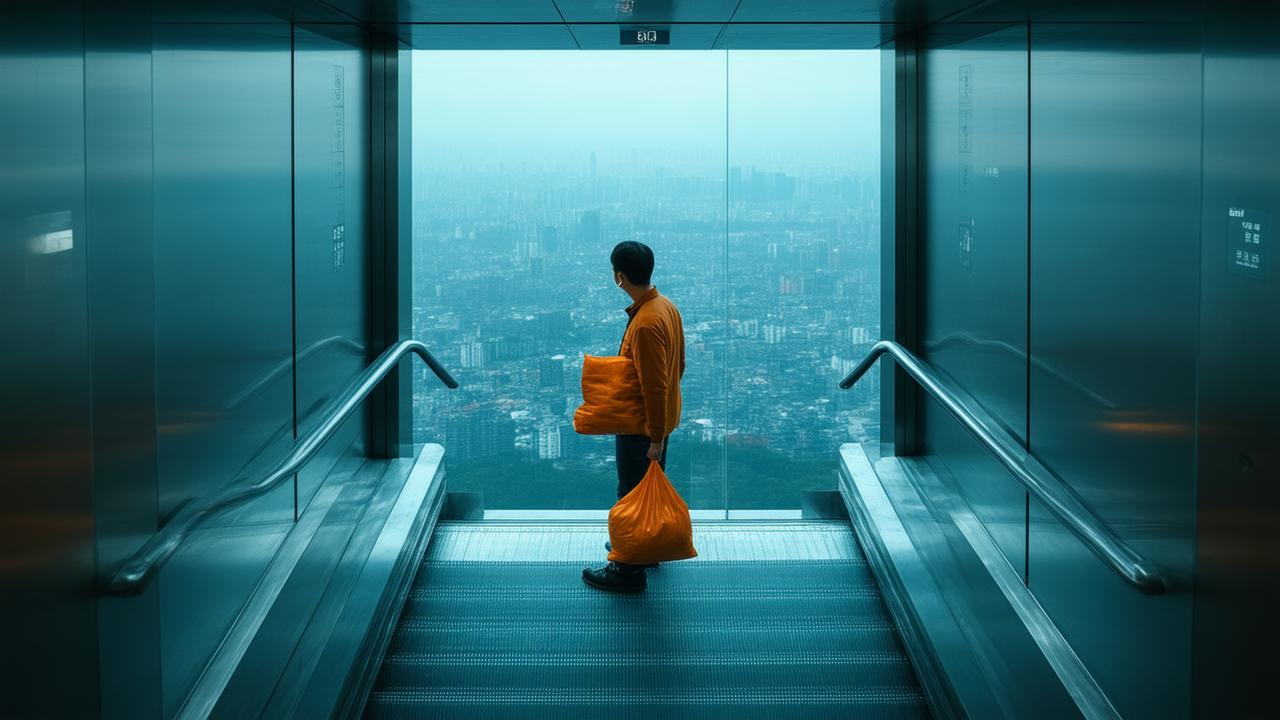
The first thing you notice is the wind. Up here, fifty, sixty, seventy storeys above the street, it doesn’t feel like air so much as a living thing – a restless animal padding around the glass and steel. The city below shrinks into a glittering circuit board of light, horns, and distant sirens. From this height, delivery scooters look like toys, buses like matchboxes. And yet, wedged between the clouds and the humming office lights, someone is hungry, someone has tapped a few icons on a phone, and somewhere down below, a human being has begun a long, vertical journey with a warm plastic bag of food.
Riding the Vertical Wave
In China’s megacities, where the skyline looks like a forest of steel gums sprouting straight out of concrete, a curious new kind of job has emerged: people whose whole working day is defined not by distance across the ground, but by distance into the sky.
Forget the familiar image of a food delivery rider weaving between cars. Imagine instead a rider pulling up to a skyscraper lobby, chaining their e-bike, swiping through three different building-access apps, slipping past security gates, and then launching into a vertical marathon of lifts, locked doors, and echoing corridors. Their task isn’t just to ferry food from restaurant to customer; it’s to navigate a maze of altitude.
In cities like Shenzhen, Shanghai, and Guangzhou, some towers reach so absurdly high that regular food delivery becomes a logistical headache. Thick security, multiple lift systems, and floors so high the ride up feels like changing pressure in an aeroplane all conspire to slow things down. Out of that friction, a new specialisation has formed: dedicated “top‑floor runners” – people whose main advantage isn’t a motorbike, but their ability to outsmart a building.
For Australians used to low, sprawled skylines – more backyard than balcony, more beach than glass – the idea sounds like the premise of a sci‑fi film, not an everyday job. Yet it is as ordinary in some parts of urban China as baristas are in Melbourne laneways.
Life Between Ground Floor and Sky
Meet Jun, a delivery worker in Chengdu. On paper, he’s a rider for a big food‑delivery platform. In practice, he rarely spends more than a few minutes actually on the road. Most of his working day occurs inside buildings – particularly one 80‑storey office tower with a mirrored façade that swallows clouds like a vertical lake.
Jun explains that the restaurant district sits in the shadow of half a dozen high‑rises. Orders ping, he stacks them in an insulated box, and then the true work begins. He knows which tower has the slow lifts at lunchtime, which one has a cranky security guard who insists on logging every visitor, which one lets couriers piggyback off staff access if they look confident enough.
“The distance is not far,” he might say, shrugging. “But it is tall.” He laughs when he says “tall”, stretching the word out, as if his mouth is also climbing.
His job has evolved to the point where he’s effectively a “vertical specialist”. Some platforms in China even designate workers by their building expertise: those who do the street runs, and those who are fast and fluent inside complicated towers. To be quick, you need an almost intimate relationship with the architecture around you. You listen to the building. You learn when the lift banks are full, when the office workers pour in and out, when the kitchens send down their rubbish and clog the service elevators.
The Architecture of a New Job
It’s tempting to think of these delivery climbers as just another quirky consequence of technology – app economies, gig work, and instant noodles arriving hotter than your coffee at the office. But really, they are something more ancient: workers adapting to the shape of a landscape. Only now, that landscape is not desert or forest or reef. It is the geometry of glass boxes and security turnstiles.
In Australia, geography still spreads outward. Our suburbs fan like dry riverbeds from central business districts. Even where towers rise – Sydney’s Barangaroo, Melbourne’s Docklands, Brisbane’s riverside stacks – the idea of needing a specialist just to get food to the top floors still feels odd. A lift ride or two, a quick call from the lobby, and we’re done.
In the densest pockets of Chinese cities, the maths is very different. Hundreds, sometimes thousands, of people occupy a single tower. Multiply that across a clutch of buildings and you get something like a vertical suburb, only with most of the residents working 9 to 9, six days a week. Come mealtimes, delivery traffic surges like a king tide. Ground‑level riders can only do so much before the tower itself becomes the bottleneck.
Out of that pressure grows a strange form of urban ecology. Where we might talk about birds exploiting thermal updrafts along a cliff, here human beings are exploiting lift cycles and swipe‑card loopholes along an elevator shaft. The tower becomes less a building and more a habitat, and the top‑floor runner is one of its nimblest inhabitants.
The Invisible Vertical Race
Inside, the race is against the clock – an unforgiving digital timer ticking away on both the customer’s phone and the worker’s app. Did the restaurant run five minutes late? Did a lift break down? Did security refuse entry because the courier forgot their ID? The system doesn’t much care. Points are lost, rankings slip, bonuses fade.
For someone like Jun, knowing the building is a survival skill. He memorises “cheat paths”: the service lift that skips ten floors at a time, the stairwell that opens directly onto a lobby, the maintenance door that lets him transfer between towers without exiting to the street. He may be delivering dumplings, but the choreography of his movement has more in common with a parkour athlete or a canyoning guide.
And then there is the sensory world of this work: the brief, almost shocking cold of an over‑airconditioned corporate lobby after the sticky warmth of the street; the faintly stifling smell of carpet and toner ink on the mid‑floors; the whoosh and clunk of high‑speed elevators that leave your ears half‑blocked. On the top floors, the air feels cleaner, drier, as if the pollution hasn’t quite made it this high, and the city’s noise has been turned into a distant hum.
What This Says About Our Cities – And Ourselves
For Australians, watching this from our own urban edge, these skyscraper delivery runners are a window into a future we may or may not want. Our tallest towers are still dwarfed by Asia’s true giants, but we are stacking people higher every year. Sydney’s newest builds lean into the clouds. Melbourne scrapes past 100 storeys. Brisbane and Perth continue to punch skyward.
The emergence of a “vertical delivery” workforce in China is less a curiosity and more an early signpost: this is what happens when you compress living and working spaces into tall, dense cores and marry that with the expectation of instant service. It’s a physical manifestation of the promises we make to ourselves about convenience.
We scroll through an app and believe the story that distance has dissolved, that geography has been tamed. But for someone, somewhere, space still has to be crossed – whether it’s 500 metres across a suburb, or 300 metres straight up the side of a tower.
| Work Feature | Typical Aussie Suburban Delivery | Chinese Skyscraper Top‑Floor Delivery |
|---|---|---|
| Main Challenge | Distance and traffic on roads | Access, lifts, and building security |
| Key Skill | Navigation through streets and suburbs | Intimate knowledge of tower layouts and timing |
| Time Risk | Traffic jams, long red lights | Lift queues, security checks, access errors |
| Customer Expectation | Quick door‑to‑door hand‑off | Precise delivery to high floors, often under strict time limits |
| Landscape | Horizontal sprawl, low‑rise living | Vertical density, super‑tall towers |
A Mirror Held Up to Australian Habits
There’s another layer to this story, one that might hit close to home when you next tap “Order Again” on a Friday night in Brisbane or Hobart. The same forces that birthed top‑floor couriers in China are increasing here: long working hours, shrinking kitchens, and the seductive comfort of having everything brought to you.
We don’t build many 80‑storey residential towers ringed by noodle shops, but our appetite for convenience is quietly reshaping our own cities. In inner‑city Sydney and Melbourne, footpaths clog with delivery riders at dusk. Apartment intercoms buzz like cicadas. Shared lobbies become mini‑terminals for bags of pad thai and pizza. The architecture of mealtime is shifting from stove to screen.
When we look at China’s sky‑high delivery workers, we’re also looking at a more concentrated version of ourselves – our preference for speed over encounter, our willingness to let strangers weave through our private spaces, our growing acceptance that someone else will cross the physical world on our behalf.
➡️ The streak-free window-cleaning method that still works flawlessly even in freezing temperatures
➡️ The quick and effective method to restore your TV screen to like-new condition
➡️ Thousands of passengers stranded in USA as Delta, American, JetBlue, Spirit and others cancel 470 and delay 4,946 flights, disrupting Atlanta, Chicago, New York, Los Angeles, Dallas, Miami, Orlando, Boston, Detroit, Fort Lauderdale and more
➡️ The sleep pattern that predicts alzheimer’s risk 15 years before symptoms
➡️ These zodiac signs are destined for major prosperity in 2026, according to astrological forecasts
➡️ The RSPCA urges anyone with robins in their garden to put out this simple kitchen staple to help birds cope right now
➡️ The RSPCA urges anyone with robins in their garden to put out this simple kitchen staple today
Risk, Reward, and the Human Body in the Sky
No matter how sleek the app or glossy the lobby, this remains a job done with bodies. Knees wear out on stairwells. Backs strain under the weight of multiple stacked orders. Fingers chap in winter drafts that whistle around service doors fifty storeys up. In summer, heat radiates from glass like an invisible flame, and the humidity in lower lift banks can feel like the inside of a greenhouse.
For top‑floor runners, the risk is intensified by strict delivery windows. A blocked lift could mean a penalty. A closed security turnstile might trigger a complaint. One wrong turn in a maze of identical corridors, and the lunch goes cold, the rating drops, the income slips.
Yet ask many of these workers why they specialise in tall buildings and they’ll talk about the money – the bonuses for challenging runs, the higher density of orders, the way one tower can provide the same earning potential as an entire suburb. There is a strange, pragmatic romance in it: learning to dance with an enormous, impersonal piece of infrastructure to coax a living out of it.
Looked at from an Australian perspective, it feels both alien and familiar. Our miners descend deep underground; our rural posties cross vast empty kilometres; our roadside tradies cling to highway shoulders as trucks thunder past. Physical risk, traded for a wage, has never left our economy. It has just migrated into new terrains – including the sky.
What Future Do We Want to Build?
So where does this vertical story leave us? Standing on a Brisbane balcony, watching a summer storm roll in over the river, it can be hard to imagine needing a “top‑floor delivery specialist” to get a laksa to level 72. But then again, it wasn’t so long ago that booking a cab meant calling a human dispatcher, or that buying groceries meant pushing a trolley under fluorescent lights.
The question for Australians isn’t whether we will copy China’s extreme urban form tower for tower. It’s whether we want to follow the same path of invisible labour that makes everything feel magically instant. Do we design our high‑rises so that deliveries are easy, safe, and fair? Do we accept slightly slower service so that someone else doesn’t have to sprint a vertical obstacle course ten times an hour? Do we look the rider, the courier, the climber in the eye at the door, or do we prefer contactless drop‑offs, where the human doing the work dissolves into a notification?
Somewhere in Guangzhou right now, a rider is stepping out of a lift into a plush, quiet hallway that smells faintly of perfume and printer ink. In Sydney, someone is leaning over a balcony rail to catch a seabreeze off the harbour. In Melbourne, a student in a 20th‑floor apartment is waiting for a cardboard box of noodles. All of them are connected by a simple desire: to eat, to rest, to carve a small moment of comfort out of a busy day.
And in between – sometimes on the ground, sometimes in the sky – there is another person whose job is to bridge the gap.
Frequently Asked Questions
Do these skyscraper delivery workers only operate in China?
They are most visible and widespread in large Chinese cities because of the extreme height and density of the buildings there. However, similar patterns are emerging in other high‑rise cities around the world, including parts of Asia and the Middle East, where specialised building‑focused couriers are becoming more common.
Could this kind of job appear in Australian cities?
Yes, particularly in areas with clusters of tall residential or office towers, such as parts of Sydney and Melbourne. While our buildings are generally shorter and less dense than China’s, the combination of tower living and high delivery demand could lead to more roles focused on navigating specific buildings efficiently.
How is this different from regular food delivery?
Regular delivery is mostly about covering horizontal distance on roads or bike paths. Top‑floor delivery work is about navigating vertical distance and complex building access – multiple lifts, security checks, and large floor plates – all under tight time pressure.
Are there safety concerns for these workers?
Yes. They face physical strain from constant movement through stairwells and corridors, time pressure that can encourage rushing, and the stress of dealing with building security systems and tight deadlines. As in Australia, gig‑economy safeguards and protections are a major topic of debate.
What can building designers and residents do to help?
Designers can include clear, safe delivery routes, accessible lifts, and designated collection points that don’t require excessive detours. Residents and office workers can allow realistic delivery windows, be ready to meet couriers promptly, and recognise the human effort involved in each “quick” delivery.





