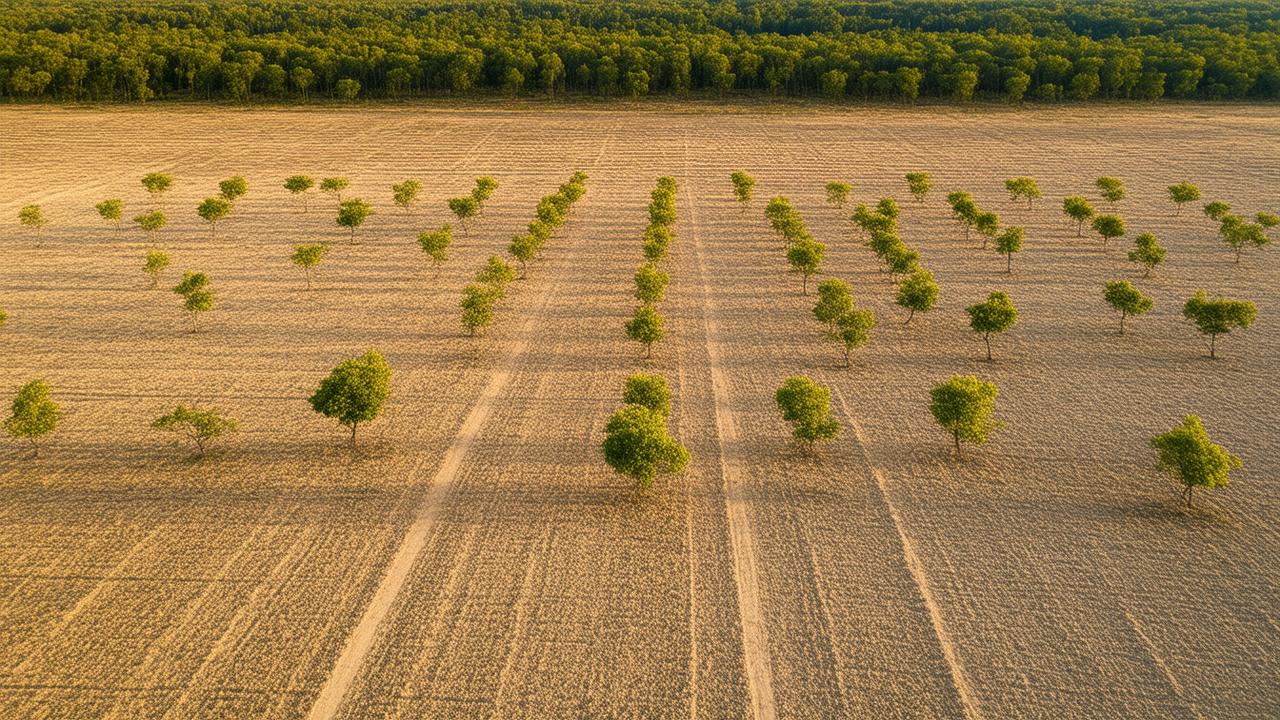
The first time the sand moved, villagers heard it before they saw it. A long hiss, like wind dragging fingernails across a sheet of tin, rising over the low roofs and poplar groves in northern China’s arid heartland. For decades, that sound meant one thing: the desert was coming. Fields swallowed. Roads buried. Homes abandoned. So when China announced it would plant a “Great Green Wall” of trees to hold back the sands, it sounded like a miracle. A billion trees, maybe more, marching across the dust. Satellite images now show something astonishing: some deserts really are slowing down. But beneath that hopeful green stain, scientists are starting to whisper a different story—one about thirsty roots, quiet extinctions, and ecosystems being remade at a speed the land can’t handle.
A green wall against the sand
If you live in Australia, the story might feel strangely familiar. Swap the Gobi for the Great Victoria Desert, Inner Mongolia for inland New South Wales, and you can almost see the parallels. Arid lands creeping towards farms. Dust storms turning midday skies into a bitter brown dawn. People caught in a slow-motion fight between ecology and survival.
In China, that fight became a national mission. Starting in the late 1970s, the government began one of the largest environmental engineering projects in human history: the “Three-North Shelterbelt Program,” often called the Great Green Wall. Over decades, teams of workers and local residents planted belts and grids of trees across northern and north‑western China—planes dropping seed, farmers tending saplings, whole landscapes lined with fast-growing species. The numbers are staggering: billions of trees, spread over an area larger than many countries.
From space, it looks like the stuff of environmental triumph. Satellite data suggests vegetation cover has increased across vast swathes of what used to be bare or sparsely vegetated land. Dust storms that once howled towards Beijing and even drifted across to Korea and Japan have, in some years, become less frequent and intense. There are images of schoolchildren in dusty towns now standing under a canopy of shelterbelt trees where thirty years ago there was only grit and sky.
For a world increasingly terrified of climate change, this seems like exactly the sort of story we want: a determined country taking on the desert and winning with trees. But as Australian ecologists looking on from our own drought‑prone continent are pointing out, nature tends to resist simple narratives. Especially in dry places.
When trees become thirsty invaders
Walk into one of these planted forests on the fringe of the desert and the first thing you notice is the smell. Dust still hangs in the air, but now it’s threaded with the sharp, resinous tang of pine, the slightly sour-green scent of poplar leaves. The wind, once unbroken, rustles and clacks its way through row upon row of trunks. It feels, at first blush, like life reclaimed.
Yet if you look down, the picture changes. In many of these plantations, the ground is bare or nearly so. Little understorey. Few native shrubs. Sparse herbs. Sometimes an eerie carpet of needles or leaves that blocks the light and smothers seedlings. These forests, scientists say, too often behave more like thirsty monocultures than restored ecosystems.
Species like poplars and pines, chosen for their speed and hardiness, can guzzle water far faster than the sparse, slow-growing native shrubs and grasses they replace. In an already water‑stressed landscape, that’s not a minor detail; it’s the whole story. Studies from different parts of northern China have found that plantations may be depleting groundwater, lowering local water tables, and leaving streams and soils drier than before the first sapling was pushed into the dust.
For Australians living on the driest inhabited continent, this should ring alarm bells. We know what happens when deep‑rooted, water‑hungry trees are planted en masse in the wrong place. In parts of Western Australia, pine plantations have altered groundwater dynamics and salinity. In South Australia, tree belts have changed how water moves through the landscape. In semi‑arid regions, planting the wrong species in the wrong place can tip a fragile system over the edge.
The quiet cost to native life
In the shadow of those tree lines, quieter losses are stacking up. Before the plantations arrived, many of these marginal lands weren’t empty wastelands; they were steppe, shrubland, or desert grassland. Sparse, yes—but alive. Home to saltbush, hardy grasses, burrowing animals, insects that bloom after the rare rain, birds that ride the thermals hunting lizards across open ground.
The Great Green Wall hasn’t just added trees; it has fundamentally changed habitats. Shade penetrates where full sun once ruled. Needle litter alters soil chemistry. Simplified tree stands block the movement of some animals and favour others. In many cases, the planted species are not native to those specific regions, meaning local flora and fauna have had little time—or genetic preparation—to adapt.
Ecologists in China report declining diversity of native plants under dense plantations, with local grasses and shrubs out‑competed or shaded out. Some desert specialists—plants and animals exquisitely tuned to open, harsh conditions—lose their ecological niche entirely. What looks like “greening” from space might, at ground level, be a conversion from complex native desert ecosystems to comparatively sterile, uniform tree farms.
There’s a warning here for Australia, where we too sometimes fall for the seductive equation: more trees = better nature. Carbon markets are driving a wave of large‑scale tree planting projects, some proposed for marginal or semi‑arid pastoral lands. If we chase “green on a map” without asking what kind of green, and what it replaces, we risk replaying China’s mistakes on our own soils.
Slowing deserts, speeding decline?
The uncomfortable twist in China’s story is that both things can be true. The billion‑tree project may be slowing the advance of some desert margins and cutting dust storms; at the same time, it may be driving long‑term ecological damage and vulnerability that will only fully appear decades from now.
Consider water again. Many of these plantations were established during periods with relatively favourable rainfall or with the help of irrigation. A forest that survives on marginal water today might collapse in a string of bad years—something climate models suggest will become more frequent. When that happens, dead trees could leave soils even more exposed than before, roots no longer holding sand, the land stripped twice: once of its original vegetation, and again of its engineered green shield.
Then there’s climate resilience. Natural arid ecosystems, like Australia’s mulga country or China’s native shrub‑steppe, are messy but tough. Species assemblages evolved over millennia to ride out cycles of drought, fire, flood, and wind. Planting vast corridors of a few fast‑growing species may create what ecologists call “green brittleness”—systems that look lush in good times, but lack the diversity and structural complexity needed to absorb shocks. Under extreme heat or pest outbreaks, monoculture belts can fail spectacularly.
Australians have long experience with ambitious environmental engineering—think of the Snowy Scheme, river regulation, broadscale land clearing, and later revegetation. The Chinese project reads like a warning written across another continent: scale alone doesn’t guarantee success, and good intentions can rewrite landscapes in ways we can’t easily reverse.
What China’s experiment whispers to Australia
Step back for a moment and imagine a map of inland Australia, from the red centre to the edges of the wheatbelt. Now overlay the story of China’s green wall: the will to act, the urgency of dust and drought, the visual comfort of green pixels on satellite images. It’s not hard to see how similar pressures might push us down similar paths.
Already, tree‑planting schemes here are being promoted as a triple win—soak up carbon, halt erosion, restore “degraded” land. Some are thoughtful, grounded in local ecology, and led by Traditional Owners and regional communities. Others are more blunt: large parcels of land earmarked for single‑species plantations, often with an eye on carbon credits and yield curves rather than complex ecological outcomes.
➡️ The streak-free window-cleaning method that still works flawlessly even in freezing temperatures
➡️ The quick and effective method to restore your TV screen to like-new condition
➡️ Thousands of passengers stranded in USA as Delta, American, JetBlue, Spirit and others cancel 470 and delay 4,946 flights, disrupting Atlanta, Chicago, New York, Los Angeles, Dallas, Miami, Orlando, Boston, Detroit, Fort Lauderdale and more
➡️ The sleep pattern that predicts alzheimer’s risk 15 years before symptoms
➡️ These zodiac signs are destined for major prosperity in 2026, according to astrological forecasts
➡️ The RSPCA urges anyone with robins in their garden to put out this simple kitchen staple to help birds cope right now
➡️ The RSPCA urges anyone with robins in their garden to put out this simple kitchen staple today
China’s experience suggests two big questions we should be asking, every time someone proposes a wall of trees against our own expanding drylands:
- Is this about restoring an ecosystem, or about engineering a simplified landscape to meet one or two targets—like dust control or carbon storage?
- What happens to water, native biodiversity, and local people across fifty or a hundred years, not just the next decade?
Australian arid lands hold a depth of knowledge that doesn’t show on satellite images. Indigenous fire regimes, water‑hole lore, species stories—ways of understanding that see deserts not as broken places needing to be “fixed” with trees, but as functioning, intricate systems. If we listen, we may avoid building our own brittle green walls.
Beyond tree counts: learning to read the land
In both China and Australia, the temptation is to measure success in hectares planted, seedlings survived, tonnes of carbon sequestered. These metrics are tidy, easily graphed, politically appealing. But landscapes, especially dry ones, don’t work to quarterly targets. They work to deep time.
Ecologists now argue that the real measure of success in China’s desert‑facing regions shouldn’t be “how many trees” but “how much functioning ecosystem.” Are native grasses returning? Are soil crusts—those fragile films of lichen and microbes that hold drylands together—recovering or being smothered? Are birds and small mammals using these new habitats, or avoiding them?
The same shift in thinking is emerging in Australia. Regenerative agriculture, Indigenous‑led land management, and nuanced restoration projects are slowly reframing what “good” looks like in degraded landscapes. Sometimes, that means planting trees. Sometimes, it means cutting them down to restore open woodland. And sometimes it means leaving a sparse, scruffy desert largely as it is—because what looks empty to a satellite is, in reality, alive in a way a plantation can never be.
China’s billion‑tree story isn’t a simple cautionary tale, nor a celebration. It’s a case study in scale: what happens when human ambition and fear of environmental collapse meet head‑on. For Australians watching sand dune by sand dune as climate pressures tighten, there’s a chance here to learn—before we repeat the same quiet harms.
| Issue | China’s Billion-Tree Project | Relevance for Australia |
|---|---|---|
| Primary Goal | Slow desert expansion, reduce dust storms, stabilise soils | Control erosion, store carbon, protect farms and towns from dust and degradation |
| Main Strategy | Large‑scale planting of fast‑growing tree species in belts and blocks | Expanding tree planting and carbon forestry, especially on marginal agricultural land |
| Key Concerns | Groundwater depletion, monocultures, loss of native desert ecosystems | Water stress, inappropriate species choice, displacement of native grasslands and shrublands |
| Hidden Impacts | Reduced biodiversity under dense plantations, long‑term vulnerability to drought | Potential for brittle, low‑diversity landscapes that may fail under future climate extremes |
| Lesson | Greening isn’t always restoring; tree cover can mask ecological damage | Design projects around whole ecosystems, local knowledge, and water limits—not just tree counts |
FAQs
Is China’s billion-tree project considered a success?
It depends on what you measure. The project has increased vegetation cover and likely helped reduce some dust storms and soil erosion. But scientists warn that many plantations are water‑hungry monocultures, may damage native dryland ecosystems, and could prove fragile under future droughts. It’s a partial success with significant ecological trade‑offs.
How is this relevant to Australia?
Australia faces similar challenges: land degradation, expanding drylands, and pressure to plant trees for carbon and erosion control. China’s experience shows that large‑scale planting, if poorly planned, can deplete water, reduce biodiversity, and create brittle landscapes. It’s a real‑world case study of what to avoid—and what to improve—here.
Are deserts really something we should “stop” with trees?
Not always. Deserts and semi‑arid regions are natural, functioning ecosystems, not failed forests. The goal shouldn’t be to erase deserts, but to prevent human‑driven desertification—land degradation caused by overgrazing, deforestation, or mismanagement. In many cases, restoring native grasses, shrubs, and soil health is more appropriate than planting dense tree belts.
Do more trees always mean better outcomes for climate and nature?
No. Trees can store carbon and support biodiversity, but context matters. Planting water‑intensive or non‑native trees in dry or grassland areas can harm local species, alter water cycles, and even increase vulnerability to drought and fire. For both climate and conservation, diverse, well‑placed native vegetation usually delivers better long‑term results than simple tree counts.
What should Australia do differently when planting trees?
Prioritise native species suited to local conditions. Protect and restore existing ecosystems—grasslands, shrublands, and open woodlands—instead of replacing them with plantations. Involve Traditional Owners and local communities in planning. And measure success by ecological health, water balance, and resilience over decades, not just the number of seedlings in the ground.





