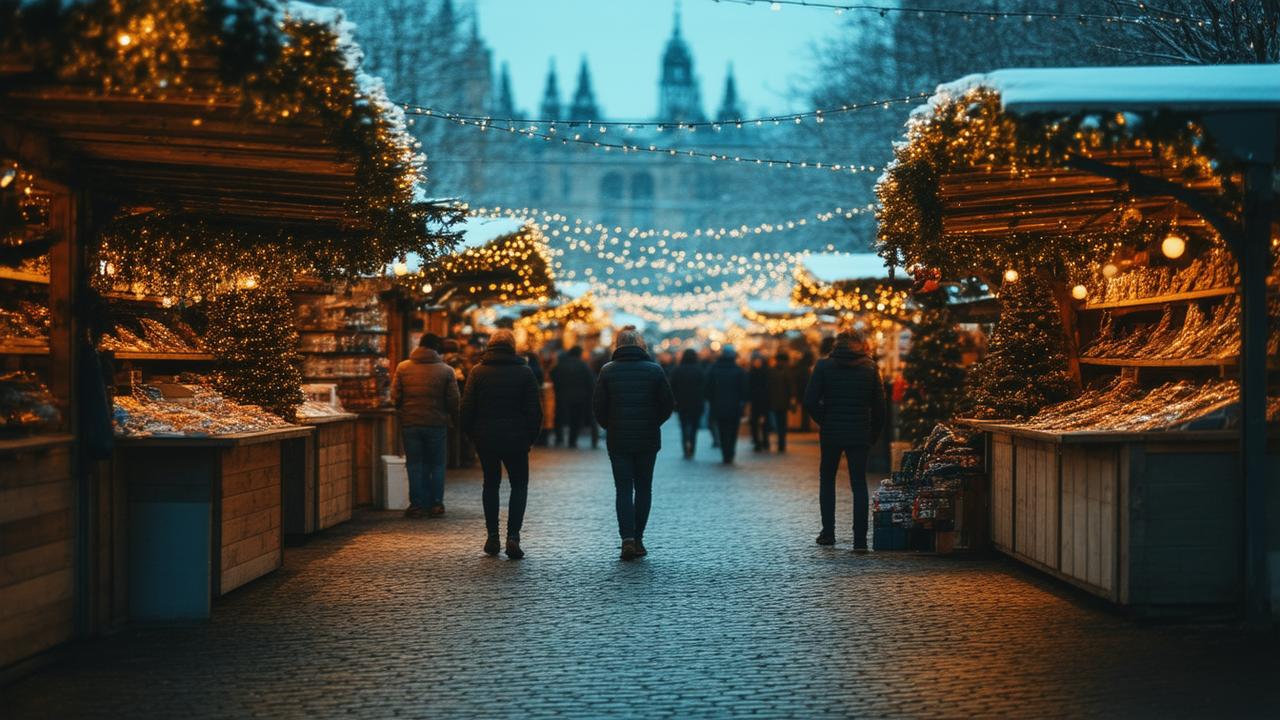
The scent should have been cinnamon and clove, mulled wine and roasted nuts. Instead, it was the faint whiff of generator fumes and reheated chips drifting across a concrete plaza in the middle of an Australian November evening that was still 29 degrees at 8pm. Families wandered in, kids tugging at their parents’ hands, eyes wide with the hopeful expectation you only ever see at the start of summer and the start of Christmas. But one by one, those hopeful faces settled into the same look: confusion, then disappointment, then a shrug that silently said, “No, thanks.”
The Promise of Magic, the Reality of Plastic
In the weeks leading up to opening night, the posters had been everywhere. “European-style Christmas Market!” they promised, in looping gold letters surrounded by soft-focus fairy lights. There were snowflakes on the flyers, despite the forecast of a heatwave. Social media posts conjured visions of a glowing village: wooden huts, handmade gifts, gingerbread, live music, maybe even a dusting of machine-made “snow” for the kids to squeal under.
Australians know how to suspend disbelief at Christmas. We’ve long accepted the strange cultural mash-up of carols about snow while we’re in shorts and thongs, the oven blasting for a roast on a 35-degree day, and inflatable reindeers baking in the sun on suburban lawns. We are willing participants in the dream.
So people came ready to believe. They stepped off light rail stops and out of car parks, the air still humming with day heat. You could hear that familiar end-of-year mixture: tired chat about office parties, weekend surf conditions, and how early the jacarandas had bloomed this year. Parents had brushed sand out of the back seats, thrown on their “nice casual” outfits, and arrived with the hope that this might be the night the season really began.
Then they walked through the entrance archway and saw it.
“Is… this it?” a woman near the entry murmured, her voice half amusement, half disbelief. In front of her, instead of a bustling village of stalls, were a few white plastic marquees, lit with harsh floodlights that flattened every colour. The promised “artisan market” looked suspiciously like a school fete at pack-up time. Fake snowflakes sagged from nylon string, already drooping in the humidity.
The Sound of Deflated Expectations
It wasn’t that the market was empty. Technically, things were there. There was a doughnut van with a queue, a bar tent selling plastic cups of warm-ish wine, a stall with mass-produced Christmas ornaments still wrapped in plastic, and another with LED toys flashing impatiently in the twilight. A tired Santa wandered past, his beard sliding sideways in the heat.
But the sounds were wrong. The music was a tinny loop of the same three pop Christmas songs fighting against the thrum of generators. You couldn’t hear the layered sound that makes a market feel alive: stallholders talking about their craft, buskers weaving songs into the night, that rising murmur of people discovering something unexpectedly special.
Near the centre, a group of teenagers stood in a loose circle, phones out. “I thought there’d be more,” one said, gesturing around. “This is like… that sad aisle in the supermarket after Boxing Day.” They laughed, but it wasn’t unkind, just resigned.
Even the kids seemed unsure what to make of it. A small boy clutched his glow stick sword, looking around as if the rest of the fun might be hiding behind a pillar. “Where’s the big tree?” he asked his dad. “On the poster there was a big tree.” His dad looked around, then pointed at a modest artificial tree, its tinsel half-tangled in its own lights. “There, mate.” The boy frowned. “That’s not big.”
Nearby, a couple in their 60s, both wearing Christmas tees, shared a paper tray of chips and watched the slow trickle of visitors. “We came last year when they had that small market at the surf club,” the woman said, turning to her partner. “Remember? The lady who made candles that smelled like rain on hot concrete? And the guy who carved kookaburras out of old fence posts?” She shook her head. “This is… not that.”
When “European-Style” Forgets Where It’s Standing
Walking through the stalls, the disconnection felt deeper than just a lack of atmosphere. It felt like a copy of a copy of someone else’s Christmas, dropped into an Australian city plaza with no sense of place.
The “German sausages” were served from a generic food van that does the rounds of every local event, their glossy plastic menu still advertising “Footy Night Special” on the side. The “mulled wine” was poured from a sloshing plastic jug, its spices so faint you could barely taste them over the cheap red. The “handmade decorations” carried barcodes from overseas manufacturers, the kind you can find online in bulk.
Nothing bore the fingerprints of a local maker or the story of a local landscape. There were no stallholders with sun-reddened arms talking about the farm where they grow their ingredients; no coastal artists whose work still smelled faintly of salt; no ceramicists whose glazes matched the colours of the nearby bush. The whole event felt like it had been assembled from a catalog, then left to wilt under the southern sky.
Australians might borrow carols and tinsel, but we notice when something ignores the world it stands in. The sky above the market was a flat, blazing blue turning slowly orange as the sun sank. Bats wheeled overhead, heading out from the fig trees. You could smell the city’s summer: bitumen cooling, sprinkler mist drifting from nearby apartment blocks, someone’s distant barbecue. The market, stubbornly, tried to pretend it was a snow globe scene from another hemisphere.
Why This Year Felt Different
Across the country, there’s been a quiet shift. After a few intense years of lockdowns, closed borders, and supply chain headaches, people have become more particular about what they spend their time and money on. When a community event promises “magic” and “tradition” and “European village charm,” it’s not just selling hotdogs and fairy lights; it’s selling an experience, a story you can carry home.
But this story fell flat. Many visitors had driven in from suburbs away, paid for parking, wrangled kids into decent clothes, skipped dinner at home. They bought into the promise. So when they found something that felt rushed, generic, and oddly joyless, their disappointment ran deeper than just mild annoyance.
By 8:30pm, people were already drifting back towards the exits, faces lit by their phones as they checked bus times or rideshare apps. “Should we just go get gelato on the way home?” one mum suggested to her daughter, who nodded eagerly. “Yeah. This is.. kinda boring.”
“No, Thanks”: The Quiet Rebellion
There wasn’t a dramatic walkout. No angry crowd. No public meltdown. Just a steady current of polite refusal. A stallholder selling plastic light-up antlers called out to a passing couple, “Want to get Christmassy?” The man smiled, shrugged, and said simply, “Nah, we’re good. Thanks.” Another woman glanced at the mulled wine sign, winced at the price, and said, “No, thanks,” soft but firm, and kept walking.
That phrase floated through the warm air all night, more and more often: “No, thanks.” Not rude. Not aggressive. Just a collective drawing of a line. No, thanks to overpriced drinks in plastic cups. No, thanks to fake “European” charm with no soul. No, thanks to another event that felt like it was designed by someone who’d never actually stood barefoot on hot December concrete, or fallen asleep to the buzz of cicadas on a sticky Christmas Eve.
It was as if people, quietly and without coordination, decided that if Christmas in Australia was going to lean into fantasy, it needed to at least be honest. Honest about the heat. Honest about the light that lingers well into the evening. Honest about the gum trees and the beach towels and the backyard cricket and the magpies carolling at dawn. Honest about craft and community, not just commerce.
What Australians Actually Want From a Christmas Market
Standing at the edge of the market, watching families leave almost as quickly as they arrived, you could hear fragments of conversation that sounded almost like a design brief for something better:
➡️ The streak-free window-cleaning method that still works flawlessly even in freezing temperatures
➡️ The quick and effective method to restore your TV screen to like-new condition
➡️ Thousands of passengers stranded in USA as Delta, American, JetBlue, Spirit and others cancel 470 and delay 4,946 flights, disrupting Atlanta, Chicago, New York, Los Angeles, Dallas, Miami, Orlando, Boston, Detroit, Fort Lauderdale and more
➡️ The sleep pattern that predicts alzheimer’s risk 15 years before symptoms
➡️ These zodiac signs are destined for major prosperity in 2026, according to astrological forecasts
➡️ The RSPCA urges anyone with robins in their garden to put out this simple kitchen staple to help birds cope right now
➡️ The RSPCA urges anyone with robins in their garden to put out this simple kitchen staple today
- “I’d rather pay decent money for something someone here actually made.”
- “Where’s the live music? Even just a local choir would be nice.”
- “Imagine if they had cold sangria and prawns instead of pretending we’re in the Alps.”
- “I wish there were stalls from the bushfire-affected towns, I’d buy from them in a heartbeat.”
- “Couldn’t they do something with native plants instead of all this plastic garland?”
If you boiled those comments down, you’d get a simple truth: people weren’t asking for perfection, just authenticity. They wanted an event that knew where it was, and who it was for. Something that felt like it respected their time, their culture, their climate.
Here’s what many had hoped to find, and what was mostly missing on that disappointing opening night:
| What People Expected | What They Found | What They Actually Wanted |
|---|---|---|
| Local makers with stories behind their products | Mass-produced trinkets and generic imports | Honest, handmade goods from nearby towns and creators |
| Atmospheric lighting and music | Harsh floodlights and tinny pop tracks on repeat | Soft lights, live local music, a place to linger |
| Seasonal food that felt special | Standard food truck fare and lukewarm “mulled wine” | Fresh, summery Aussie twists on Christmas flavours |
| A sense of discovery and surprise | Repetition of what’s in any shopping centre | Unique stalls, small-batch items, local characters |
| A Christmas atmosphere rooted in place | Imported “European” theme ignoring the heat and landscape | An Australian Christmas feel: warm nights, native greenery, ocean and bush |
Learning to Say Yes Again
As the night wore on, the crowd thinned. A few determined kids danced in front of the speakers, their parents chatting in a loose circle at the edge of the makeshift “village.” One stallholder, selling simple handmade soaps, stood out precisely because her products weren’t pretending to be anything else. Her labels were plain, her hands ink-smudged from stamping, her accent pure local. She chatted with the few buyers who stopped, asking where they lived, recommending scents for sensitive skin. Her presence was a small reminder of what the entire market could have been.
Because when Christmas markets work here, they really work. They become places where you can feel the season shifting, not in the falling of snow but in the lengthening of twilight, the smell of mangoes in green bags, the sound of kids practising carols they’re half-embarrassed to sing. Places where regional producers bring in jams inspired by native fruits, where local First Nations artists tell stories in colour and thread and timber, where a band from down the road plays “Silent Night” with a saxophone and a grin.
The disappointment of this particular opening wasn’t just about one event’s failure. It was about the gap between what Australians are ready to celebrate—and what some organisers still think they can get away with offering. The quiet chorus of “No, thanks” that drifted through that underwhelming plaza might just be a turning point.
Because beneath the polite refusals is a louder, less spoken desire: “Yes, please”—to something real, something thoughtful, something that recognises that Christmas here smells more like sunscreen and eucalyptus than pine and fireplace smoke. Australians aren’t rejecting the idea of Christmas markets. They’re rejecting the laziness of cutting and pasting someone else’s idea of Christmas without doing the work to make it ours.
Next time a set of glossy posters goes up promising “magic” and “wonder,” people will remember this night. They’ll weigh up the petrol money, the parking, the kids’ patience. And they’ll decide whether to give their time, their cash, and their hope to another attempt.
If those behind the scenes are paying attention, they’ll understand the message carried in that simple phrase: “No, thanks” isn’t the end of the conversation. It’s an invitation to do better—to build the kind of market where, next year, under that same hot twilight sky, people walk through the entrance and say, with genuine delight, “Oh. Yes. This is it.”
Frequently Asked Questions
Why were visitors so disappointed with the Christmas market opening?
Visitors felt the market didn’t live up to its promises. Advertising hinted at a magical, “European-style” village, but what they found was a small collection of generic stalls, mass-produced products, and a lack of atmosphere. For many, the event felt rushed, inauthentic, and disconnected from Australian summer and local culture.
Is this kind of disappointment common at Australian Christmas markets?
Experiences vary widely. Some Australian Christmas markets are vibrant, locally focused, and genuinely special. Others lean heavily on themes and aesthetics that don’t suit our climate or culture, or rely too much on generic imports and food trucks. When expectations are raised through glossy marketing but not met on the ground, disappointment is almost inevitable.
What do Australians actually want from a Christmas market?
Many Australians are looking for authenticity: local makers, seasonal food that suits the heat, live music, and a sense of place. They want markets that reflect an Australian Christmas—warm nights, native greenery, coastal and bush influences—rather than a copy of European winter traditions with no local twist.
How can organisers improve future Christmas markets?
Organisers can focus on partnering with local artists, regional producers, and community groups. Thoughtful lighting, live performances, proper shade and seating, and clear value for money all matter. Most importantly, the design of the event should acknowledge the Australian climate and culture instead of pretending we’re somewhere else.
Are smaller or regional Christmas markets a better option?
Often, yes. Smaller or regional markets can feel more personal and grounded, with stallholders who live nearby and products that carry a real story. While not every small market is perfect, many offer the kind of genuine, community-based experience that larger, heavily branded events sometimes lack.





