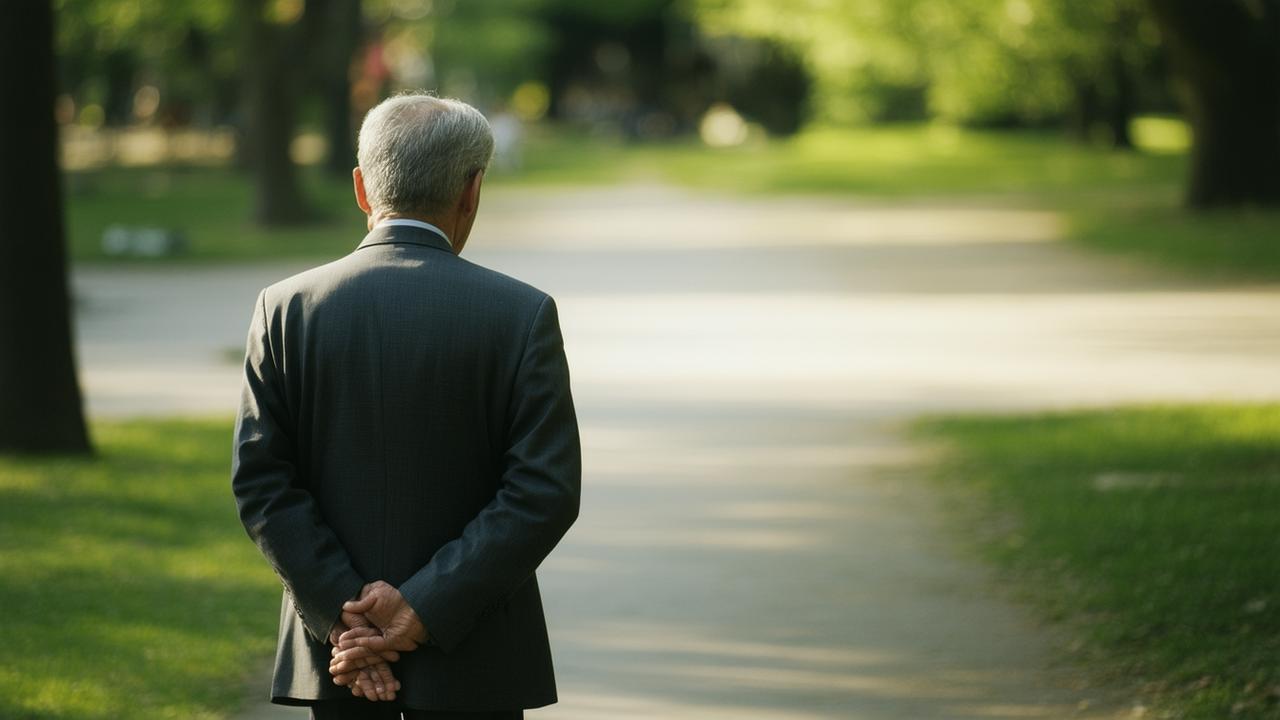
The first time I noticed it was on a winter morning along Melbourne’s Yarra River. The air was that particular kind of crisp that bites at your nose but warms your lungs as you move. Runners in fluorescent lycra flashed past, prams rolled over fallen leaves, and magpies eyed off unattended crumbs. Among them was an older bloke in a navy jumper, walking slowly, hands clasped neatly behind his back, face turned slightly to the gum trees as if listening to them breathe. He wasn’t rushing anywhere. He wasn’t fiddling with a phone. He just walked, hands tucked away, as if he had all the time in the world and nothing to prove.
Once you start looking for it, you see this pose everywhere: on the Bondi to Bronte coastal path, in suburban Adelaide streets at dusk, under the fig trees in Brisbane’s South Bank, even in the fluorescent aisles of Coles. Hands behind the back, shoulders rolled just a little, gaze detached from the frantic forward focus of everyone else. It’s a small, almost old-fashioned gesture—but psychologists will tell you it says surprisingly much about what’s happening inside someone’s head.
The quiet posture that speaks volumes
Body language is the mind’s accent. We all have one, even when we think we’re not “doing” anything. Walking with your hands behind your back is one of those postures most people never consciously choose. You don’t wake up and decide, “Today I’ll walk like a retired professor.” You just fall into it. And that unconscious choice is exactly why psychologists find it fascinating.
In social psychology, this kind of stance is often read as a blend of openness, contemplation, and subtle control. Your hands—those primary tools for defence, work, and fidgeting—are tucked away, exposed, not ready to lash out or shield you. It’s a posture that says, “I’m not on guard.” There’s no clenched fist, no crossed arms, no phone barrier. In a world where so many of us walk glued to our screens, this small gesture stands out as curiously vulnerable and strangely confident.
Walk like this down a quiet street in Fremantle or through the eucalyptus-scented air of the Blue Mountains and you might notice your gaze lifts. Without a device in your hands, your eyes have room to wander. You start noticing the cockatoos shrieking on powerlines, the particular crunch of dry leaves underfoot, the way the late sun paints gold stripes across suburban fences. Psychologically, you’ve shifted from task mode to observation mode—less “get there” and more “be here.”
What your brain is probably doing
Cognitive researchers often talk about “default mode” networks in the brain—the circuits that light up when you’re not focused on a specific task. They hum when you’re daydreaming, reminiscing, or quietly piecing together your life story. Walking with your hands behind your back nudges you toward that default mode. You’re not frantically checking directions or messages; you’re letting thoughts find their own pace.
For many Australians, these quiet walks are where the big inner conversations happen—mulling over a job change in Perth’s King’s Park, replaying a tough chat with your partner as you circle Sydney’s Centennial Park, or just letting your mind drift with the wind over a Gold Coast beach. Psychologically, this posture often reveals a person who is comfortable being alone with their thoughts, at least for a while.
Confidence, curiosity, or quiet control?
Now comes the big question: does walking like this mean you’re confident—or hiding something? Here’s where it gets interesting. According to personality research and practical psychology, this simple posture can reflect a mix of traits, depending on the pace of the walk, the setting, and the person’s overall style.
| Walking Style | Likely Inner State | Personality Hints |
|---|---|---|
| Slow, hands loosely clasped | Reflective, relaxed | Thoughtful, observant, comfortable with silence |
| Steady pace, eyes scanning surroundings | Curious, engaged | Analytical, curious, possibly introverted |
| Fast, head slightly down | Anxious, mentally preoccupied | Prone to overthinking, conscientious, maybe stressed |
| Straight posture, open chest | Calm confidence | Self-assured, secure, reflective |
Psychologists often see this as a “low-threat” posture. By exposing the front of your body and removing your hands from immediate use, you signal that you’re not expecting conflict. That can indicate underlying self-assurance: you’re not bracing yourself against the world. Australians, with their cultural tilt toward laid-back understatement, often show confidence not in chest-thumping bravado but in quiet, unhurried gestures like this. It’s the opposite of swagger; it’s ease.
At the same time, there’s usually a hint of control in this walk. Hands clasped behind the back reduce fidgeting. You’re quite literally holding yourself together. In high-pressure environments—think a principal strolling the school grounds in regional NSW or a manager pacing a warehouse floor in Darwin—this walk can be a way to project calm authority, even when decisions are weighing heavily inside.
A very human habit with a long, quiet history
If walking with your hands behind your back feels a bit old-school, that’s because it is. Historically, this posture shows up in portraits of philosophers, scholars, military officers, and elders—figures associated with reflection and authority. In some cultures it still signals rank or respect, especially in formal settings. You can see echoes of that when an older uncle in Brisbane’s outer suburbs strolls the backyard like a quiet general surveying his domain.
From a psychological perspective, repeated body-language patterns often become linked to particular mental states. If you tend to clasp your hands behind your back when you walk and think, over time your brain may start to treat that posture as a cue: “We’re in reflection mode now.” Like putting on running shoes can prime your body for exercise, this simple posture can prime your mind for slower, deeper thinking.
Australian landscapes invite that kind of thinking. It’s hard not to drift inward when you’re walking a long, dusty track in the outback, waves of heat rising off the road, galahs screeching overhead, and absolutely nothing demanding your attention for kilometres. Hands behind your back there aren’t just a quirk—they’re almost an instinctive response to having space, both physical and mental.
Stillness in motion
Modern psychology also talks about “embodied cognition”—the idea that how we hold our bodies can shape how we think and feel. When your hands are behind your back, your front is open, your shoulders tend to roll back slightly, and your breathing often deepens. That combination can downshift your nervous system, pulling you away from fight-or-flight and closer to a calm, observant state.
Imagine an early morning walk along the Esplanade in Cairns. The sky is slowly pinking over the water, the air still holding a trace of night’s coolness. You slip your hands behind your back, fall into a slow rhythm, and suddenly the internal static—the emails waiting, the bills due, the awkward conversation from yesterday—blurs at the edges. You’re still moving, but mentally, you’ve found a kind of still point. This isn’t laziness or zoning out; it’s a deliberate—or at least habitual—shift into a gentler state of attention.
The introvert myth (and why context matters)
It’s tempting to look at someone walking like this and think, “Must be an introvert.” They look inward, self-contained, detached from the hustle. And introverts do often gravitate toward more contained, reflective postures. But psychology warns against neat boxes. Extroverts walk like this too—especially when they’re off-duty from their usual social energy.
This is where context is everything. A teenager strolling around a Perth skate park with hands behind his back may be feeling awkward or unsure where he fits, using the posture as a kind of emotional shield. A retired woman wandering Canberra’s lakeside paths the same way could be luxuriating in long-awaited solitude after decades of busyness. The same gesture can mean calm reflection in one person, and quiet self-protection in another.
Australian culture adds its own twist. Many of us grow up being taught not to make a fuss, not to “big-note” ourselves. That modesty can show up in body language. Instead of broad gestures and expansive arm swings, we tuck our hands away, insulate our movements, keep our posture understated. So yes, walking with your hands behind your back can suggest introspection and self-containment—but filtered through a cultural lens that prizes subtlety over spectacle.
Signals you might be sending (without realising)
Even if you don’t think much about your own body language, people around you are constantly—if unconsciously—reading it. Colleagues might see your hands-behind-back walk at lunchtime and assume you’re in “thinking mode” and give you space. Kids might see it and read it as a sign that you’re calm and unthreatening. A partner might notice that when you start pacing the hallway like this, you’re chewing over something important.
➡️ The streak-free window-cleaning method that still works flawlessly even in freezing temperatures
➡️ The quick and effective method to restore your TV screen to like-new condition
➡️ Thousands of passengers stranded in USA as Delta, American, JetBlue, Spirit and others cancel 470 and delay 4,946 flights, disrupting Atlanta, Chicago, New York, Los Angeles, Dallas, Miami, Orlando, Boston, Detroit, Fort Lauderdale and more
➡️ The sleep pattern that predicts alzheimer’s risk 15 years before symptoms
➡️ These zodiac signs are destined for major prosperity in 2026, according to astrological forecasts
➡️ The RSPCA urges anyone with robins in their garden to put out this simple kitchen staple to help birds cope right now
➡️ The RSPCA urges anyone with robins in their garden to put out this simple kitchen staple today
Psychologists often suggest paying gentle attention to these personal tells, not to become self-conscious, but to gain insight. When do you catch yourself walking like this most often? On peaceful holidays down the Great Ocean Road, or only when work stress climbs? Do you walk this way when you’re happy and thoughtful, or when you’re trying not to show you’re upset? Your honest answers say more about your personality than any generic definition.
What it might reveal about your current state of mind
Underneath the cultural layers and individual quirks, certain themes keep showing up in psychological interpretations of this posture. When you’re walking with your hands folded behind your back, especially in a relaxed setting, you’re often signalling some combination of:
- Contemplation: You’re mulling something over, letting thoughts roll rather than forcing conclusions.
- Emotional regulation: You may be consciously or unconsciously calming yourself, containing excess energy or anxiety.
- Observation: Your attention is more outward and wide-angled, less tunnelled into immediate tasks.
- Non-aggression: You’re not gearing up for conflict; your posture says “I’m not here to fight.”
- Subtle confidence: You’re okay not performing, not proving, not rushing—just inhabiting the moment.
Of course, there are exceptions. Someone might clasp their hands behind their back tightly, shoulders hunched, walking fast down a city street because they’re fuming or deeply anxious. Another might adopt the posture in a formal, almost rigid way, using it as a disciplined mask over inner chaos. The psychology is never in the posture alone; it’s in the posture plus pace, plus face, plus context, plus history.
What walking like this reveals, then, isn’t a neat label like “introvert” or “old soul.” It reveals that you have a habit of giving your mind a bit of breathing room while your body moves. It hints that you’re someone who—at least sometimes—lets life slow down enough to be noticed. In a nation where we love to talk about “switching off” but rarely actually do it, that’s no small thing.
Trying it on, mindfully
If you’re curious what this posture does to your own headspace, you can experiment. Next time you’re walking somewhere low-stakes—a lunchtime loop around the block in Hobart, a slow wander along the Swan River in Perth—slip your phone into your pocket, place your hands behind your back, and deliberately soften your pace. Notice what your attention does. Do thoughts rush in or thin out? Do you see more of what’s around you? Do you feel oddly exposed, or quietly grounded?
This tiny shift in how you move can act like a psychological dimmer switch—turning down the intensity of your day just enough to notice the kookaburra on the powerline or the perfume of jasmine curling over a neighbour’s fence. Maybe that’s the most revealing thing about walking with your hands behind your back: it doesn’t just show your state of mind—it can also gently change it.
FAQ: Walking with your hands behind your back
Does walking with my hands behind my back mean I’m an introvert?
Not necessarily. While reflective, contained postures are often associated with introversion, extroverts also walk this way—especially when they’re thinking, de-stressing, or simply enjoying some quiet. Context and your overall behaviour matter more than the posture alone.
Is this posture a sign of confidence or insecurity?
It can be either, depending on how you do it. A relaxed pace, open chest, and loose hands usually signal calm confidence and reflection. A tight grip, hunched shoulders, and hurried steps can suggest tension or anxiety. The details tell the real story.
Why do older Australians seem to walk like this more often?
Age brings habit, experience, and often a different relationship with time. Older people may have learned this posture from school, work, or cultural norms, and they’re often more comfortable slowing down and reflecting. It’s part practical, part generational, and part psychological.
Can changing my walking posture really affect how I feel?
Yes, to a point. Research on embodied cognition suggests that altering posture and movement can influence mood and thought patterns. Walking with your hands behind your back, more slowly and openly, can promote a calmer, more observational mindset for many people.
Is there anything wrong with walking like this in public or at work?
Not at all. In many settings it reads as thoughtful and non-threatening. Just be aware of context—if you’re in a fast-paced environment where responsiveness and energy are expected, you might want to mix it with more active body language when you need to appear highly engaged or urgent.





