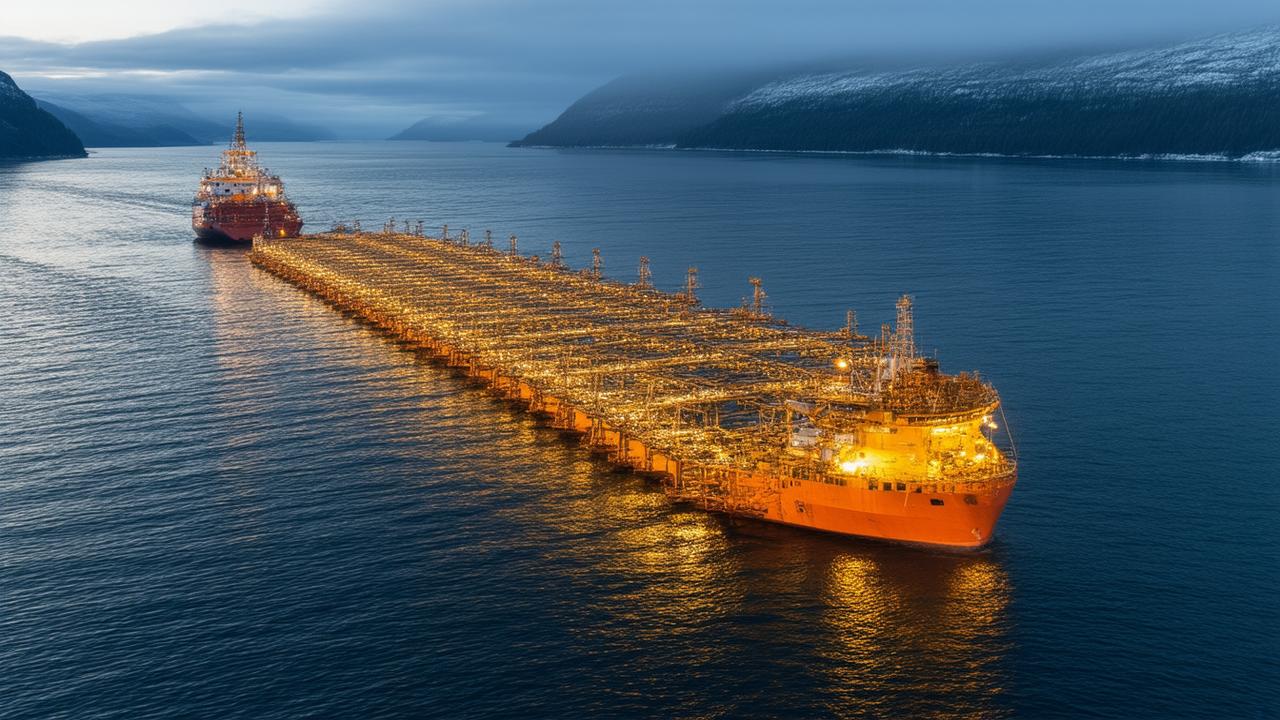
The first thing you notice is the scale. Out on the steel-grey sea, where you’d expect to glimpse the white triangle of a sail or the boxy silhouette of a freighter, something else is moving on the horizon. Long, low, and impossibly straight. At 385 metres, it stretches almost the length of four football fields. It looks like a ship that’s forgotten how to be a ship. But this is no cargo giant, no cruise liner. This is Havfarm – the world’s largest offshore salmon farm – and it’s quietly rewriting the rules of how we grow seafood on a planet that’s running out of easy choices.
The Strange “Ship” on the Horizon
Picture standing on a headland along the New South Wales coast, salt on your lips, the boom of the Pacific in your ears. The sky has that milky brightness of late afternoon, and the wind is picking up, tossing spray from the breaking waves. You scan the horizon, looking for whales maybe, or that familiar container-ship highway. Instead, you spot a long, industrial line cutting across the swell, like someone has drawn a ruler on the sea.
As you watch, you expect it to turn like a vessel, but it doesn’t. It holds steady, anchored to the unseen muscle of engineering below the surface. Seabirds circle over it in lazy arcs. From this distance you can’t see the individual walkways or the cages, but you feel the oddness of it. The ocean is supposed to be restless and shapeless; Havfarm looks like someone has taken a piece of land and laid it down on the water.
Off the coast of Norway, where Havfarm currently lives, the water is colder, the light harsher, the winter longer. But the feeling is the same: this sense of a line being crossed. Farming, in the truest sense of the word, has moved further offshore, out into deeper, rougher seas. And for Australia—a country ringed by ocean, shaped by seafood, and increasingly anxious about where its food will come from—that matters more than we might think.
The Anatomy of a Sea Giant
Walk onto Havfarm—if you’re lucky enough to get an invitation—and the first impression is the hum. Not loud, but always there: pumps, generators, motors, the quiet churn of systems designed to keep millions of salmon alive and thriving. Under your boots, the steel deck gives ever so slightly, reacting to the push and pull of waves. Salt spray lashes the handrails, and the air smells like a clean mixture of sea, metal, and fish feed.
Forget the idea of circular pens bobbing near shore. Havfarm is a different beast: a rigid, barge-like structure holding a series of enormous cages in a straight line. Each one is a submerged world, with nets that plunge tens of metres into the dark green below. The fish swim in three dimensions, following currents, schooling and circling, never quite meeting the net walls the way they might in a cramped inshore pen.
Above water, there’s a small industrial village: cranes poised like patient herons, feed silos, control rooms with glowing monitors, sleeping quarters, workshop spaces. Sensors and cameras feed data to a central hub where staff watch oxygen levels, water temperature, currents, fish health and behaviour, almost in real time. Where older farms relied on a lot of guesswork and a farmer’s eye, Havfarm lives in a constant loop of measurement and response.
A New Frontier for Salmon—and for Us
For Australians, salmon has become unexpectedly familiar. We stack fillets in supermarket trolleys, order it pan-seared at bistros, wrap it in sushi rolls. Much of that comes from Tasmania, where net pens dot sheltered bays and channels, their orange feed buoys as recognisable as channel markers.
But our coastal waters are changing. Marine heatwaves, shifting currents, algal blooms, community pressure, and concern for wild marine life all push against the limits of traditional inshore salmon farming. The industry is under scrutiny—and rightly so. Every fin in a pen is part of a bigger story about ecosystems, local communities, and climate.
Havfarm represents one possible answer: move farms further out, where the ocean is cooler, deeper, and more dynamic; where waste can disperse more easily; where lice and some parasites are less prevalent; where impacts on coastal ecosystems and shared bays can be reduced. It’s not a perfect answer—no form of industrial food production is—but it’s a new chapter in how we might balance demand with responsibility.
Life in the Moving Water
Stand at the rail and look down. Beneath you, nets vanish into the green. On a good day, when the sun slants just right and the sea is calm, you can see the flicker of bodies shifting and glinting far below—thousands of salmon moving like smoke in water. The current doesn’t stop at the edge of the cages; it flows through them, carrying oxygen, sweeping away waste, forcing the fish to swim against a gentle, constant push.
For the salmon, this is closer to a wild life—still controlled, still confined, but more demanding. They burn more energy. They build stronger muscle. Many advocates of offshore farming argue that this translates into better fish health, lower disease pressure, and potentially better flesh quality. The fish are less likely to be fin-worn and lethargic. They live in water that feels more like open sea and less like a static pond.
Down here, though, subtle choices matter: the mesh size of the nets, the stocking density (how many fish per cubic metre), the depth at which the fish spend their time, the feed they’re given. Offshore doesn’t automatically mean “sustainable”; it just offers new tools and more space. How those tools are used will define whether a project like Havfarm is a breakthrough or just a bigger version of old mistakes.
Australia Watching from the Shore
In a café in Hobart or Adelaide, talk about salmon and the conversation quickly becomes heated. Some will speak about jobs, regional economies, a dependable source of protein. Others will bring up fish kills, visual pollution, seals tangled in nets, or the subtle shift in a once-pristine bay. For coastal communities in Tasmania or along parts of South Australia, salmon farming isn’t abstract; it’s something you can smell on certain days, see from your front porch, and debate at the pub.
Offshore mega-farms like Havfarm enter this conversation as both promise and threat. On one hand, they suggest a future where farms can be pushed away from sensitive inshore areas, reducing direct pressure on estuaries, seagrass beds, and sheltered bays that double as playgrounds and fishing grounds. On the other, they raise tough questions: Who controls these offshore spaces? How are they regulated? What happens if something goes wrong far from shore—if nets tear, storms hit, or systems fail?
Australian regulators, scientists, and industry players are watching platforms like Havfarm closely. Our coastline is long, but our oceans are already busy—shipping lanes, defence zones, oil and gas, offshore wind exploration, commercial fisheries, and cultural and spiritual sea Country for First Nations communities. If structures like Havfarm ever appear off our coast, they won’t arrive in empty water. They’ll enter a web of uses, rights, and histories.
Promises, Trade-Offs, and the Plate in Front of You
It’s tempting to see Havfarm as a shiny techno-solution—a sleek answer cruising over the horizon to rescue our guilt-ridden appetite for salmon. Reality, as always, lives in the grey spaces between excitement and caution.
Here are some of the potential advantages and trade-offs of massive offshore farms like Havfarm, viewed through an Australian lens:
| Potential Benefit | What It Could Mean for Australia |
|---|---|
| Deeper, faster-moving water | Less localised pollution and better conditions for fish compared to some crowded inshore sites. |
| Distance from sensitive coasts | Reduced visual impact and fewer direct conflicts with recreational users and tourism-focused communities. |
| High-tech monitoring and control | More data-driven management, with the potential for stricter environmental performance and quicker responses to problems. |
| Larger scale operations | Greater production from fewer locations, which could reduce pressure to approve more inshore leases. |
| New offshore jobs and skills | Opportunities in regional centres for marine engineers, technicians, skippers, and scientists—if training and safety standards are strong. |
Yet each row in that table hides a mirror image: larger operations mean larger accidents if they occur. Deeper water might dilute waste, but it doesn’t erase the need for strict limits and monitoring. High-tech systems are only as good as the people, policies, and values behind them.
For Australians standing at the fish counter, those complexities are invisible. We see fillets on ice, not steel platforms at sea. But the choices made far offshore—about stocking densities, feed ingredients, antibiotic use, predator control, and escape prevention—are as much a part of our food culture as the way we cook the fish at home.
Imagining Havfarm off an Australian Coast
Imagine, for a moment, a Havfarm-like structure anchored well off the coast of Victoria or Western Australia, the deck rising and falling in big southerly swells. Helicopters bringing in crew, supply vessels nudging up alongside, data beaming back to a control centre in a regional port town.
➡️ These zodiac signs are destined for major prosperity in 2026, according to astrological forecasts
➡️ The RSPCA urges anyone with robins in their garden to put out this simple kitchen staple to help birds cope right now
➡️ The RSPCA urges anyone with robins in their garden to put out this simple kitchen staple today
➡️ “I used to multitask constantly,” this habit helped me stop without effort
➡️ Workers in this role often earn more by becoming specialists rather than managers
➡️ If you want a happier life after 60 be honest with yourself and erase these 6 habits
➡️ Most people store cables incorrectly, this method keeps them accessible
In that town, kids might grow up dreaming not of working on a trawler but on a futuristic sea farm, where drones check nets and sophisticated sensors pick up early signs of disease. Local TAFEs and universities might launch programs in offshore aquaculture engineering. New debates would flare at community meetings: is this a smart use of our marine space, or one more step towards industrialising the ocean?
Traditional Owners whose sea Country extends far beyond the shore would rightly ask: how does this fit with cultural responsibilities and rights? Conservationists would examine maps of bird migration, whale routes, and marine parks, looking for overlaps. Recreational fishers would wonder whether these structures attract or repel wild fish, and how they might reshape local ecosystems.
The truth is, platforms like Havfarm don’t exist in isolation. They plug into everything: city dinner tables, export markets, coastal politics, climate science, Indigenous custodianship, and our own complicated feelings about eating animals in the age of ecological crisis.
Standing Between Sea and Future
Back on that imagined Australian headland, the wind picks up. You pull your jacket tighter and watch as the not-a-ship on the horizon settles silently into the coming evening. Seabirds still wheel above it, drawn by the pulse of life in the water below. Somewhere, deep in the cages, salmon flick their tails and hold position against the current.
We live in a time when food stories stretch far beyond the fence line of a farm. Wheat fields are linked to global grain markets; cattle paddocks to deforestation debates; a single prawn to the health of a mangrove system. Now a salmon fillet connects to a 385-metre steel platform moored in heavy seas, thousands of kilometres away from most of the people who will ever taste its harvest.
What you see, when you look at Havfarm, is not a ship. It’s a question: how far out to sea are we willing to push our farming? How much ocean are we prepared to turn into carefully managed, intensely monitored production zones? And what responsibilities follow us when we take that step?
For Australians, surrounded by blue on every map, the answers will shape not only what’s on our plates, but how we think about the vast, restless water that defines our island lives. Offshore giants like Havfarm might never anchor off our coasts. Or they might become as familiar a part of the seascape as oil rigs and wind turbines. Either way, the horizon will never look quite the same again.
Frequently Asked Questions
Is Havfarm actually a ship?
No. Havfarm looks like a ship from a distance because of its length and low, linear profile, but it’s essentially a fixed or semi-fixed farming platform. It’s designed to hold large salmon cages offshore, not to transport cargo or passengers.
Why is offshore salmon farming seen as different from inshore farming?
Offshore farms like Havfarm operate in deeper, more open water with stronger currents. This can reduce localised pollution, improve water quality for the fish, and limit some disease and parasite issues that are more common in crowded, sheltered bays.
Could something like Havfarm operate off the Australian coast?
In principle, yes. Australia has the engineering skills and coastal conditions to support offshore aquaculture platforms. But any such development would need to navigate complex regulations, environmental assessments, Indigenous sea Country rights, and community expectations.
Does offshore salmon farming automatically make salmon “sustainable”?
No. Offshore farming offers advantages, but sustainability depends on many factors: stocking densities, feed ingredients, waste management, energy use, escape prevention, predator interactions, and transparent regulation. Location is only one part of the puzzle.
As a consumer in Australia, how can I make more informed salmon choices?
You can ask where and how the salmon was farmed, look for credible certification schemes, stay informed about local environmental reports, and balance salmon with other seafoods that are rated as sustainable by reputable Australian guides. Curiosity at the counter is a powerful tool.





